
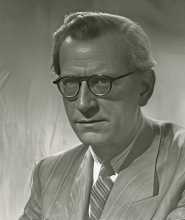
 The Hungarian artist and theatre designer István Básthy was born and grew up in Budapest, and after completing his training at the Iparművészeti Iskola, Budapest’s School of Applied Arts and the city’s principal training ground for graphic and decorative artists in the late Habsburg period, he began his professional career as a stage designer in 1923 with the Unió Színházak, the umbrella company that managed five of the principal commercial theatres of Budapest – the Magyar, the Király, the Belvárosi, the Blaha Lujza, and the Andrássy Úti. He remained with the Unió houses until 1927, working in the eclectic mixture of secessionist, romantic and realist idioms which Hungarian theatrical lexicons would later identify as characteristic of his style.
The years immediately following his departure from the Unió saw Básthy expanding his repertoire. Hungarian-born scenographers of his generation routinely supplemented theatre engagements with film commissions and short residencies abroad, and Básthy was no exception. He is documented as designing sets for productions in both Budapest and Berlin between 1923 and 1963, which would help explain his evident familiarity with German.
Básthy returned to the major Hungarian stages in the second half of the 1930s, working at the Nemzeti Színház – the Hungarian National Theatre – between 1936 and 1940, alongside engagements at various musical entertainment houses. After the war he designed for the Ifjúsági Színház, the Miskolci Nemzeti and the Pécsi Nemzeti, and for the state touring company, the Déryné Színház. During this long career he was, with Márton Vincze, one of the two most prolific set designers of the Hungarian film industry, with credits on more than fifty productions reaching from the silent era of the 1920s through to the communist period, frequently in collaboration with Sándor Iliszi. His best-known films as production designer are Leányvásár (The Women’s Market, 1941), Három csengő (The Three Bells, 1941) and Dr Kovács István (Dr István Kovacs, 1942).
Similar artists
László Boris – Hungarian illustrator of figurative-erotic subjects.
Marcel Chirnoagă – Romanian engraver of fantastical erotic subjects.
Anca Georgescu – Romanian contemporary illustrator of figurative-erotic subjects.
Pavel Hlavatý – Czech printmaker of fantastical and erotic subjects.
Antoni Uniechowski – Polish draughtsman of literary and erotic subjects.
Mihály Zichy – Hungarian painter and draughtsman of aristocratic erotic scenes.
Example illustration

Die zwei Witwen (1928)


