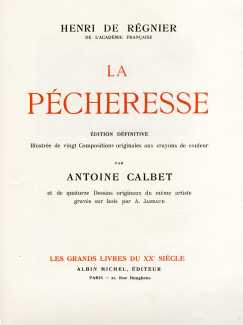
 Henri de Régnier (1864–1936) was born into an old Norman family in Honfleur, and is regarded as the foremost French poet of the early twentieth century. Encyclopedia Britannica He studied law in Paris but was drawn into literary circles, becoming an assiduous disciple of Stéphane Mallarmé and a leading figure among the Symbolist writers. In 1896 he married Marie de Heredia, daughter of the poet José María de Heredia, and under her father's influence he gradually moved from free verse toward more classical forms. He was elected to the Académie Française in 1911. Alongside his poetry, he composed novels written in a mannered style and set in past centuries, and a younger generation including André Gide and Marcel Proust looked to him for inspiration early in their careers.
La Pécheresse (The Sinner) is probably the best-known of Régnier's novels evoking eighteenth-century France. The subtitle, histoire d’amour (a love story), signals its central preoccupation. The novel follows a passionate and ultimately ruinous extramarital affair – a married woman of good social standing, Françoise de Séguiran, is drawn into an obsessive liaison with a younger man, Bernard de la Péjaudie, her surrender to desire casting her as the sinner of the title. The narrative unfolds with the elegant, slightly melancholy detachment typical of Régnier, desire and transgression rendered in cool, formal prose, with the atmosphere of the ancien régime lending the story a sense of beautiful, inevitable doom. Any moral judgment is implicit rather than declamatory; the reader left to weigh the woman’s passion against the wreckage it creates.
La Pécheresse was one of Calbet’s first book commissions, demonstrating his skill and imagination in a powerful series of coloured etchings on a sepia ground; the emphasis is on the wages of sin rather than the rewards of desire, but from the frontispiece of a naked Françoise de Séguiran we can see why Bernard was so smitten.
The Calbet-illustrated La Pécheresse was published by the Paris publisher Albin Michel in a limited and numbered edition of 570 copies.