
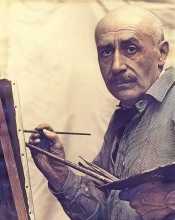
 The Belgian graphic artist, printmaker, book illustrator and poster designer Armand Rassenfosse is widely regarded as one of the outstanding artists of his generation. He was born in Liège into a bourgeois family whose business, maintained for several generations, dealt in home furnishings and decorative arts. He was expected to continue the family trade, and for some years did so – his transformation into an artist was entirely self-taught.
During his secondary education in Namur, living with an uncle who owned several etchings by Félicien Rops, Rassenfosse became intrigued with the etching process. Back in Liège and working in the family business, he was befriended by Auguste Donnay and hired to decorate Donnay’s father’s home; Donnay introduced him to students at the Liège Academy of Fine Arts, among them Gustave Serrurier and Émile Berchmans. By 1882, unknown to his family, he was contributing drawings signed ‘Zig’ to the satirical journal Le Frondeur (The Rebel), and experimenting with etching using improvised tools.
At the age of twenty-five, while in Paris on family business, Rassenfosse was introduced to Félicien Rops, then at the height of his career. The meeting transformed his artistic trajectory. As well as opening doors to the Parisian art world, it led to a close friendship and sustained collaboration on engraving techniques. Around 1892 the two artists jointly developed a process for soft-ground printmaking, transparent, resistant, and well-suited to the transfer of crayon drawings onto intaglio plates, which they named ‘The Ropsenfosse Method’. Rassenfosse would go on to become one of the most technically accomplished printmakers of his generation, distinguished by his mastery of mixed intaglio methods combining aquatint, etching, drypoint, crayon and soft-ground in varied combinations, a technique so refined that many of his prints resemble sophisticated pencil drawings.
Abandoning the family business, Rassenfosse joined the printing house founded by his friend Auguste Bénard in Liège in 1887, a relationship that would anchor his professional life for two decades. From this base he built a substantial career as illustrator, poster designer and printmaker. In 1895 he illustrated the supplement to the catalogue raisonné of Rops’ engravings published by Eugène Rodrigues-Henriques.
The commission that secured his reputation came at the end of the decade. In 1899 Rassenfosse undertook a major contract to illustrate Baudelaire's Les fleurs du mal (The Flowers of Evil), creating 170 colour etchings. The edition is regarded as both the magnum opus of Rassenfosse’s career, and one of the high points in the history of book illustration.
When Bénard died in 1907, Rassenfosse took on greater responsibilities at the printing house, leaving him less time for personal artistic work and producing a period of relative stagnation. He continued, however, to illustrate books, notably editions of Barbey d’Aurevilly in 1907 and 1925, and to produce bookplates, around a hundred of which survive.
After the first world war Rassenfosse continued to develop new engraving techniques and to produce book illustrations. He received numerous honours, including the rank of Commander of the Order of Leopold and membership of the Royal Academy of Belgium.
Rassenfosse has often been associated with Rops as a follower, a comparison that does not do him justice. Where Rops portrayed the upper classes, Rassenfosse depicted mostly working people; his intimate portraits of naked women present them with natural elegance. His is a warmer, more empathetic vision of the female figure, and it is this quality, the capacity to render erotic subject matter with psychological attentiveness rather than allegory, that gives his illustrations their distinctive character within the tradition he inherited from Rops.
Similar artists
Émile Bracquemond – French nineteenth-century artist and engraver.
Frans de Geetere – Belgian-French surrealist etcher of dark and hedonistic subjects.
Luc Lafnet – Belgian illustrator of romantic and clandestine erotic subjects.
Henri le Riche – French etcher of literary and erotic subjects.
Alméry Lobel-Riche – French illustrator of Sade’s Justine in a similar decadent line.
Félicien Rops – Belgian symbolist printmaker shaping fin-de-siècle erotic imagery.
Martin van Maële – French illustrator of clandestine erotic editions at the turn of the century.
Example illustration

Les fleurs du mal (1899)


