
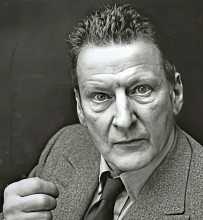
 Lucian Michael Freud was born in Berlin into the remarkable Freud family – his father Ernst was an architect and the son of the famous psychoanalyst Sigmund Freud; his mother, Lucie Brasch, came from a German-Jewish family. Lucian was the second of three sons, with an older brother, Stephan, and a younger brother, Clement, who later became a well-known writer and broadcaster.
In 1933, as the Nazis came to power, the family left Germany and settled in St John’s Wood, London. Freud was ten years old. His schooling was unsettled: he attended Dartington Hall School in Devon and later Bryanston School, from which he was expelled for disruptive behaviour. He became a British citizen in 1939. After briefly attending the Central School of Art, he studied from 1939 to 1942 at Cedric Morris’s East Anglian School of Painting and Drawing, and later attended Goldsmiths’ College. During the war he served briefly as a merchant seaman on an Atlantic convoy before being invalided out in 1942.
Freud’s first solo exhibition was held in London in 1944, when he was twenty-one. Two years later he travelled to Paris and then spent several months in Greece visiting the painter John Craxton. During the following years he also made frequent visits to Dublin, sharing a studio with the artist Patrick Swift, but London remained his permanent home.
Freud’s personal life was famously complicated and intensely private. In the 1940s he was involved with fellow artists Adrian Ryan and John Minton in a homosexual love triangle. After an affair with Lorna Wishart, he married her niece, Kitty Garman, in 1948. Garman was the daughter of the sculptor Jacob Epstein and Kathleen Garman, and the marriage produced two daughters, Annabel and Annie, before ending in 1952.
Freud subsequently eloped to Paris with Lady Caroline Blackwood, a writer and Guinness heiress, whom he married in 1953. Their marriage ended in divorce in 1959. He later had numerous relationships and children with several women. From the late 1970s and into the 1980s he was also in a long-term relationship with the painter Celia Paul. Freud acknowledged fourteen children, two from his first marriage and twelve others by five different women – the writer Esther Freud and the fashion designer Bella Freud are his daughters by Bernadine Coverley. The journalist Geordie Greig has published a chart naming all the acknowledged children and their mothers, adding that ‘he may have fathered as many as thirty children according to estimates by his friends’.
Freud’s biographer Phoebe Hoban writes that ‘At seventy-nine Freud was still actively pursuing women, at least some of whom eagerly reciprocated. In 2001, he began living with a twenty-seven-year-old journalist named Emily Bearn. At eighty-two his latest lover was Alexandra Williams-Wynn, an art student, aged thirty-two.’ After the relationship with Williams-Wynn ended she told the magazine Vanity Fair that ‘being with Lucian made me understand that selfishness is what it takes to make great art’.
Many of the people with whom Freud formed close relationships – family members, friends, lovers, wives and children – became subjects of his work, sometimes returning over many years. His relationship with his mother became especially important after the death of his father and her subsequent suicide attempt; during the 1970s he devoted more than four thousand hours to painting her.
Similar artists
Cecily Brown – British painter of abstracted, painterly figurative-erotic scenes.
John Currin – American painter of figurative-erotic subjects in a revisionist classical idiom.
Marlene Dumas – South African painter of psychologically charged figurative-erotic subjects.
Eric Fischl – American painter of suburban figurative scenes with psychological erotic content.
Jenny Saville – British painter of unflinching naked figures and bodily reality.
Lisa Yuskavage – American painter of figurative-erotic subjects in a classical-revisionist mode.
Example illustration


