
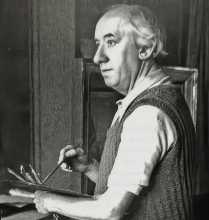
 The Belgian artist Edgard Tytgat grew up in Bruges. First apprenticed to a watchmaker from 1893 to 1895, he then worked for his father, an intaglio engraver and printer. From 1897 to 1900 he attended evening classes at the Académie Royale des Beaux-Arts (Royal Academy of Fine Arts) in Brussels, and full-time classes in 1901, notably under Constant Montald. It was there that he forged friendships with other future painters, including Rik Wouters and Fernand Verhaegen.
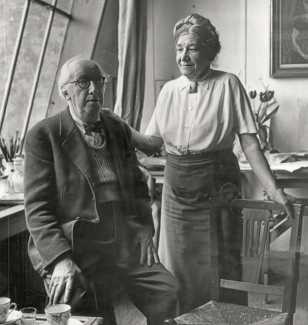
Tytgat lived much of his adult life in relative domestic stability, married in 1905 to Maria Van Bogaert (often referred to simply as Mietje), who appears frequently in his paintings and prints. Unlike artists who cultivated scandal or bohemian myth, Tytgat led a modest settled life, centred on work, friendships, and a small circle of writers and artists. He was described by contemporaries as quiet, reserved, and dryly humorous, with a caustic wit. He avoided self-promotion, and even when exhibiting remained marginal to the art market social scene.
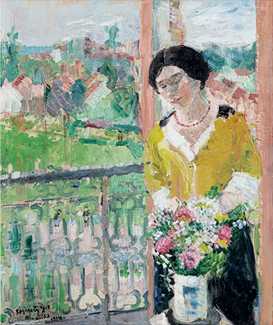
He was a member of Contemporary Art, the Group of IX, Sélection and Le Centaure and from 1901 to 1903 participated in the Antwerp Triennial Salon. During the first world war he and Maria left Belgium to take refuge in England. They did not return until 1920, settling permanently in Woluwe-Saint-Lambert in 1923.
Tytgat is best known for his small-scale paintings and gouaches, which often depict intimate domestic scenes, lovers, musicians, fêtes, circuses and fairgrounds. His figures are often deliberately awkward – flattened, stiffly posed, and outlined with an almost childlike directness. This apparent simplicity is deceptive, for beneath the naïve surface lies a sharp observational intelligence and an ironic wit. Scenes of bourgeois leisure frequently carry undertones of erotic frustration, loneliness or quiet absurdity, reflecting Tytgat’s sceptical view of social conventions.
As an engraver, he illustrated numerous books, including Little Red Riding Hood and The Magic Flute. He also illustrated texts by Félix Timmermans, Gérard Walschap and Michel de Ghelderode).
He was a member of the Free Academy of Belgium (The Edmond Picard Foundation) and of the Royal Flemish Academy of Belgium. Towards the end of his life, he turned to the representation of mythological legends, often with erotic undertones, in a style akin to naive painting.
Similar artists
Jean de Bosschère – Belgian-British illustrator of refined literary and erotic editions.
Frans de Geetere – Belgian-French surrealist etcher of dark and hedonistic subjects.
Luc Lafnet – Belgian illustrator of romantic and clandestine erotic subjects.
Armand Rassenfosse – Belgian printmaker of figurative-erotic and Baudelaire subjects.
Félicien Rops – Belgian symbolist printmaker shaping fin-de-siècle erotic imagery.
Armand Simon – Belgian surrealist of obsessive erotic-fantasy ink drawings.
Marcel Stobbaerts – Belgian painter and illustrator of lively, colourful erotic subjects.
Example illustration


