
Árpád Elfer was one of the most charismatic of creative directors in post-war advertising. He was a superb visualiser who could encapsulate the mood, style and desirability of a product in ways that would excite the client and appeal to the public. He grew up in Hlohovec, then in Hungary and now in Slovakia, and at the age of six lost his father in the first world war. Nine years later he was invited by an aunt to stay with her in Berlin, where he attended the famous college of art, and went on to become an art director. In 1933 he was lured to Paris to be art director of Dorland and Crawfords, leaving two years later to join the London firm of Colman, Prentis and Varley as creative artist.
The second world war saw him in the Pioneer Corps and then the cartographic section of the Royal Engineers Ordnance Survey, where he became a sergeant and was charged with drawing maps on silk handkerchiefs for use by parachutists behind enemy lines. While there, in 1945-46, he also planned an elaborate exhibition for the War Office on The History of England.
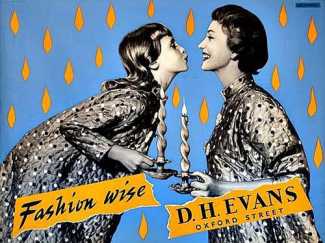 In 1946 he was promoted to art director at CPV and travelled round the world helping to develop their export advertising business. By the early 1950s he had produced such long-lasting images as the ‘face in the flower’ for Dickins & Jones, the Jaeger logo and the D.H. Evans ‘Fashion wise’ London Underground posters. Elizabeth Arden, Gossard and Goya were among the companies whose look he was responsible for, including their advertising, decor and display.
It was Elfer as creative director and Jack Beddington as head of public relations who between them pioneered the use of writers and artists such as the biographer and poet Peter Quennell and the French artist Jean Hugo, who in 1953 was commissioned to illustrate an enchanting small book, Jaeger’s Natural History. This limited edition contained Hugo’s depictions of the animals who ‘supplied’ Jaeger, Lilla Spicer's delightful verses, and was art-edited by Elfer. Hugo called Elfer ‘a marvellous person to work for, calm, never fussing, always sending copious amounts of research material to help the artist, not to mention paying well!’
In 1968 Elfer parted company with CPV to join the BBC, where he became Head of Graphic Design until his retirement two years later. From then on his house, Eldon Studios in Kensington, became his realm, with a second working home in Paris. Elfer loved to plan his own version of Travels with a Camera, depicting for advertising campaigns the commonplace in India, the picturesque in Peru, whitewashed houses in Mexico (where he survived an earthquake), or Portuguese fishermen mending their nets. He revelled in the new world of photography as an art form.
Elfer was dapper, diminutive, barrel-chested and saturnine, and his dark looks had a tremendous attraction for women. He enjoyed life to the full until in 1990 he fell under the wheels of a double-decker bus, which led to a long hospital stay and many broken bones, then a stroke, but with the devoted care of his nephew John Ross and his wife Nicky, he rallied to complete a full and varied life.
Similar artists
László Boris – Hungarian-Munich illustrator for Simplicissimus and similar journals.
Marcello Dudovich – Italian art-deco poster artist of fashionable subjects.
André Dugo – Hungarian-American interwar illustrator and magazine cartoonist.
Joseph Hémard – French interwar illustrator with an advertising background.
Miklós Vadász – Hungarian commercial-magazine illustrator of refined erotic subjects.
Marcel Vertès – Hungarian-French commercial illustrator of fashionable amorous subjects.
Example illustration

Les écarlates (1963)


