
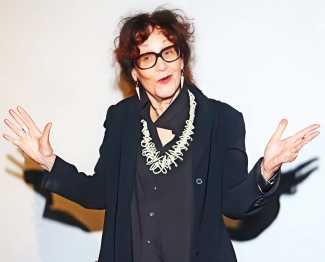
 Born in Newark, New Jersey, Judith Bernstein grew up in a household shaped by modest ambitions and conventional expectations. Her father was a Sunday painter, and she developed an early interest in art by sitting in on his sessions. Though she showed natural ability from a young age, her parents were reluctant to support a purely artistic education, insisting she train for a practical career. She duly earned a BS and MEd in art education at Pennsylvania State University before pursuing what she truly wanted: an MFA from Yale School of Art, which she received in 1967.
Yale proved formative in ways that would define her entire practice. As a graduate student in an institution with an all-male undergraduate programme, the gender inequality was extreme. She became drawn to the graffiti she found in the men's bathrooms on campus — attracted to its bold defiance and to the masculine pompousness of tagging property with images of genitalia. Where others might have been repelled, Bernstein was galvanised. The phallus, in her hands, would become not a symbol of male power but a weapon turned against it.
After moving to New York in 1967 she joined the Art Workers’ Coalition, an artist-led anti-war group that also addressed discrimination within the art world. She was also a founding member of A.I.R. Gallery, the first cooperative devoted entirely to showing female artists, where she held her debut solo exhibition in 1973. That same year she became involved in the Fight Censorship Group, and later joined the Guerrilla Girls, organisations that reflected her view of art and activism as, in her own words, one package.
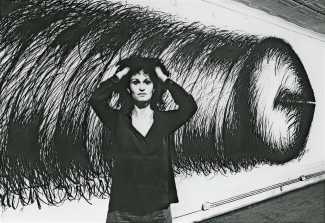
Her monumental charcoal screw drawings, begun in 1969, quickly established her reputation and her troubles in equal measure. In 1974 her drawing Horizontal was banned from a Philadelphia exhibition by an administrator who claimed it lacked redeeming social value. A protest petition was signed by Clement Greenberg, Linda Nochlin, Lucy Lippard, Louise Bourgeois, and the New Museum's founding director Marcia Tucker, yet the show still opened without her work being included.
Recognition proved slow and partial for decades. Bernstein spent many years teaching at SUNY Purchase College, where she is now Professor Emerita, while continuing to make art that galleries were largely unwilling to exhibit. It was a chance encounter at Mitchell Algus Gallery in 2008, and meeting artist Paul McCarthy and his daughter Mara, the curator of The Box LA, that reintroduced her to a wider art world. In 2012 the New Museum gave her first major museum solo exhibition, a mini-retrospective titled Hard, and a 2015 New York Magazine profile announced her as ‘an art star at last at 72’.
The belated recognition was richly deserved. In 2016 she received the John Simon Guggenheim Memorial Fellowship and was elected a National Academician. Her work now resides in the collections of MoMA, the Whitney, the Brooklyn Museum, the Carnegie Museum and the Kunsthaus Zürich. A major retrospective at Kunsthaus Zürich in 2026 was confirmation, if any were still needed, that one of the most uncompromising voices in post-war American art has finally, irrevocably, arrived.
In January 2025, to coincide with the opening of a new exhibition at Kasmin, New York, Juliet Jacques of Frieze magazine interviewed Judith Bernstein. You can read the whole interview here; here is a taste.
You’re interested in things outside the world of art. I’m thinking particularly of public toilet graffiti, with its irreverent humour.
Yes. Bathroom scatological graffiti is more deeply psychological than you think because someone is there alone defecating, and they don’t have anyone to edit anything. While I was still a student at Yale I took inspiration for my work from the bathroom, but almost all of it I made up. I produced, for example, a drawing of Superman with his cock three times the size of his body, called Supercock. I also did Vietcock, a guy with a rope from his rear connecting to the Capitol Building. At that time it was the Vietnam War, and everyone was horrified that they had to go. Get killed for what? I made the connection between the phallus and masculinity. The Fun Gun is an anatomical drawing of a penis with bullets in the sac and a trigger coming out of the urethra. As crude as you can make it, it’s never as crude as the horror of war.
Your work is very overt. You’ve talked about confronting issues head on and prioritising memorable visual imagery. What do you make of criticism of your work for being unsubtle?
Subtlety is not my forte. My work is about the political and the sexual – real life, full on stuff.
Were you influenced by movements like abstract expressionism, minimalism or pop art?
I went to an academic university. They had people who made big forays into wonderful artworks. It was not a conservative school by any means. Abstract expressionism was before my time, but I always did what I wanted to do. There was always the political, the sexual, and my rage at injustice. I was going my own way, not following someone else’s path. That was great for me because, if you’re not successful, at least you’ve done what you wanted to do. And that’s the most rewarding thing.
Yes, absolutely. Notoriously, your drawing of a screw resembling a phallus, Horizontal, was excluded from an exhibition at the Philadelphia Civic Center Museum in 1974. Can we talk about that, its effect on your career, and how you responded to it?
The show was called ‘Focus: Women’s Work’. The organisers wanted to make a statement with the exhibition because the work of women was so ignored. There was a big censorship issue, and they didn’t want to include the piece. Almost all the show’s participants signed a petition because they wanted it reinstalled. They printed up badges that said, ‘Where’s Bernstein?’ Nevertheless, the show went on without my work and got a lot of coverage, which was wonderful. I didn’t want to close the exhibition down because it was so important at that point in time to show that women had a voice. They referred to my work as porn. It was hardly porn, but it was a much more conservative time.
How and why was it difficult to be a bad-boy feminist in the 1970s? Was there a framework for feminist art at the time? And what’s changed?
I’ll tell you something. Bad girls don’t get as much as bad boys. Bad boys get a hell of a lot. It wasn’t my intention to be a bad girl. I just wanted my voice to be heard. From the time I was a kid in a very rambunctious house, I was always screaming about what I wanted and what I needed, which is something that women didn’t do then.
How did you become involved with the Guerrilla Girls and the anonymity within the group?
The Guerrilla Girls were great. It was wonderful to have a group that called attention to the fact that so many galleries showed no women, or that critics had only written about one woman artist but twenty men. Galleries wanted to be politically correct, so they were embarrassed by it, which helped enormously. We wanted to do it anonymously because we thought that, since we’re already stigmatised by being women, we didn’t want to be double stigmatised by calling attention to critics and galleries that may want to get back at us. We postered at night. We used humour, which I love. It relieved a lot of our anger and effort. It was a wonderful time to do that.
How do you feel about nostalgia for that period of radical feminist art and protest that lasted from the 1960s through to the 1990s? Does it box off the politics as something that belongs to the past but not to the present?
Quite frankly I’m not into nostalgia. Art must be current. It has to say what it has to say now. I think that my work is not sentimental. It’s hard-hitting. I like using the penis as a feminist symbol.
More recently you’ve used the vulva a lot in your work.
For a long time I couldn’t figure out where to go from the Screws series. They were so impactful, no matter what size they were reduced to. But I wanted to also go into the vagina. I wanted some self-reflection. The Birth of the Universe series was about the explosiveness of the universe and what women contribute, which is extraordinary. Women are the centre.
Do you have any thoughts about how you might respond to the second Trump presidency?
I already did so many pieces criticising Trump. I just kind of had it. It blew my mind. I can’t sleep. I use a lot of phallic imagery with him. He’s a fool. Nevertheless, we’ll see what happens now. I suspect it will be much worse than what happened in the first term. Now, I’m doing something more overreaching, reflecting the psyche of our times. It deals with the primal scream. The series is called ‘Death Heads’ [2022–ongoing]. I made many of these paintings with fluorescent paint so that they look completely different under black light, which gives them an enormous amount of power. I’m very interested in visual impact. This survey goes through my trajectory from 1966 to 2024, and you can see continuity in my interests. I have never stopped.
Judith Bernstein’s website, with information about new artworks, exhibitions, publications and much more, is here.
Similar artists
Heather Benjamin – American contemporary illustrator of bodies and visceral imagery.
Tracey Emin – British confessional artist of intimate erotic and emotional content.
Marion Fayolle – French contemporary cartoonist of strange and intimate erotic narratives.
Polly Nor – British contemporary illustrator of feminine intimacy and the demonic.
Joan Semmel – American painter and pioneer of feminist body imagery.
Kara Walker – American contemporary artist of explicit racial-sexual silhouettes.
Example illustration


