
The Italian artist Carlo Farneti, who was born and grew up in Naples, trained from 1906 to 1911 at the Museo Artistico Industriale, where he distinguished himself in ceramics and illustration, disciplines that remained closely linked throughout his career. In 1921 he received a diploma of merit for applied art at the first Naples Biennale, exhibiting ceramics and majolica, and he was also active within the city’s artistic circles through the Circolo Artistico Politecnico, of which he became a member in 1912. Some of his early drawings survive in the organisation’s collections, revealing the imaginative and literary inclinations that would define his mature work.
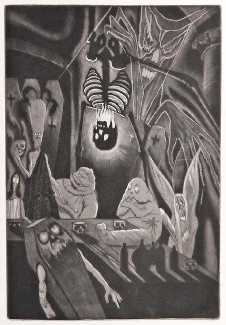
Farneti first attracted serious attention as an illustrator in 1924, when the Galleria Corona in Naples devoted two exhibitions to his work, including a remarkable cycle of forty drawings inspired by the tales of Edgar Allan Poe. These exhibitions established the direction of his artistic imagination – literary, psychological, and increasingly drawn toward the macabre and visionary. After the death of his father he moved to Paris in 1926, and it was there that his most important illustrative work was produced. In 1927 and 1928 he created two extensive suites of etchings for Poe’s Nouvelles histoires extraordinaires, and in 1935 a much-praised portfolio for Charles Baudelaire’s Les fleurs du mal. His illustrations, characterised by stark contrasts and emotionally charged distortions, have been associated with symbolism and with the expressionist worlds of James Ensor and Edvard Munch.
Farneti remained active in Paris until 1939, when the approach of war brought that phase of his career to an end. Called up for military service in 1940, he later returned permanently to Naples, where poor health increasingly limited his activities after 1945. During his final years he turned mainly toward landscape painting, though even these later works reportedly retained traces of the fantastic and visionary sensibility that had animated his earlier illustration.
Similar artists
Alessandro Biffignandi – Italian comics and pulp-cover illustrator of erotic adventure.
Umberto Brunelleschi – Italian-French art deco pochoir master.
André Collot – French illustrator of refined erotic editions in the period.
Marcello Dudovich – Italian art-deco poster artist of fashionable subjects.
Amerigo Folchi – Italian painter and designer of erotic tarot-card decks.
Example illustration

Les fleurs du mal (1935)


