
Xavier Saint-Justh, apparently born Georges Neczpál, probably in Hungary, in 1931, remains an elusive figure in twentieth-century French illustration. Almost nothing is known about his early life, artistic training, or personal background, and the name under which he became known as an artist appears to have been a carefully constructed pseudonym. ‘Saint-Just’ evokes the uncompromising French revolutionary Louis Antoine de Saint-Just, while the added final h gives the name a faintly foreign or aristocratic flavour, perhaps reflecting the central European origins of his family name.
Saint-Justh emerged during the flourishing post-war world of French commercial illustration, working during the 1950s and 1960s for advertising campaigns and magazine publishers at a time when illustrators moved fluidly between publicity art, publishing, and decorative design. His work places him firmly within this richly visual era of French graphic art, when hand-drawn illustration still dominated children’s publishing and magazine advertising. His style is characteristically soft, whimsical, decorative and narrative in emphasis, relying on expressive line, sentimental animal imagery, and carefully composed colour harmonies rather than modernist experimentation.
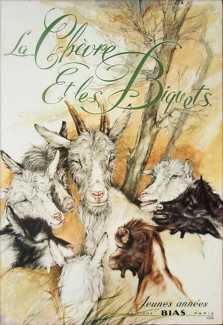 He became best known as a children’s illustrator, producing imagery for publishers in France and Britain, including works such as The Mischievous Kitten by Yvonne Cruwys (1966), Les Cavernes de la Rivière Rouge by Claud Cénac (1967), and La chèvre et les biquets (The Goat and the Kids) after the Brothers Grimm. His illustrations for adaptations of Bambi by Felix Salten are among his most widely circulated creations, reproduced on commercial and decorative objects as well as in books.
Alongside this public career, Saint-Justh also produced erotic illustrations and limited-edition bibliophile work, revealing a markedly different side of his artistic personality. The contrast between children’s imagery and erotic illustration was not unusual among twentieth-century commercial artists, though in Saint-Justh’s case the divide seems especially striking.
Similar artists
Marcos Carrasquer – Spanish-born, Paris-based painter of surreal-looking documentary narrative scenes.
Jean-Pierre Ceytaire – French contemporary painter of erotic-religious subjects.
Pierre Adrien Ekman – French interwar bibliophile illustrator of refined sensual subjects.
Sanam Khatibi – Belgian-Iranian contemporary painter of figurative-erotic and mythological subjects.
Thomas Lévy-Lasne – French painter of everyday intimate and erotic scenes.
Jean Rustin – French painter of bleak, naked figures in sparse interiors.
Jean-Pierre Stholl – French painter and lithographer of figurative subjects.
Example illustration

Les crimes de l’amour (1966)


