
The censor in the studio

In the past, when we’ve been discussing the censorship of erotic art we’ve usually been referring to suppression after the fact – a book banned, a print seized, a painting removed from display. The work already existed; the argument was about whether the public should be allowed to see it. But today something much more profound is happening. The real question is no longer simply what gets removed – in this age of digital dissemination and censorship algorithms it’s often more to do with what never gets made and displayed.
Erotic art has always existed under constraint. The history of erotic publishing is full of workarounds – false imprints, clandestine circulation, private suites of illustrations available only to ‘discerning’ collectors. Just to give one relatively recent example, in the 1950s Tom of Finland learned to circulate his homoerotic drawings through beefcake magazines available only in back-street outlets, because openly gay imagery was still legally dangerous. None of this is new. What is new is where the limitations now originate.
For a while the internet seemed to promise an escape from these older, elitist systems. Artists no longer needed galleries, publishers or specialist booksellers to reach audiences directly. But now that social media platforms have become the dominant infrastructure through which artists build audiences, sell work, secure commissions and maintain visibility, those platforms increasingly rely on automated moderation systems that are incapable of understanding artistic context.
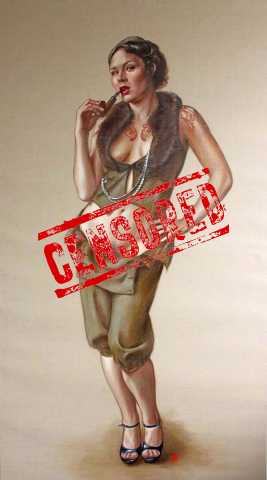
Meta and similar companies officially prohibit most nudity while allowing loosely defined ‘artistic’ exceptions, leaving algorithms to decide where the boundary lies between art, pornography, fashion, activism, exploitation and obscenity. The results are predictably absurd. Facebook’s removal of Courbet’s ‘L’origine du monde’ and the temporary censorship of Nick Ut’s photograph of Phan Thị Kim Phúc fleeing a napalm attack in Vietnam reveal what happens when human judgement is taken out of the loop. The problem is that online systems are designed for scale rather than judgment.
Then there are age-verification schemes like the UK’s 2025 law, requiring users accessing NSFW material online to submit passport details, facial scans or credit card information. Supporters frame the legislation as child protection. Critics argue that it discourages adults from engaging with legitimate erotic art while pushing younger users toward less regulated corners of the web. The reported surge in VPN downloads after the law took effect suggests that many people immediately began trying to evade it.
The well-respected erotic filmmaker Erika Lust points out that moderation standards are not culturally neutral. Classical nudes remain respectable museum objects, while contemporary depictions of sexuality, particularly female pleasure or queer intimacy, are rapidly removed from social media. The distinction between art and pornography is not objective; it reflects inherited assumptions about whose bodies and desires are considered culturally acceptable.
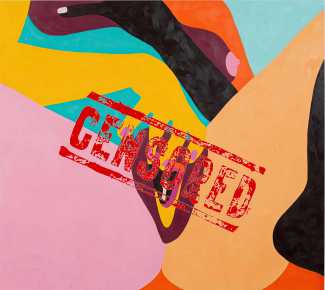
Increasingly, erotic artists who show their work online have experienced takedowns, shadowbanning, or account restrictions. Artists describe having images removed despite apparently following platform rules, while near-identical works remained online untouched. This often results from algorithmic arbitrariness – machine-learning systems do not behave consistently, and their behaviour can drift over time. From the artist’s perspective the rules are not merely strict, but unknowable.
Shadowbanning is often worse than outright removal. A deleted post can at least be appealed. A post whose visibility has been silently reduced leaves the artist with no explanation at all, just collapsing engagement, fewer commissions, and shrinking reach. Since social media now functions as a professional infrastructure rather than just as a promotional tool, these invisible penalties can directly affect livelihoods.
Most importantly, the censorship increasingly happens before the artwork is even produced. Many artists describe changing their practice in anticipation of moderation, cropping compositions, avoiding nipples or genitalia, softening themes, or abandoning subjects entirely. The moderation system no longer operates only at the point of publication, but increasingly at the point of conception.
Female-presenting bodies, queer imagery, and non-western traditions are more vulnerable than most to censorship. Moderation algorithms learn from datasets shaped by particular cultural assumptions, and what falls outside those assumptions is more easily classified as transgressive.
This is the real chilling effect. Over time, platforms reward imagery that is easier for algorithms to classify and quietly disadvantage work that is ambiguous, confrontational, historically informed, or formally experimental. Younger artists entering the field learn what survives, and adapt accordingly. The range of original and imaginative erotic art being produced gradually and imperceptibly narrows.
Artists can respond by building independent infrastructure – mailing lists, personal websites, backup accounts, alternative platforms. Erika Lust offers what is essentially the same counsel that erotic publishers would have given a century ago – never rely entirely on the gatekeeper.
The irony isn’t hard to see. The internet was supposed to free erotic art from the old systems of control. Instead, it has recreated them in automated form. The difference is that today’s censorship is less visible. Rather than banning work outright, platforms simply make certain kinds of work less viable year after year, until artists begin reshaping themselves around the algorithm.
The trend needs to be resisted, which is one of the reasons why honesterotica has its own website and its own online following which cannot be determined by arbitrary algorithms. Long may the resistance continue.
This blog piece draws heavily on two online articles, a Dazed feature on online censorship, which you can read here, and an ACM CHI paper Exposed or Erased: Algorithmic Censorship of Nudity in Art by Piera Riccio, Thomas Hofmann, and Nuria Oliver, which you will find here.