
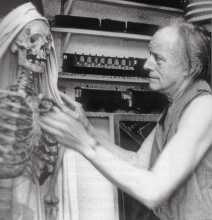
 Paul Delvaux, one of the most distinctive figurative painters of the twentieth century, was born in Antheit near Liège, though his family lived in Brussels. His father was a successful lawyer, while his mother, Laure Jamotte, exercised a strong influence over his upbringing. Intelligent but reserved, Delvaux received a traditional classical education, studying Greek and Latin at the Athénée of Saint-Gilles. The literature of Homer and the adventure novels of Jules Verne remained lifelong passions, later providing many of the recurring characters and motifs that populated his paintings. His music lessons took place in a museum room containing a human skeleton, an image that would return repeatedly.
His parents hoped he would pursue a respectable profession, but after an unsuccessful spell in business Delvaux entered the Académie Royale des Beaux-Arts in Brussels in 1916 intending to study architecture. He abandoned the course after only a year, and encouraged by the landscape painter Franz Courtens, who recognised his talent during a chance meeting in 1919, Delvaux returned to the Académie to study painting under Constant Montald and Jean Delville. His earliest works were sober landscapes and urban scenes rooted in the traditions of Belgian and French academic painting.
During the 1920s Delvaux gradually expanded his subject matter to include naked figures, initially placing them within landscapes or domestic interiors. At this stage he absorbed elements of Flemish expressionism through artists such as Constant Permeke, Gustave De Smet and Frits Van den Berghe, but his true artistic direction emerged only after his encounter with the metaphysical paintings of Giorgio de Chirico. Delvaux later acknowledged that de Chirico revealed ‘the climate that had to be developed’ – silent streets, enigmatic spaces, and an atmosphere in which ordinary reality becomes quietly uncanny.
René Magritte also exerted an influence, although the relationship between the two Belgian painters remained respectful rather than close. Whereas Magritte questioned the nature of representation through visual paradox, Delvaux constructed complete imaginary worlds. He briefly exhibited alongside the Belgian surrealists during the 1930s, but always resisted being labelled a surrealist in any strict sense.
The decisive years came between the late 1930s and the end of the second world war, when Delvaux developed the imagery that would define his reputation – statuesque women wandering among classical architecture, deserted railway stations, gas-lit streets and moonlit landscapes. Skeletons, scholars, businessmen and characters borrowed from Jules Verne entered these compositions as detached observers or mysterious companions.
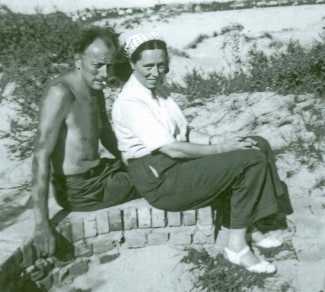
In 1929 Delvaux fell deeply in love with Anne-Marie de Maertelaere, whom he affectionately called Tam. Under pressure from his domineering mother the relationship ended, leaving a lasting emotional wound. A subsequent marriage to Suzanne Purnal proved unhappy and short-lived, but by chance Delvaux met Tam again in 1947, the relationship was renewed, and following his divorce they married in 1952. The couple settled at Saint-Idesbald on the Belgian coast, where Delvaux established the studio that became the centre of his creative life for decades. Tam remained his companion and inspiration until her death in 1989.
Alongside his painting, Delvaux enjoyed a distinguished academic career. Between 1950 and 1962 he taught monumental painting at La Cambre in Brussels, later serving as president of the Académie Royale des Beaux-Arts. He also completed a number of ambitious murals, while international exhibitions established his reputation across Europe and America. By the 1960s and 1970s he had become one of Belgium’s most celebrated living artists. The Paul Delvaux Museum opened in Saint-Idesbald in 1982 during his lifetime, an unusual honour reflecting his national importance.
Similar artists
Leonor Fini – French surrealist painter of dreamlike erotic mythology.
Sanam Khatibi – Belgian contemporary painter of symbolic mythological scenes.
Félicien Rops – Belgian symbolist printmaker shaping fin-de-siècle erotic imagery.
Jindřich Štyrský – Czech surrealist artist exploring dreams and the subconscious.
Toyen – Czech surrealist of erotic and dreamlike subjects.
Clovis Trouille – French surrealist painter of provocative erotic imagery.
Example illustration


