
The great honesterotica feedback questionnaire
The results are in! Thank you all so much for taking the time to respond, and in many cases in such detail. It really does give us a clear idea of who you are, how you use the website, what you like and value about it – and importantly how we can help make your experience of the site even better.
The questionnaire closed with 219 responses, which are summarised question by question below. All percentages are rounded and calculated against the number of respondents who answered each question, since not every respondent answered every question.
Q1. How often do you visit the honesterotica website?
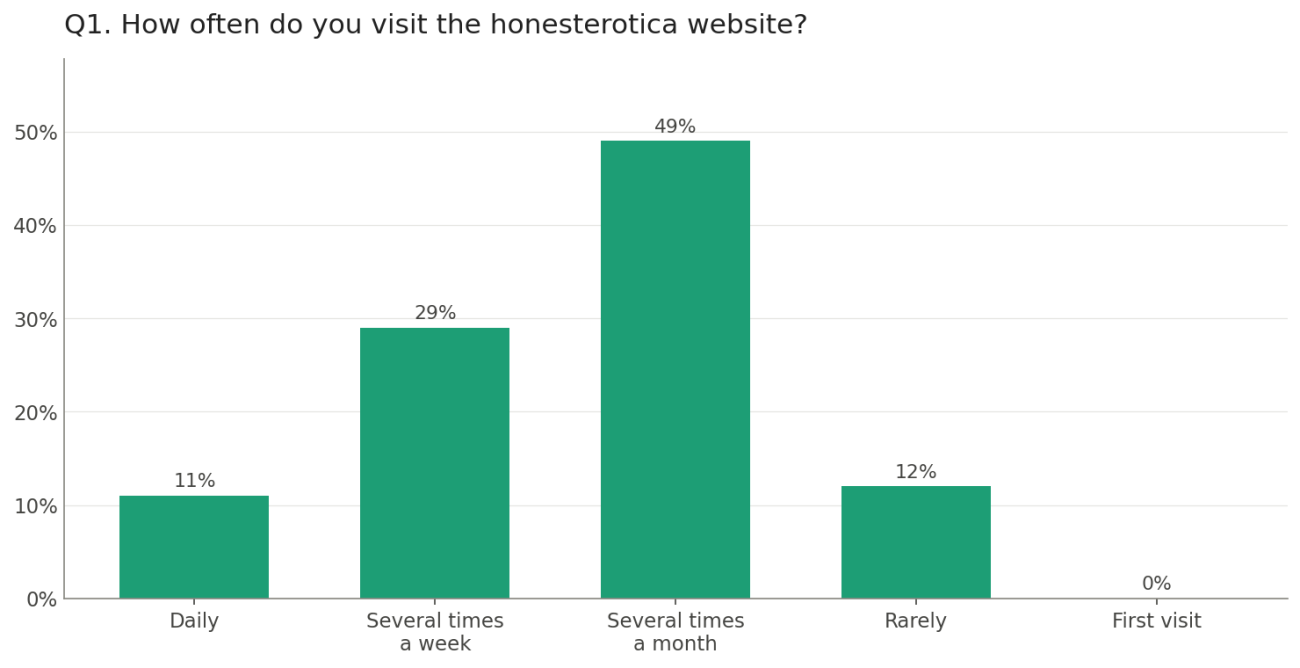 The respondent base is overwhelmingly composed of regular visitors. Nearly half (49%) visit several times a month, with a further 29% visiting several times a week and 11% daily. Only 12% are rare visitors. It is worth bearing in mind though that a self-selecting questionnaire of this kind will inevitably draw disproportionately from the site’s most engaged users.
Q2. How did you first discover the honesterotica website?
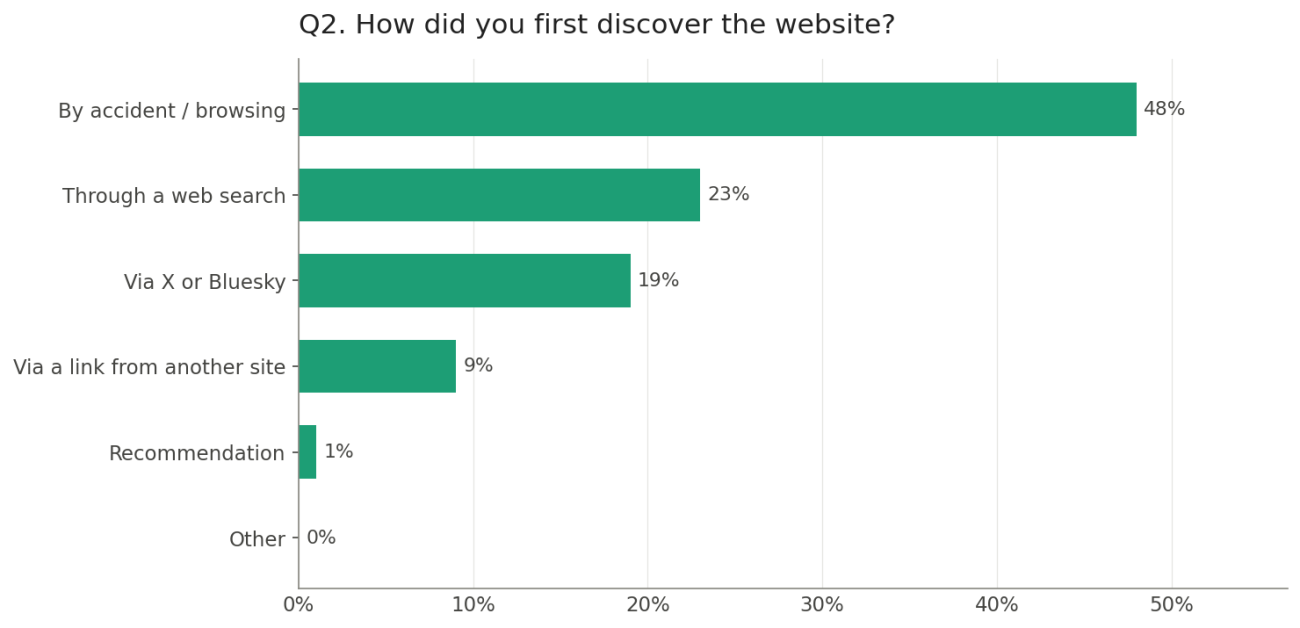 Accidental browsing is the dominant route to the site, accounting for 48% of respondents. Web searches follow at 23% and social media – specifically X or Bluesky – at 19%. Links from other websites brought in 9%, and personal recommendation accounted for just 1%. The near-absence of personal recommendation is striking, maybe due to the subject matter not being one most readers feel comfortable advocating to friends! By contrast the substantial role of social media is notable for a site that doesn’t actively self-promote, and the dominance of accidental discovery underlines the site’s findability through searching and casual browsing.
Q3. When you visit the website, where do you usually begin?
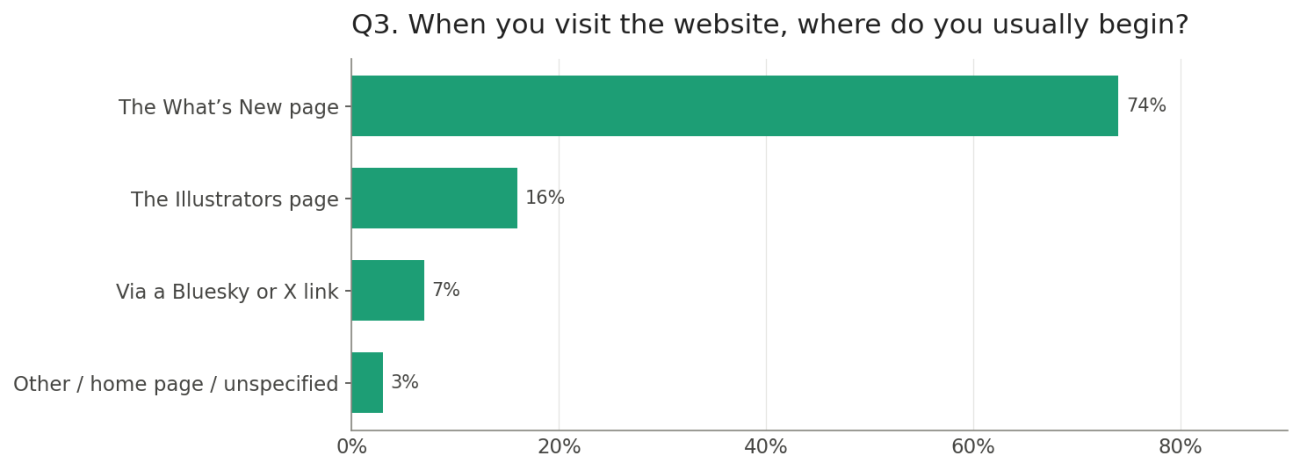 The What’s New page is the overwhelming entry point at 74% of respondents, followed by the Illustrators page at 16%. The remaining 10% almost all describe entering the site via a link in a Bluesky or X post to a newly featured artist (about 7% of all answers), with a small handful landing on the home page, following an RSS feed, or arriving at a bookmarked artist or portfolio.
The dominance of the What’s New page confirms that the site’s regular updates are the main driver of return visits. The social-media route is also important – 7% of respondents go straight to a particular portfolio from a Bluesky or X post.
Q4. What makes you click on a particular artist on the Illustrators page?
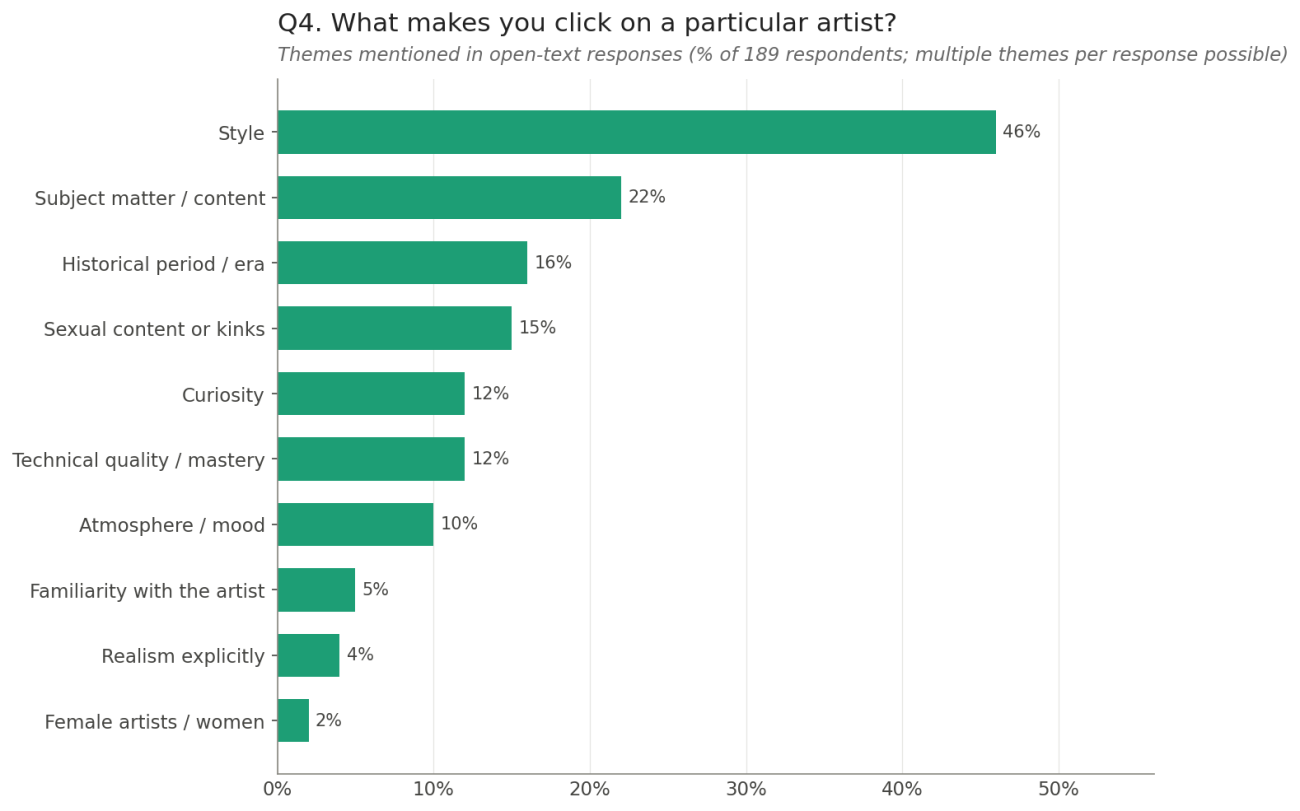 The dominant motivator is style, mentioned by 46% of respondents – usually as the first or only criterion, frequently in combination with other factors. Subject matter and historical period follow at 22% and 16% respectively. Specific kinds of erotic content (queer, heterosexual, BDSM, spanking) are named by 15%, and curiosity and technical or artistic quality are each mentioned by 12%. Atmosphere or mood appears in 10% of responses.
Several less frequent but distinctive patterns are worth noting. Realism is mentioned explicitly in 4% of responses – a small share, but striking given that respondents were not prompted on it. Familiarity with the artist from elsewhere (‘I admire his work’, ‘the name rang a bell’) drives clicks for about 5% of respondents. A small but identifiable group highlights an interest in female artists, often together with sapphic or women-authored erotic work. And several respondents emphasise that they are drawn by ‘the thumbnail above the illustrator’s name’, or by colour, shading and linework visible in the preview – confirming that the visual hook of the thumbnail does much of the navigational work on the page.
Q5. How do you usually navigate the site once you have started?
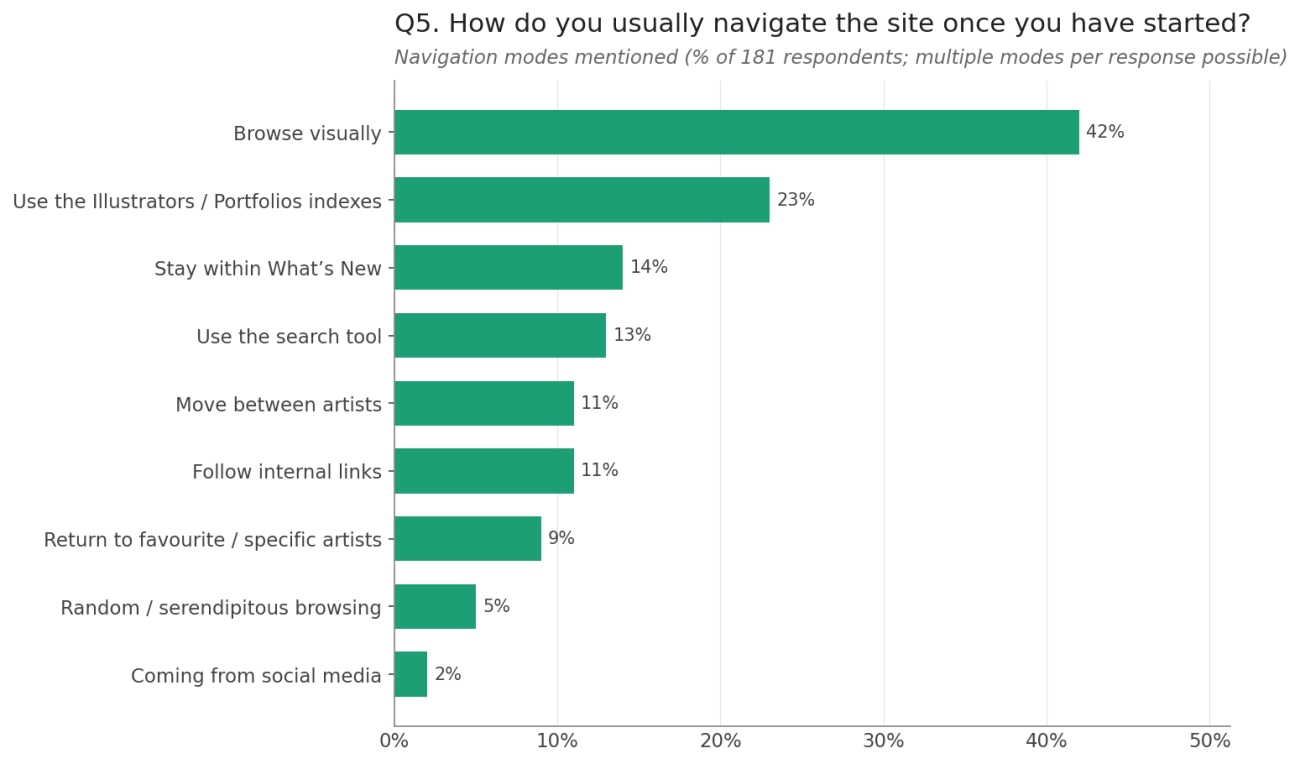 The distribution matches what we would expect for a visually rich archive – 42% browse visually as their primary mode, 23% use the Illustrators or Portfolios indexes, 14% essentially remain within the What’s New section, 13% reach for the search tool, 11% follow internal links, and a further 11% explicitly describe moving between artists. Around 9% return to favourite or specific artists, and a smaller group (5%) describes navigating randomly or by chance.
What is more interesting than the relative shares is the volume of practical site-design feedback that surfaces here, even though the question was not soliciting suggestions. The most frequent ask is for some kind of thematic or topic-based tagging system. One respondent put it succinctly: ‘in my ideal world, I’d browse the site via tags, but I know tagging is a huge amount of work at this point’. Others describe specific use-cases the current site does not easily support – finding erotic art produced in the 1950s, work in the form of etchings or woodcuts, or artists working in the style of a particular figure.
Q6. Do you use the Search function at the top of the page?
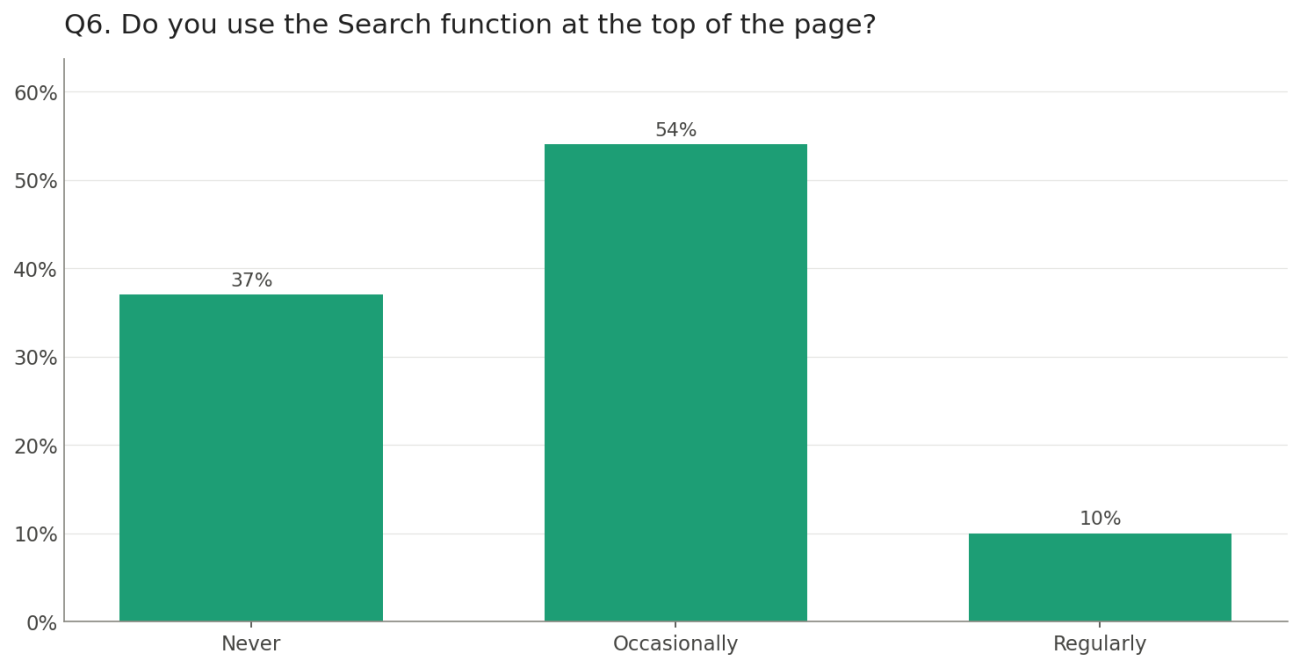 54% of respondents say ‘occasionally’, 37% ‘never’, and just 10% ‘regularly’. The headline finding is that the search function has relatively little active use – only one in ten respondents reaches for it routinely, with a substantial third never engaging it at all. The implication is that the search tool is underused not because the catalogue is shallow but because the tool can be hard to extract value from for the kind of query a typical reader actually wants to make.
Q7. If you use the search box, what kinds of words, names or subjects do you usually search for?
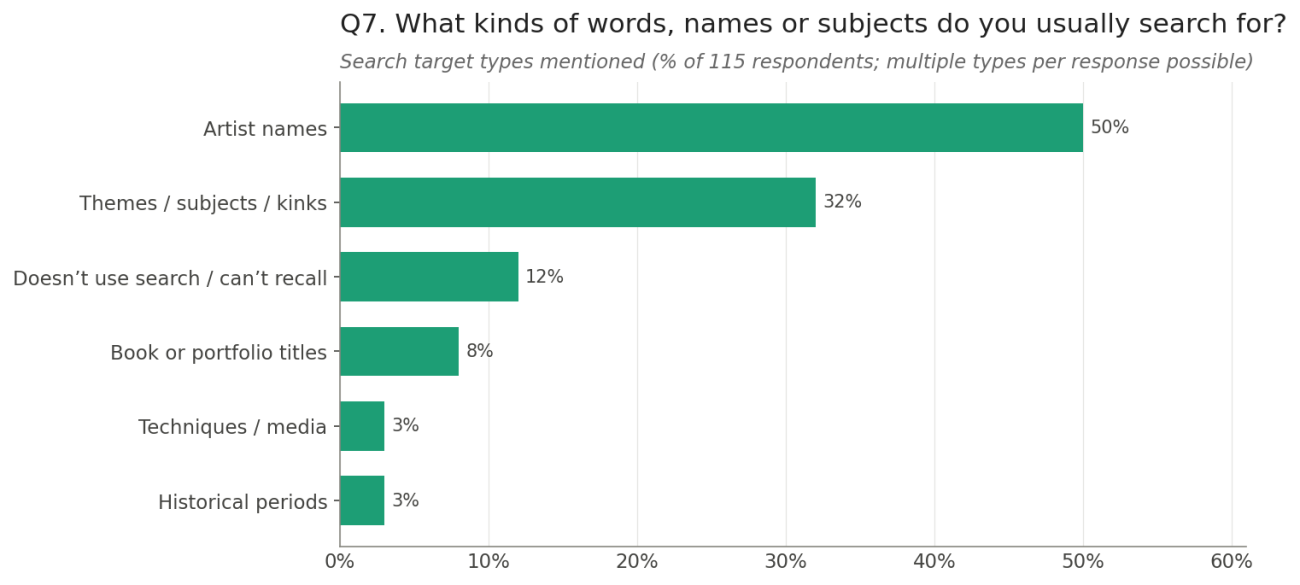 The single dominant use is to find a specific artist by name – 50% of respondents describe their searches in these terms (‘artist names’, ‘illustrator’s name’, ‘last name’). The second-largest use, at 32%, is search by theme, subject or kink, respondents naming a strikingly wide range including spanking, BDSM, threesomes, queer, gay, lesbian and bisexual content, trans and crossdressing imagery, voyeurism, BBW, mixed-age, and various sexual positions and acts. Book or portfolio titles account for 8% of searches, with a small number searching by historical period (3%) or by technique and medium – woodcut, linocut, bookplate, etching (3%).
Q8. How often do you click on links within the site (both internal and external)?
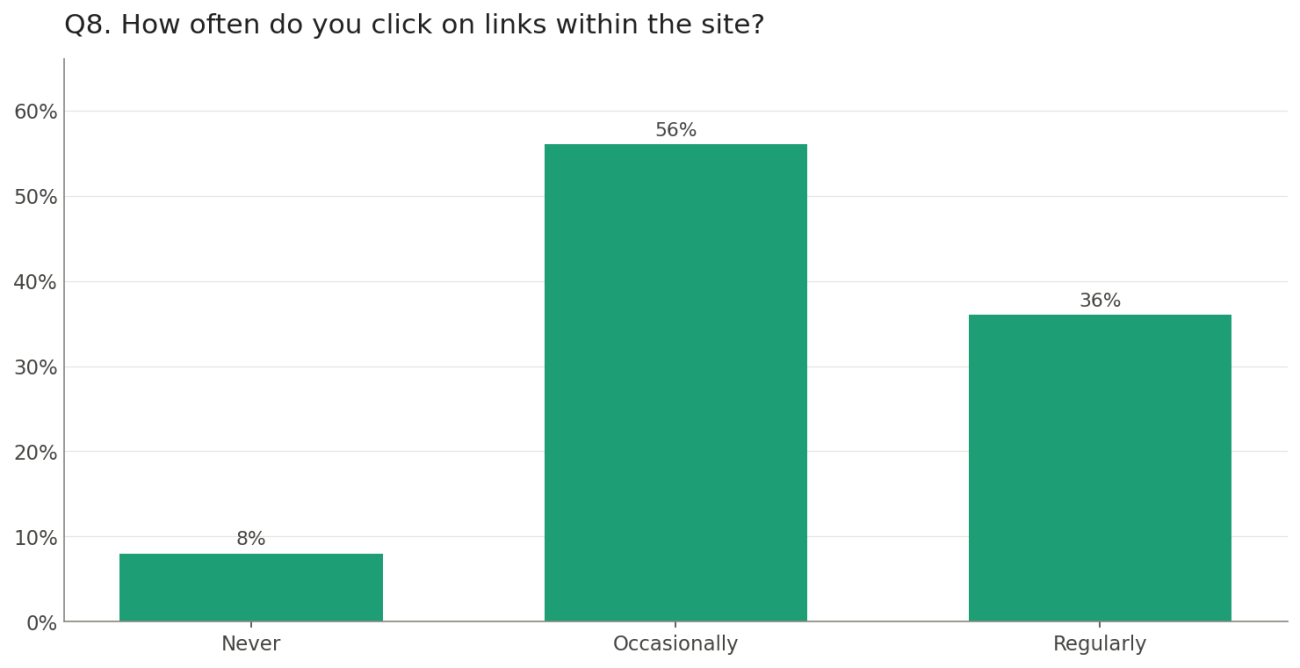 Active engagement with the site’s navigation is the norm – 36% of respondents click links regularly and 56% occasionally, leaving only 8% who never do. This validates the site’s heavily cross-referenced structure – readers are evidently using it as a hypertextual archive, moving between artists, editions and contextual entries, and not merely browsing a gallery of images.
Q9. How often do you look at the websites, books or other resources linked from the artist texts?
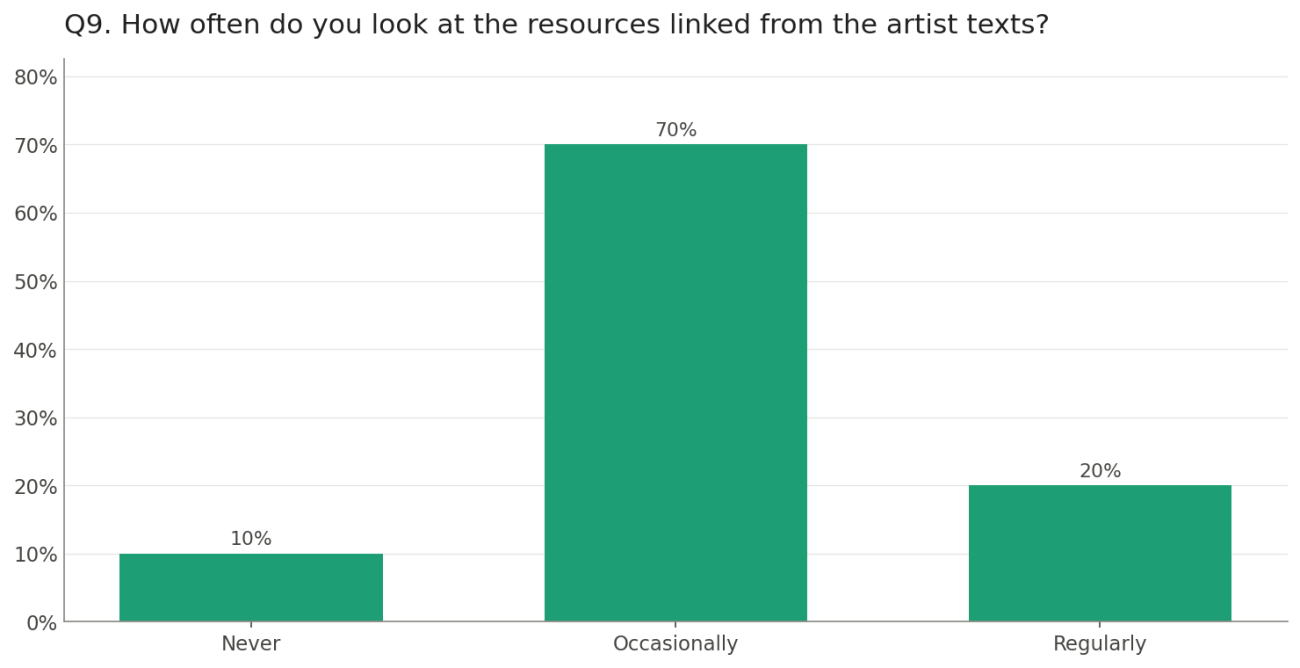 This question produced a similar overall pattern, but weighted more toward occasional use – 70% follow external resources occasionally, 20% regularly and 10% never. Readers explore happily within the site but are more cautious about being sent off it. The 20% who do regularly pursue external links are presumably the researchers and serious collectors using the site as a point of departure for further inquiry.
Q10. Do you usually read the biography and portfolio texts on the site?
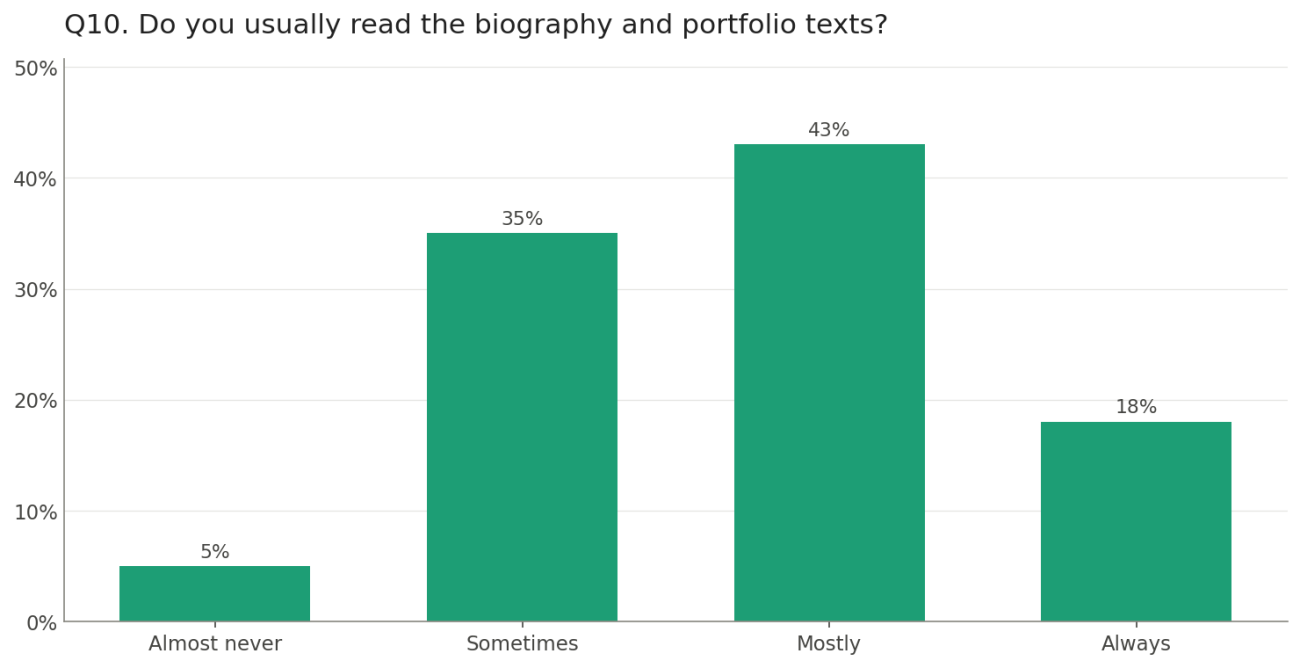 The texts are evidently read – 18% always, 43% mostly and 35% sometimes; only 5% almost never engage with the writing. This is a useful rebuttal of the common assumption that visitors to a site of this kind come purely for the pictures – nearly two-thirds read the accompanying texts mostly or always, and a further third do so at least intermittently. On this evidence the editorial investment in scholarly biographical and bibliographical writing appears to be amply justified.
Q11. How would you rate the written texts on the site?
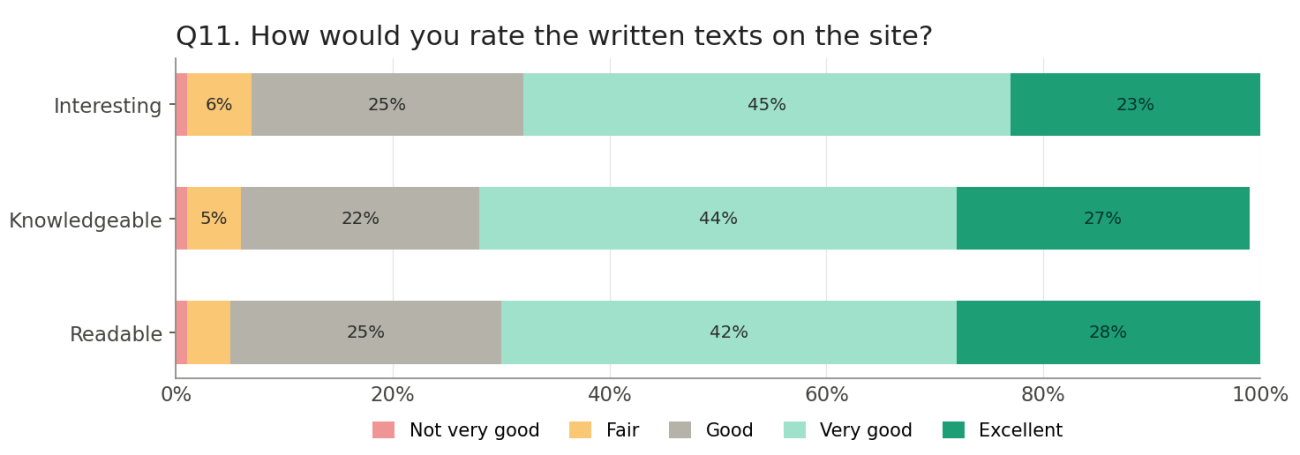 The response is strongly positive across all three attributes. Combining the top two bands (‘Excellent’ and ‘Very good’), the texts are rated Interesting by 68% of respondents, Knowledgeable by 71% and Readable by 70%; negative ratings remain under 7% in every case. The internal pattern is mildly informative: ‘Knowledgeable’ and ‘Readable’ attract slightly more top-tier scores than ‘Interesting’, suggesting that readers value the authority and accessibility of the writing fractionally above its intrinsic interest – a fair reflection of bibliographic prose at its most useful.
Q12. Have you ever used the website for research or reference purposes?
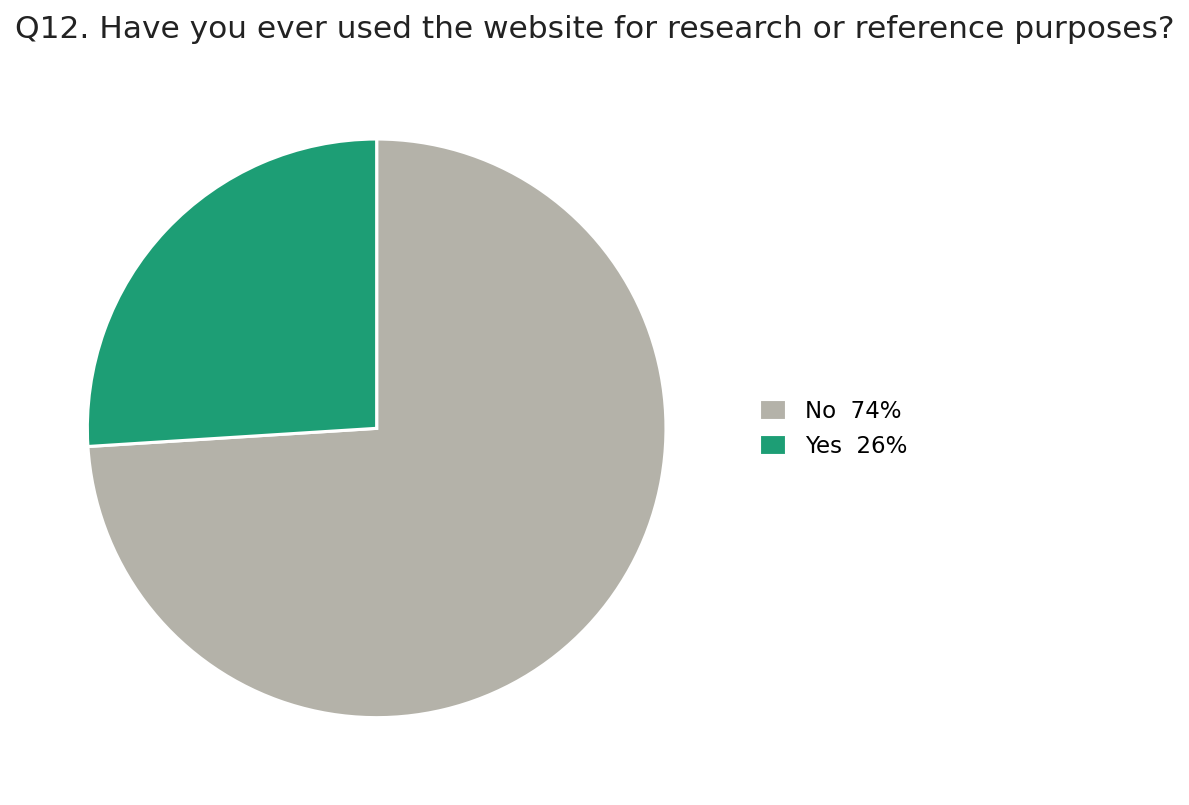 Yes 26%, No 74%. Roughly a quarter of respondents have used the site for some kind of research or reference – a meaningful figure for an archival site, even if the majority engage with it more casually. One respondent who answered ‘No’ added that this was only because they had not had a reason yet, but that the site would be one of the first places they would consult if they did. The underlying willingness to treat the site as a reference work is likely somewhat higher than the bare 26% suggests.
Q13. If yes, what were you researching?
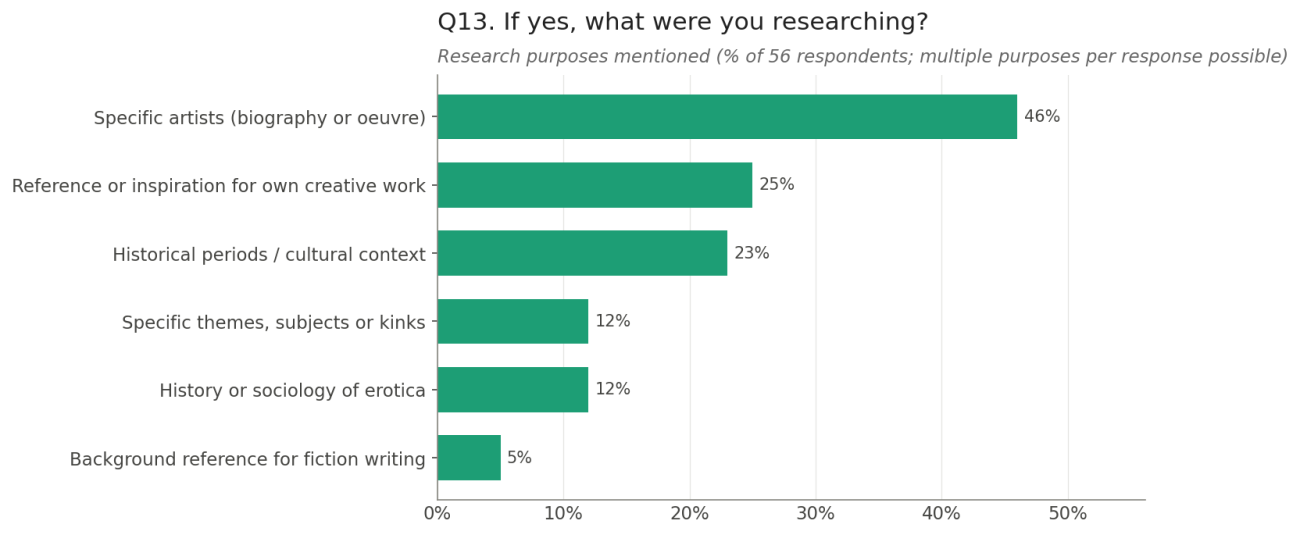 The largest single use, at 46% of responses, is research into specific artists – their biographies, their œuvre, their dates, or attempts to identify an unattributed image or signature. The site is being used here as a biographical and bibliographical reference work for the field, which is consistent with its own self-conception.
The second-largest group, at 25%, are respondents using the site as visual reference or inspiration for their own creative work. These are working artists, illustrators, painters and miniaturists – and at least one writer of erotic fiction – drawing on the site for poses, compositions, colour choices and stylistic precedents. One respondent describes themselves as ‘an artist interested in art history and particularly figurative works, with erotica as a very interesting sub-genre of the figurative nude’; another mentions mimicking a particular artist’s colour choices when painting miniatures.
A further 23% describe research into historical periods or cultural contexts – Weimar culture, expressionism, the 1920s, attitudes to sex in earlier eras. 12% pursue specific themes or subjects (queer erotica, spanking imagery, erotic bookplates). A similar 12% are interested in the history and sociology of erotica more broadly. And 5% – a small but interesting niche – describe using the site as background reference for fiction writing that includes erotic content.
The bottom line is that roughly a quarter of the questionnaire base treats honesterotica as a working scholarly and creative resource, not simply as visual entertainment.
Q14. Overall, how would you rate the material featured on the site?
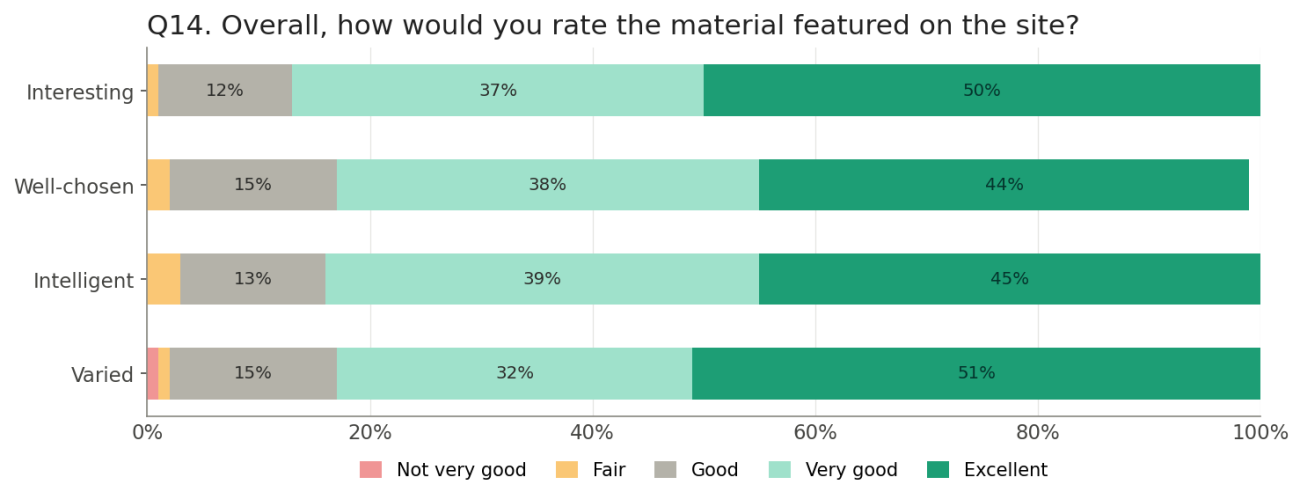 Responses here were even more positive than the writing, with ‘Excellent’ the most common response for every attribute – Interesting at 50%, Well-chosen 44%, Intelligent 45% and Varied 51%. It is worth noting that the material itself is rated rather more highly than the writing about it (compare the ‘Excellent’ shares of 44–51% here against 23–28% in Q11), which is not in itself surprising, since the images are the heart of the site.
Q15. How erotically engaging do you find the material on the site?
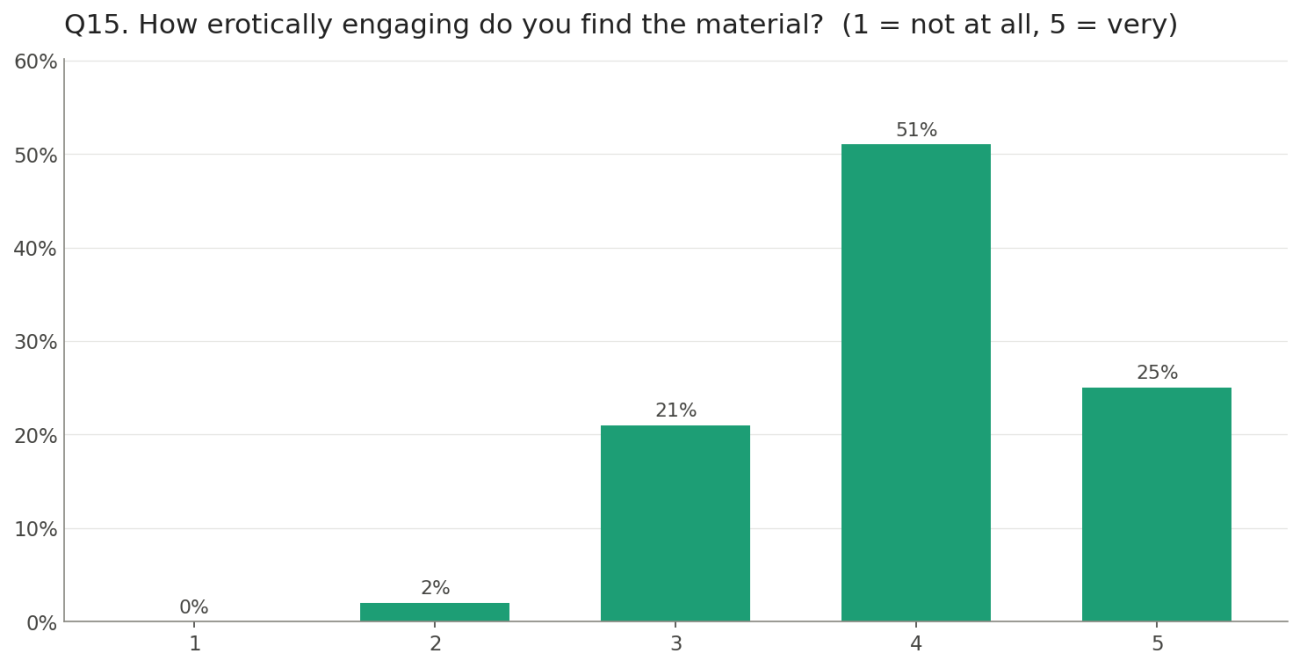 Responses to this question were skewed firmly toward the upper end of the 1–5 scale. 25% of respondents gave the top rating of 5 and 51% gave 4 – three-quarters at the top two levels. Only 3% rated the material at 1 or 2, and the mean rating is approximately 4.0. That the average sits at 4 rather than at the top of the scale is itself interesting – it may reflect the inherent tension between scholarly framing and erotic charge, or simply the breadth of the material on the site. Not every visitor will find every artist or every period personally engaging.
Q16. What would you like to see more of on the site?
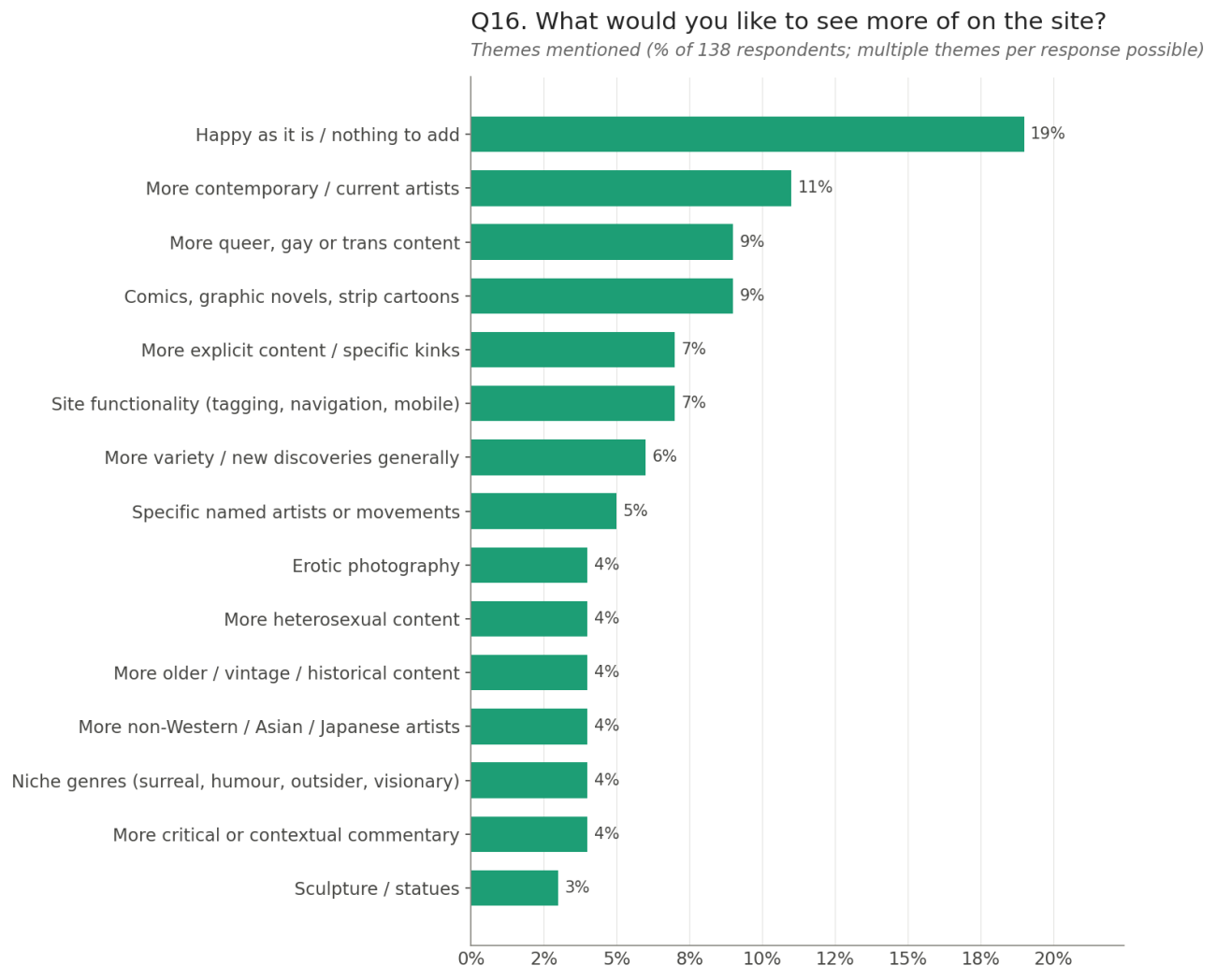 The single largest ‘category’ of reply, accounting for around 19% of responses, is essentially nothing – variations on ‘happy as it is’, ‘just keep doing what you’re doing’, ‘good as it is’, ‘don’t change anything’. This is worth noticing as a finding in its own right – nearly one respondent in five, given a free-form prompt to ask for more, declined to, amounting to a substantial endorsement of the site’s current direction.
Of the substantive ‘more of’ requests, content wishes outweigh feature wishes by roughly three to one. The biggest single content request, at 11%, is for more contemporary or current artists – a recurring note across the survey and the only content wish that stands clearly above the others. Comics, graphic novels and strip cartoons follow at 9%; smaller shares ask for more erotic photography (4%) and sculpture (3%), both of which categories are specifically not covered by the site, or niche genres such as the surreal or the explicitly funny (4%).
Demographic and identity wishes are spread across the spectrum rather than concentrated. 9% of respondents ask for more queer, gay or trans content, while 4% specifically ask for more heterosexual content; 4% ask for more non-western artists (Asian, Middle Eastern, generally world-cultural); and a single respondent mentions female artists explicitly – probably reflecting the fact that we are already actively working on this area. The overall picture is one of an audience with genuinely diverse tastes, in which no single demographic gap is large enough to swamp the others.
A smaller but more substantive theme – around 4% of responses but coherent across them – is the appetite for fuller critical commentary on the works. One respondent puts it sharply: ‘more awareness of the problematic aspects of artists and their art – exploitation, fusion of sex and violence, paedophilia, incest’. Several others express a milder version of the same thought – that some of the biographical writing shies away from fully acknowledging difficult aspects of an artist’s work or life.
Q17. What do you value most about the site?
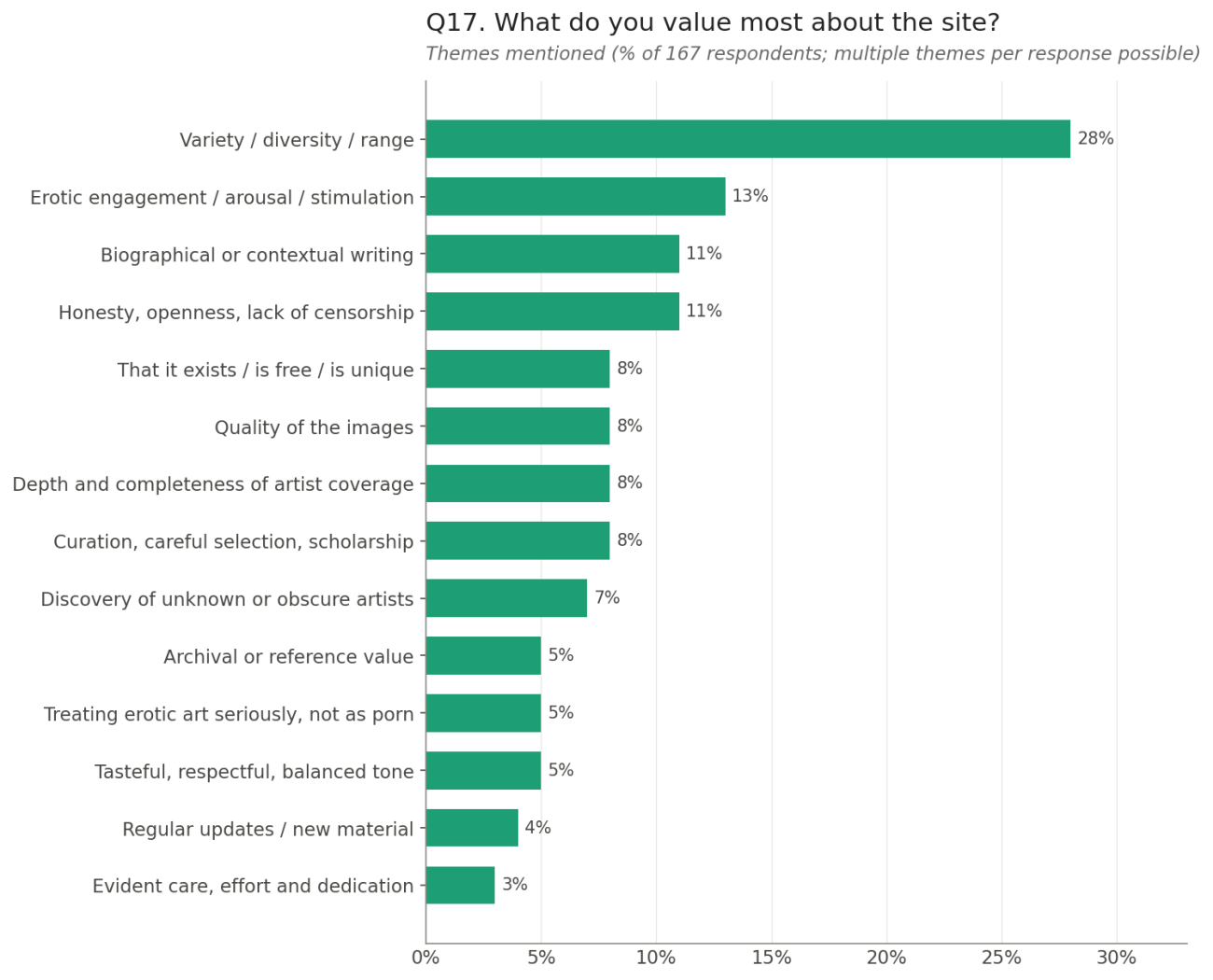 One word dominates – variety. 28% of respondents, roughly one in three, name variety, diversity, range or breadth as the most-valued feature. Many give it as a one-word answer; others combine it with other terms. Whatever else the site does, it is widely perceived as offering a coverage of erotic illustration broader than any alternative online resource.
Beyond variety, four themes form a closely-grouped core of valued attributes. 13% specifically value the erotic engagement or arousal the site provides – readers using it as functional erotica, not only as art history, with the share worth noticing because it shows that the scholarly framing has not pushed more straightforwardly erotic use to the margins. 11% value the biographical and contextual writing around the works; another 11% value what they describe variously as the site’s honesty, openness, lack of self-censorship, integrity and audacity. And 8% value either the fact that the site exists at all, that it is free, or that it is uniquely accessible relative to the alternatives.
8% point to the depth and completeness of artist coverage – specifically the fact that we try to show the whole of an illustrator’s work rather than a handful of representative images. Another 8% praise the quality of the images themselves. 8% praise the curation, careful selection, scholarship and rigour. 7% value the discovery of obscure or previously-unknown artists. Smaller groups (5% each) value the archival or reference function, the treatment of erotic art as art rather than as pornography, and the tasteful, respectful tone. 4% praise the regularity of updates, and 3% the obvious effort that goes into running the site.
Q18. Any final thoughts or comments?
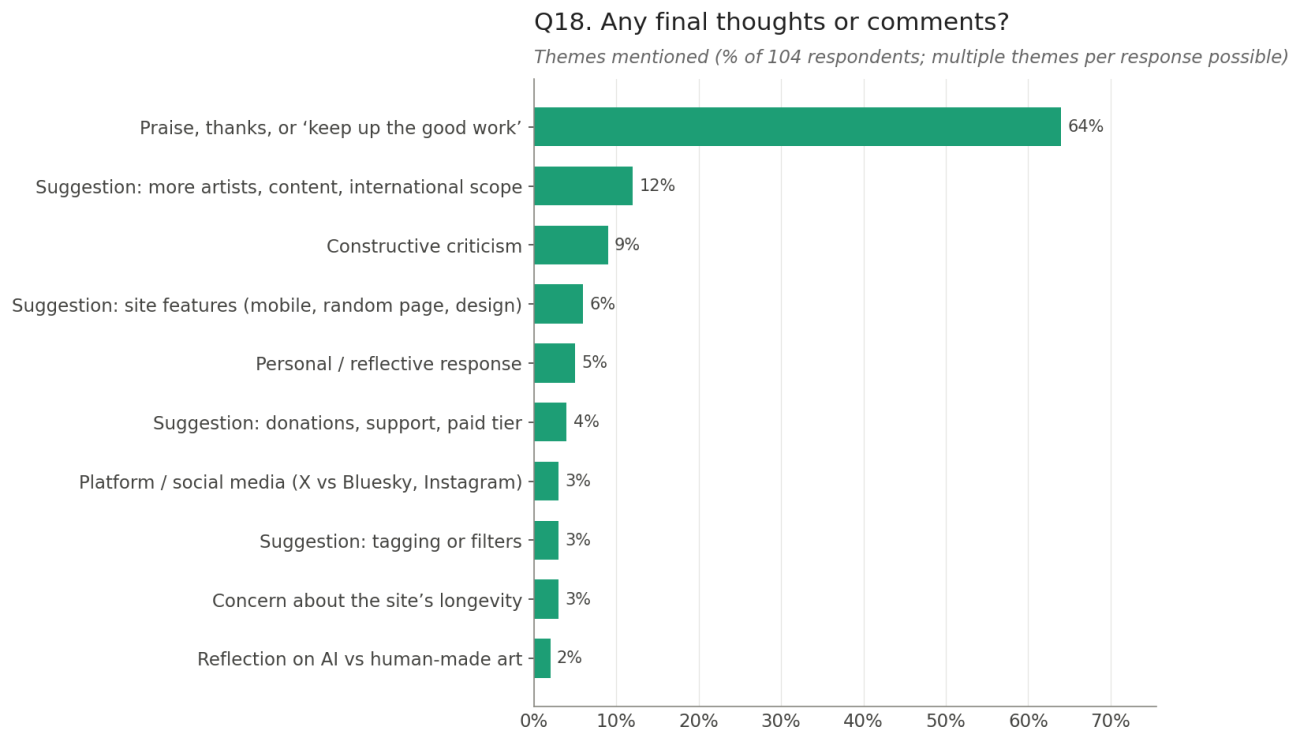 The dominant theme is gratitude – around 64% of responses consist entirely of thanks, praise, or ‘keep up the good work’, with no further content. This is itself a finding: an audience that uses the ‘any final thoughts’ box as a thank-you note, after having already answered up to twenty questions, is an unusually warmly-disposed one.
Specific comments fall into seven main categories:
Suggestions for content or new artists (12%)
Several name specific artists or movements, including more international material. A few mention the desire to be included themselves (‘I hope to make it on the site one day’).
Constructive criticism (9%)
Three themes recur. The first – mentioned twice, with Eric Gill named both times – is that some artist biographies are too apologetic about uncomfortable aspects of their subjects’ lives and work. The second is that the share of dark, exploitative or aesthetically poor material could be reduced (‘some art is verging on poor taste’; ‘the share of the dark sides could be reduced’). The third is that the site needs better tools for filtering content readers don’t want to see. These are mild criticisms, offered with evident affection, but they are coherent enough to be worth taking seriously.
Feature requests (6%)
An alphabetic index of illustrators and portfolios; a ‘similar artists’ feature; a ‘random artist’ or ‘random portfolio’ button; mobile optimisation. A further 3% of responses make the case for specific tagging or filtering of images.
Donations, financial support, and a paid tier (4%)
Three or four respondents – a small share but a consistent one across the survey – ask either how to make a donation or whether a paid tier with additional content might be on offer.
Personal or reflective responses (5%)
A quieter group of respondents describes what the site means to them rather than asking for anything in particular. The standout is a long reply on the value of human-made versus AI-generated erotic art that is worth keeping on file (‘sexual activity and the art we make about it is something that makes us human, something we will never have in common with a machine’). Others describe the site as a ‘place of resistance’ against an increasingly puritanical online culture, and as a ‘go-to site for intelligent erotic stimulation’. A small but real strand of the audience treats the site as something genuinely personally sustaining.
Concerns about the site’s longevity
Three respondents explicitly express concern that the site might disappear (‘I hope you won’t disappear overnight’). These remarks are not large in volume, but reflect how much the site is valued.
A note on platforms
The X-versus-Bluesky question that surfaced at Q3 surfaces here again in opposite directions – one respondent says that leaving X would mean the website disappearing; another values the Bluesky posts above all else. There is no clear right answer in the data, but the question of where to maintain social-media presence – and how loudly to talk about it on the site itself – does come up.
Three threads run through the open-text feedback as a whole.
First, our audience is unusually warm and committed. Roughly two-thirds of Q18 responses are essentially thank-you notes, the most common Q16 answer is ‘don’t change anything’, and Q17 is overwhelmingly an enumeration of things readers find valuable. This gives us an overall sense of an audience that finds the site exceptional within its category, and is concerned about the prospect of losing it.
Second, the structural request that recurs most often is for better discoverability – tagging, related-artists links, subject-based filtering, alphabetic navigation. The catalogue’s depth is recognised, but the tools for searching and traversing it are sometimes felt to be too limited.
And third, a smaller but coherent strand of respondents asks for more critical writing about uncomfortable artists and material – not less of it, but more honest acknowledgement of its problems. The Eric Gill comment is the touchstone, but the same theme threads through several replies.
Q19. Which age group do you belong to?
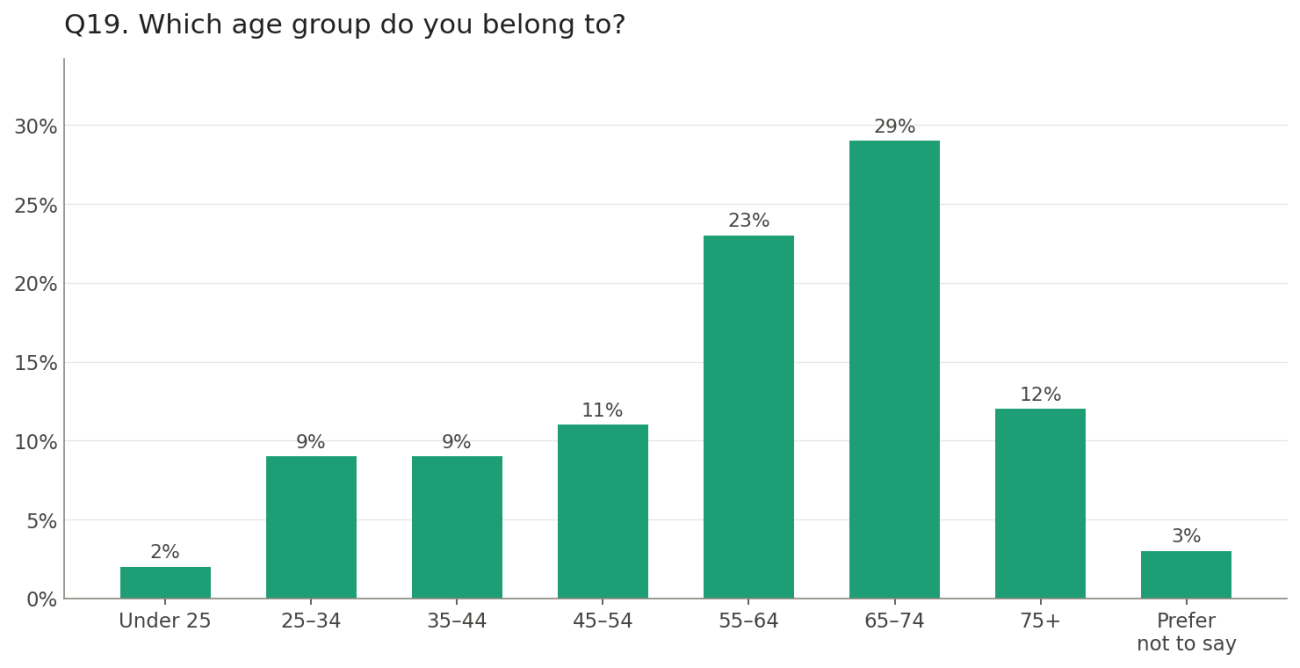 The site has a markedly older readership. 29% of respondents are 65–74, 23% are 55–64 and 12% are 75 or older, meaning well over half (62%) are aged 55 or above. The 45–54 band adds another 11%, while under-45s account for just 20% of respondents. This is broadly consistent with the demographics of book collecting in general, and with a cultural attachment to the illustrated erotic book that is naturally strongest among readers who grew up closer to its twentieth-century heyday. It does also raise a question about how younger readers might be reached.
Q20. How would you describe your gender?
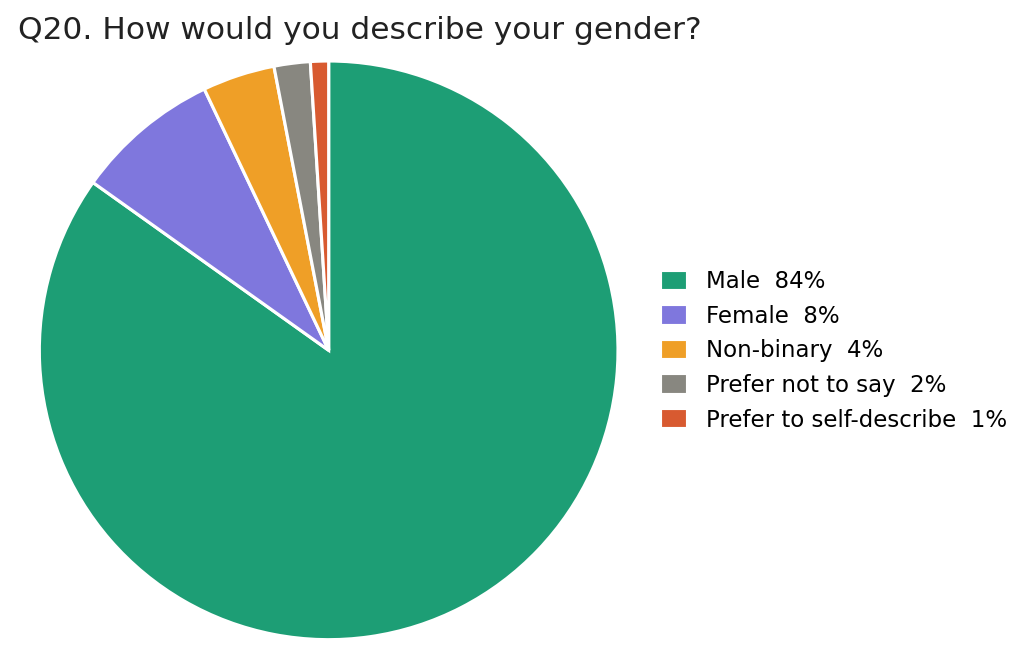 Heavily male-skewed at 84%, with 8% female, 4% non-binary, and 3% who preferred not to say or to self-describe. The dominance reflects the long-standing gender pattern of book collecting generally and of private erotic collecting in particular. Even so, around 16% of respondents identify as something other than male – a small but real readership the site reaches in a field that has historically been seen as overwhelmingly male.
Q21. Which country are you responding from?
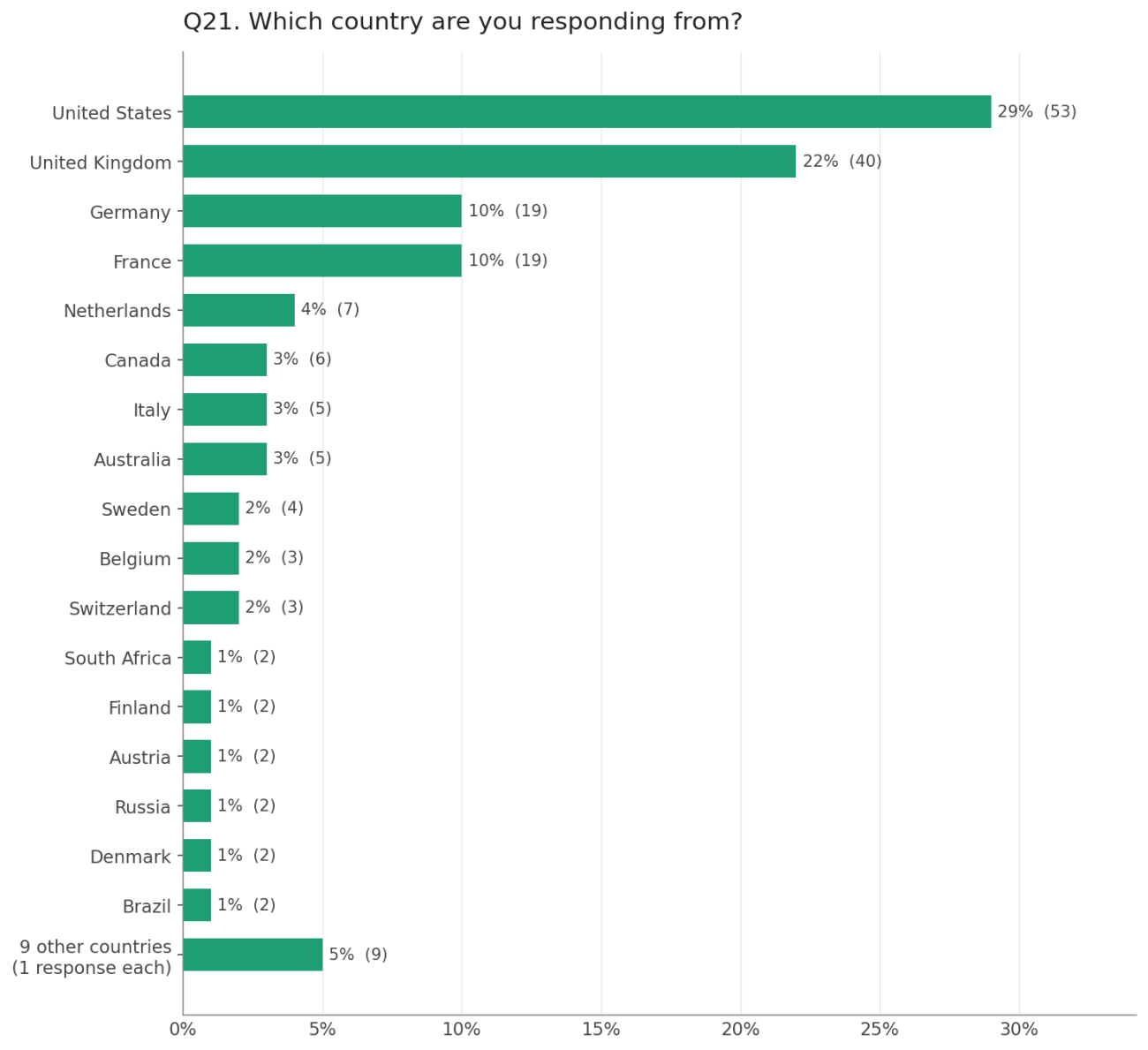 Responses came from 26 countries. The United States (53 respondents) and United Kingdom (40) together account for around half (51%) of the 185 country responses; adding Germany (19) and France (19) brings the top four to roughly 71%. Behind these come the Netherlands (7), Canada (6), Italy and Australia (5 each), Sweden (4), and Belgium and Switzerland (3 each). A long tail of nine further countries – from Romania and the Czech Republic to Mexico and New Zealand – contributed a single respondent each, confirming that the site’s reach extends well beyond its Anglophone and western European core. The substantial French, German, Dutch and Belgian contingent is consistent with the site’s deep coverage of those countries’ bibliophile traditions, and the appearance of Scandinavian, eastern European and southern hemisphere readers suggests that an English-language site on a predominantly francophone subject travels surprisingly widely.
Our feedback to your feedback
Most importantly of course it’s a big return thank you for all your remarkably positive feedback! Whatever more we can do to add material and improve our accessibility, it’s clear just how much you value and appreciate the unique resource we have put together. And to emphasise again, we very much see this as a collaboration between us as creators, the artists and illustrators we showcase, and our many, many visitors. Like you!
So – things we have already done in response to your feedback … We have created accessible and downloadable alphabetic lists of both the artists and the portfolios on the website. You will find them in a recent blog post here.
We have taken on board some of the subjects you would like to see discussed in blog posts and in the Themes and Topics section. The first of these, on the absence of contemporary lesbian explicit erotic art, is on the blog here, and we will shortly be following up with postings about online censorship and the thorny issue of children and erotic art.
We will not be coming off X/Twitter, at least for the foreseeable future, though we will keep encouraging you to follow us on Bluesky, which we believe to be a more ethically-sound, better-managed and user-friendly platform.
We are looking at ways of implementing a ‘similar artist’ feature, with suggestions at the end of each artist biography. As part of this, we may well include the ability to search artists by date, nationality, style and medium, though as you can imagine this is quite a big job. We’ve made a start with Victor Adam, the first artist alphabetically on the site – look at the end of his biography here and see if you approve of our methodology. We’ll keep you updated on this feature.
We will also look again at some of the artist biographies and have already amended the Eric Gill biography; we will see what can be done about taking on board more of the ethical issues involved.
There are, however, a few things you have suggested that we will not be doing.
We will not (at least for now) be adding photography and sculpture, tempting though it is. If somebody would like to set up a parallel website for historic and artistic erotic photography we have plenty of material and suggestions!
And we will not – ever – be tagging all 100,000+ images. Apart from the sheer work involved, tagging is impossibly subjective and selective. Tagging for every element, subject and category of even one complex image would mean making decisions that would vary from one tagger to the next.
A final thought – a central and critical value of honesterotica is that we are not informed by the language of mainstream pornography, so searching for terms like BBW, MILF, twink, teen and amateur will get you nowhere. Not that you won’t find large beautiful women and naked younger bodies; just that you’ll have to engage your imagination and investigative skills a little more.