
Is There Really an ‘Exception Française’ in Erotic Art and Illustration?
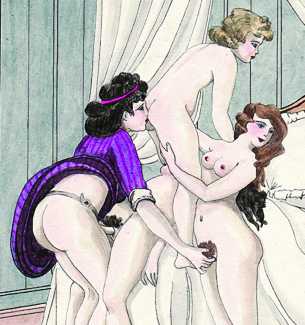
As you explore the riches of erotic art and illustration on the honesterotica website, it quickly becomes apparent that from the late eighteenth century until the 1940s, and especially in the first half of the twentieth century, the dominant contribution of French artists, writers and publishers is hard to ignore. From the Marquis de Sade at the end of the eighteenth century to Pierre Louÿs, Guillaume Apollinaire and Georges Bataille in the twentieth; from Félicien Rops to Martin van Maële, Paul-Émile Bécat and Alméry Lobel-Riche, and all the other great Parisian book illustrators of the belle époque, the centre of gravity seems persistently French. Even works written elsewhere were often published in Paris or illustrated by French artists. Does this really amount to a genuine ‘exception française’?
The simple answer is not that the French were simply more licentious or less moral than their neighbours; rather that France developed a very particular set of cultural conditions that allowed erotic material to be treated as intellectually serious, aesthetically ambitious, and commercially viable.
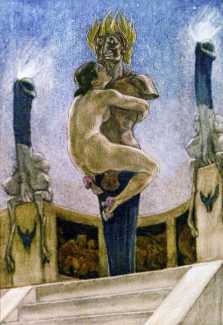
One crucial factor is the status of literature in French culture. From the enlightenment onwards, writing in France was closely tied to public debate. Thinkers such as Voltaire and Diderot were not merely story-tellers, they were participants in political and philosophical life. Literature was a place where questions about human nature could be argued openly, and within that framework sexuality could be approached not just as titillation but as a subject for analysis. The singular importance of the Marquis de Sade lies less in his explicitness than in the fact that he turned erotic, even transgressive, behaviour into a philosophical system exploring power and personal freedom.
This intellectualisation of sexual exploration never quite took hold in the same way in Britain or Germany. English erotica tended to remain furtive and commercially disreputable. German erotic culture flourished at moments, particularly in Weimar Berlin, but was repeatedly interrupted by political upheaval. France, by contrast, sustained a continuous tradition in which erotic writing could be self-conscious and reflective.
Paradoxically, French censorship helped. The French authorities did prosecute ‘obscene works’ all the way through to the 1960s, but enforcement was inconsistent and often negotiable. Instead of driving the trade entirely underground, the law pushed it into the semi-private sphere. Publishers produced limited editions ‘for subscribers’ or ‘for amateurs’, often extravagantly printed and illustrated, and sold discreetly to collectors in limited editions. This created a stable ecosystem – skilled printers, engravers and artists could make a living producing luxurious erotic books. In Britain, by contrast, the Obscene Publications Act of 1857 threatened severe penalties and discouraged any publishing seen as disreputable. British erotic works were more likely to be text-only, cheap, anonymous and ephemeral.
The strength of French art education was also significant. Drawing the naked figure was central to academic training in Paris, and students at the École des Beaux-Arts drew from life as a matter of course. The boundary between the classical nude and the erotic image was a fine one; many artists who exhibited at the Salon were also skilled illustrators of erotic editions. The techniques used – etching, aquatint, drypoint – were the same as those employed in respectable art, and erotic illustration could therefore aspire to high craftsmanship.
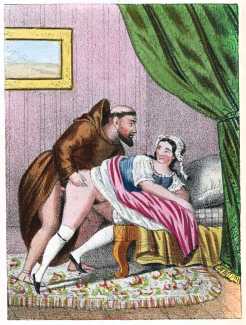
Politics also played a role. From the French Revolution through the Third Republic, France experienced a prolonged struggle with the Catholic Church and traditional authority, and erotic transgression frequently carried an anticlerical charge. Scenes set in convents or involving blasphemy were not only sexually provocative; they were symbolic challenges to institutional power. In this context, erotic literature could present itself as part of a broader critique of repression. Sexuality became a theatre in which questions of freedom and authority were staged.
By the twentieth century French writers went further still, absorbing eroticism into avant-garde theory. For the surrealists, and especially for Georges Bataille, erotic experience was bound up with ideas of taboo, death and the sacred. Bataille’s reflections on eroticism treated sexual transgression as a fundamental and important human experience, not as a marginal vice. When desire is discussed in philosophical terms it gains intellectual legitimacy. Few other national traditions integrated erotic writing so directly into serious theoretical discourse.
Language and tone also contributed. At its best French prose and poetry favours clarity, irony and psychological nuance. Erotic situations can be rendered with wit or analytical detachment rather than mere description. This stylistic flexibility allowed authors to combine suggestion and explicitness, maintaining a degree of literary poise even when the subject was on the margins of the taboo.
None of this means that France held a monopoly on erotic creativity. Britain had its clandestine presses; Germany and Austria produced remarkable graphic art; Italy has a long sensual tradition. But France alone combined a belief in literature as public argument, a tolerably flexible censorship regime, a strong academic art culture centred on the nude, an anticlerical political climate that gave eroticism symbolic force, and a sophisticated market for finely produced books.
In that sense, there is indeed an ‘exception française’. It lies not in national temperament, but in institutions and attitudes. Erotic art in France occupied a peculiar middle ground, neither wholly respectable nor entirely disreputable. It could be prosecuted, but it could also be collected, illustrated, debated and preserved. Because it was allowed to exist in this ambiguous space it developed continuity and self-awareness, and over time that continuity created a canon.
Thus when we survey the breadth of quality erotic material, the predominance of French names becomes less mysterious. France did not invent erotic imagination, but it created conditions under which erotic writing and illustration could become an enduring, intellectually engaged tradition. That, more than any stereotype of Parisian libertinage, explains the remarkable weight of the French contribution to the erotic genre.