
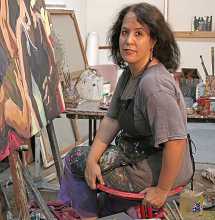
 Few contemporary artists explore intimacy with the warmth, humour and emotional honesty of Wendy Sharpe. One of Australia’s leading figurative painters, her work has consistently celebrated the pleasures and complexities of human relationships.
Sharpe grew up in a creative Sydney family. Her father was an architect and her mother a teacher with a strong interest in literature and the arts, encouraging an atmosphere in which drawing, reading and imagination were taken for granted. From an early age she showed a precocious talent for painting and drawing, developing a love of storytelling that has remained central to her work.
She spent her early years in the Northern Beaches in Sydney, and from 1979 studied at Seaforth Technical College. She received a Graduate Diploma in Professional Art from the City Art Institute in Sydney in 1984, and a master’s degree from the College of Fine Arts, University of New South Wales, in 1995. A travelling scholarship allowed her to spend extended periods in Europe, where she immersed herself in museums and galleries, absorbing influences ranging from Rembrandt, Goya and Géricault to Bonnard, Vuillard and the German expressionists. The theatricality of opera, ballet and circus also became enduring inspirations, alongside the streets and cafés of Paris, Venice and other European cities.
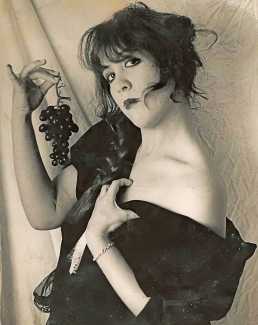
Throughout her career the human figure has remained at the centre of her art. Lovers embracing, performers preparing backstage, solitary women reading, friends gathered around a table and self-portraits all recur, united by a fascination with gesture, expression and psychological presence. Her own image appears regularly throughout her work, and these self-portraits are often candid, playful and gently self-mocking, presenting the artist as participant rather than detached observer. She paints herself ageing without sentimentality, finding humour as readily as sensuality, and rejects idealised notions of beauty in favour of honesty and lived experience.
Performance has also been a recurring source of inspiration. Actors, dancers, circus performers and burlesque artists appear regularly in her work, and she is fascinated by the transformation that occurs both onstage and behind the scenes. Dressing rooms, rehearsal spaces and moments of quiet anticipation reveal the human beings beneath the costumes.
Sharpe’s work has also been shaped by an unusually varied professional life. She has travelled extensively, undertaken numerous residencies, and in 1999 was appointed Australia’s first official female war artist since the second world war, recording the experiences of Australian peacekeepers in East Timor and later in other conflict zones. These commissions deepened her interest in the resilience and vulnerability of ordinary people, qualities that continue to inform even her most intimate paintings.
Wendy Sharpe has become one of Australia’s most popular and respected artists, exhibiting widely across the country and internationally. Her work is represented in all major Australian state galleries, the National Gallery of Australia, and numerous public and private collections. Recipient of many awards, including the prestigious Archibald Prize in 1996, she has remained remarkably independent, pursuing a figurative vision that is both accessible and intellectually sophisticated.
Sharpe currently works in a large warehouse studio in inner Sydney, and in a studio in Montmartre in Paris, which she owns with her partner, fellow artist Bernard Ollis.
For anyone interested in Wendy Sharpe and her artistic trajectory, Elizabeth Fortescue’s 2024 book Wendy Sharpe: Many Lives is a treasure-house of information and images. It’s published by Wakefield Press, and as well as Fortescue’s introduction and more than 200 full-colour images, it includes essays by art critic John McDonald, curator Justin Paton, fellow artist Anne Ryan, and journalists Scott Bevan and Stephanie Wood.
Similar artists
Cecily Brown – British painter of abstracted, painterly figurative-erotic scenes.
John Currin – American painter of figurative-erotic subjects in a classical idiom.
Eric Fischl – American painter of suburban figurative scenes with psychological erotic content.
Richard Larter – Australian painter of unembarrassed, direct pop-art sexuality.
Norman Lindsay – Australian artist of mythological erotic subjects.
Jenny Saville – British painter of unflinching naked figures and bodily reality.
Example illustration


