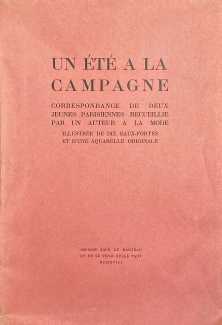
 Un été à la campagne (A Summer in the Countryside) was published in Paris in 1868, and is almost certainly by the novelist and journalist Gustave Droz (1832–95), though some think that the publisher Auguste Poulet-Malassis (1825–78) may have had a hand in its publication, if not in the writing. Like many such narratives, it is an epistolary volume, the story built around a supposedly private correspondence.
Adèle and Albertine are adolescent school friends, looking forward to the summer holidays in the French countryside with their respective families; they are also thinking rather a lot about sex. The book is written as a series of forty-one letters, describing in detail how their experiences of intimacy develop over the long hot months.
In 1901 a private press English translation of Un été à la campagne was published in Paris, which you can read here, and an online French text can be found here.
This was not the first time the summertime romp had been illustrated, nor the last. Auguste Brouet’s etchings had appeared two years earlier, with another set of illustrations, possibly by Paul Avril, not long before that. Other editions illustrated by Jean-Adrien Mercier and Gaston Barret followed later.
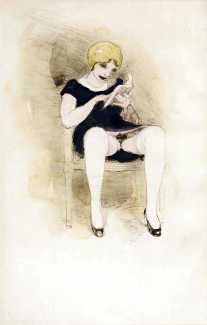
Again Frans de Geetere brings his own, rather stark and exaggerated, interpretation to what is usually seen as an innocent account of sexual awakening; maybe the gaining of such experience can never be entirely innocent. His etchings are raw and scratchy – sometimes a whole body is caught in a single quick line; elsewhere the ink builds up into dense black tangles of hair and shadow. The bodies are heavy and swollen, their faces twisted into masks – a sly smile, a head thrown back with open mouth. He leaves the rough edges showing, and several plates carry more than one study as he makes no attempt to tidy away his working process. The result feels less like the illustration of a happy summer than a study of something more driven and disturbing, darker and more feverish than Droz’s sunny tale of two girls discovering pleasure.
The first plate, of a young woman reading with her legs open and seemingly unaware of the viewer, is repeated in a hand-coloured version as a frontispiece.
The de Geetere Un été à la campagne was probably self-published, in a limited numbered edition of 125 copies.