
The erotic works of Pierre Louÿs
Biography
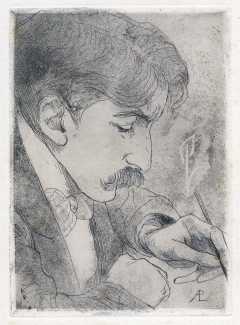 Pierre Louÿs (1870–1925) was a French poet and writer, most renowned for lesbian and classical themes in some of his writings. He is known as a writer who sought to express pagan sensuality with stylistic perfection.
Pierre Louÿs was born Pierre Félix Louis on 10 December 1870 in Ghent, Belgium, but moved to France where he would spend the rest of his life. He studied at the École Alsacienne in Paris, and there he developed a close friendship with a future Nobel Prize winner and champion of homosexual rights, André Gide. From 1890 onwards, he began spelling his name as Louÿs, and pronouncing the final S, as a way of expressing his fondness for classical Greek culture (the letter Y is known in French as i-grec). In the 1890s he became a friend of the noted Irish dramatist Oscar Wilde, and was the dedicatee of Wilde’s Salomé in its original (French) edition. Louÿs enjoyed entrée into homosexual circles. Louÿs started writing his first erotic texts at the age of eighteen, at which point he developed an interest in the Parnassian and Symbolist schools of writing.
In 1891 Louÿs helped found a literary review, La Conque, where he proceeded to publish Astarté, an early collection of erotic verse already marked by his distinctive elegance and refinement of style. He followed up in 1894 with another erotic collection in 158 prose poems, Songs of Bilitis (Les chansons de Bilitis), this time with strong lesbian themes. It was divided into three sections, each representative of a phase of Bilitis’s life: Bucolics in Pamphylia, Elegies at Mytilene, and Epigrams in the Isle of Cyprus; dedicated to her were also a short Life of Bilitis and three epitaphs in The Tomb of Bilitis. What made The Songs sensational was Louÿs’ claim that the poems were the work of an ancient Greek courtesan and contemporary of Sappho, Bilitis; to himself, Louÿs ascribed the modest role of translator. The pretence did not last very long, and ‘translator’ Louÿs was soon unmasked as Bilitis herself. This did little to tarnish The Songs of Bilitis, however, as it was praised as a fount of elegant sensuality and refined style, even more extraordinary for the author’s compassionate portrayal of lesbian (and female in general) sexuality. In 1955 one of the first lesbian organisations in America called itself Daughters of Bilitis, and to this day Louÿs’ Songs continues to be an important work for lesbians.
In 1896, Louÿs published his first novel, Aphrodite: Ancient Manners (Aphrodite: mœurs antiques), a depiction of courtesan life in Alexandria. It is considered a mixture of both literary excess and refinement, and, numbering at 350,000 copies, was the best selling work by any living French author in his day. Louÿs went on to publish the libertine Les aventures du Roi Pausole (The Adventures of King Pausole) in 1901, Pervigilium Mortis in 1916, and Manuel de civilité pour les petites filles à l’usage des maisons d’éducation, written in 1917 and published posthumously and anonymously in 1927. Even while on his deathbed, Pierre Louÿs continued to write delicately obscene verses.
Many erotic artists have illustrated Louÿs' writings, and the honesterotica website includes the majority of the illustrated editions. Some of the most renowned have been Georges Barbier, Édouard Chimot, Paul-Émile Bécat, Antoine Calbet, Beresford Egan, Foujita, Louis Icart, Joseph Kuhn-Régnier, Georges Lepape, Mariette Lydis, Milo Manara, André Édouard Marty, Georges Pichard, Rojan, Marcel Vertès and Édouard Zier.
Introduction to Pierre Louÿs’ erotic writings
Jean-Paul Goujon
Honorary professor of French Literature at the University of Seville, specialist on twentieth-century writers, and in particular Pierre Louÿs, Jean-Paul Goujon is the author of several biographies and anthologies.
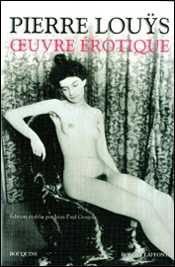 This is a shortened and translated version of his introduction to Pierre Louÿs: Œuvre érotique, published in 2012 by Bouquins Éditions. For any French-reader, this is the standard edition of Louÿs’ collected erotic works.
How can one not be interested in eroticism? – such is the provocative question posed by the entire secret work of Pierre Louÿs, a question that is essentially ironic, since we all know the answer in advance. Though this body of work is immense, it is not radically different from what might be called his ‘official’ work. Everything Louÿs wrote bears witness to a desire to push beyond the limits, either by respecting the established forms or, on the contrary, by giving free rein to amorous inspiration. On the one hand we find works such as Les chansons de Bilitis, Aphrodite, La femme et le pantin and Les aventures du Roi Pausole, whose audacity lies entirely in the detail, and which make provocative use of allusion and euphemism; and on the other the mass of explicitly erotic writings which refer only to themselves and assert a perfectly scandalous freedom. It is as though the writer had judged that, in his published works, he had not gone far enough – or to put it better, had not been able to express fully the dreams that haunted him.
Such an opinion would no doubt have astonished some of his contemporaries, who judged him excessively daring and had given him the reputation of one of the most libertine of authors. This reputation endured for a long time. In 1950 the Larousse du XXᵉ siècle was still asserting – and not badly put – that: ‘A melancholy and voluptuous writer, Pierre Louÿs celebrated, with a true mysticism, the beauty and pleasures of the body.’ In Les aventures du Roi Pausole, a sort of philosophical tale in the manner of the eighteenth century, the writer showed us a utopian country in which the most complete permissiveness reigned in matters of love. Even so, as for all the ‘official’ works he was to publish, he had had to reckon with an ever-vigilant censorship:
If I have not yet said all that I should like to say, it is because the present laws do not permit it; but I do not despair of seeing one day in France a ‘moral liberty’ equal to the religious liberty that has been granted us. The one is as just as the other, and would even have the happy result of killing pornographic literature, just as religious liberty has killed the ‘priest-eaters.’ [ … ] Unfortunately, recent writers seem to understand voluptuousness only when it is surrounded by unworthy rites, or troubled by an idiotic satanism. As if it had any need of crime or of mirth in order to become our reason for living!
Thus in February 1896, when correcting the first proofs of Aphrodite, he preferred to delete a whole series of fairly bold long epigraphs which he had placed at the head of the chapters, such as this one:
A woman thirsting to begin again – I detest that to madness. But crown me with narcissi, intoxicate me with oblique flutes, with crocus perfumes and Mytilene wine, and entrust to me a vicious little virgin.
Philodemus
Such a state of affairs made it absolutely impossible to publish the free texts that Louÿs tirelessly composed for himself and then carefully filed away in his drawers, where they remained until his death in 1925. Even after his death, works such as Trois filles de leur mère, Pybrac, Douze douzains de dialogues, La femme, and so on, were published only under the counter; it was not until the 1980s that the situation finally became more liberal. Louÿs nevertheless believed that one could outwit censorship – or, more precisely, taunt it – provided one did not flout decency in the actual choice of words. He knew too well the resources of style to be unaware that one can express anything if one does it in a certain manner. Was this not the lesson of that gallant eighteenth century which he had so frequented and whose literature he knew to perfection? He would therefore multiply the calm provocations, as for instance, from the very beginning of Aphrodite, in a passage that shows the courtesan Chrysis engaged in a solitary activity:
The hour of the bath was the hour at which Chrysis would begin to adore herself. All the parts of her body became in turn the object of a tender admiration and the motive for a caress. With her hair and her breasts, she devised a thousand charming games. At times she would even grant her perpetual desires a more efficacious indulgence, and no resting place lent itself so well to the meticulous slowness of that delicate relief.
And so Louÿs was not at all surprised to hear his friend and admirer Henriette de Bonnières say to him, after she had read this passage: ‘If you only knew how true that is! How do you manage to say such a thing without making one feel offended?’ Yet, in his eyes, this was only a foretaste. From the age of eighteen, and perhaps even earlier, he had begun to write for himself alone extraordinarily daring texts in which sexuality was staged and glorified without any kind of censorship. These were not, as one might assume a priori, mere outpourings, but genuine literary creations, nourished by the gifts of a true poet.
This secret production would continue without interruption until his last years, and it would be a grave error to consider it a temporary or intermittent outburst; one must, on the contrary, see in it the other face of the work: a gigantic edifice, built in parallel and pursued almost day after day, with a singular tenacity.
One must transport oneself in imagination back to the years 1925–30, when, after Louÿs’ death, his erotic œuvre began to be discovered – its manuscripts, piled up for decades in his small house in the Hameau de Boulainvilliers, being little by little passed quietly between his heirs and published by a few clandestine publishers. Louÿs had visibly practised, with equal facility, every genre: poems, dialogues, monologues, novels, tales, narratives, plays, and so on. He seems never even to have wearied of it, and to have composed in particular hundreds upon hundreds of free poems – to say nothing of the interminable series of quatrains entitled Pybrac, which he pursued for nearly thirty years. Even today, it must be stressed, we know only a portion of these texts, and booksellers’ and auction catalogues frequently bring fresh, unpublished items to light. On closer examination, indeed, a large part of Louÿs’ erotic work remains unknown to us. The manuscripts were dispersed to the four winds after his death, acquired discreetly by booksellers or collectors, and their subsequent fate, over three quarters of a century, is often uncertain. Thus there has lately reappeared – only to vanish again into the hands of some wealthy collector – the manuscript of an important unpublished free novel, the loss of which we deplore. The same is true of a collection of Mimes, a series of Hellenising dialogues of which we know hardly more than these lines:
Well – she licked this burning slit and this myrtle bud, still wet with the honey of love; and that voluptuousness so far surpasses all the others that, until I am married, I want to feel it every night, and to make you taste it too, you whom I love so much. [ … ] But love penetrates us through two doors, child, and my lover chooses the second, which is sterile, narrow and hot … The thing is painful but of an intense voluptuousness when the lover’s hand at the same time excites the clitoris, which swells, and the vagina, which becomes a fountain.
Furthermore, certain private collections containing many unpublished manuscripts of Louÿs remain stubbornly closed, their owners refusing to communicate what they possess. All this shows us that the texts we have gathered in this volume obviously do not constitute the totality of Louÿs’ erotic production; perhaps we are giving only half of it, who knows? Nonetheless, our ensemble represents everything that is currently known of it, and what some thirty years of research have enabled us to bring to light. With this caveat made, we must acknowledge that what we have at our disposal today gives us a fairly complete idea of this production, of its variety, its richness, and its explosive power.
The reader may finally be curious to know the history of Louÿs’ erotic manuscripts. During his lifetime, they remained buried in his drawers, which must, in the long run, have created a problem of space, so much did they accumulate. To whom, indeed, could Louÿs have shown them? One day he had ventured to let his brother Georges Louis read a few free tales of his composition; Georges Louis instantly turned sullen. For the rest, a very small number of intimate friends had knowledge of some of these writings, probably the poems. Only Quillot, Franc-Nohain, Curnonsky, Tinan and Loviot were able to read some, sent to them by post by their facetious friend. They were of course not unaware of the violent taste he had for the erotic, as was amply attested by certain books in his library, by the many photographs he himself took, or by the libertine engravings that decorated the walls of his bachelor flat. But there is no doubt that they knew nothing of the extent of his free writings and did not even suspect it. The same was true of the researches in erotic bibliography that fascinated him and made him accumulate curiosa. So far as we know, the writer never met – and the thing is sad – an interlocutor, a correspondent, in short a mind sufficiently free, with whom he could speak about it at his leisure. Even with Louis Loviot he could not always give himself entirely. It is greatly to be regretted that, alongside a Frédéric Lachèvre – a great scholar, certainly, but a strongly prudish mind – Louÿs was unable to form a friendship with a Louis Perceau, a Fernand Fleuret, and above all a Guillaume Apollinaire.
When Louÿs died on 4 June 1925, his heirs – in this case his wife Aline Steenackers and her lover (and soon-to-be husband) Georges Serrières – set about taking inventory of his library and his papers. They then discovered an enormous quantity of erotic manuscripts accumulated over more than thirty-five years, and didn’t really know what to do with them. There were, it was claimed, more than four hundred kilos of them, and all were unpublished. As Robert Télin writes:
After his death, the bookseller-experts who came to value, at Passy, the treasures of his library deliberately set aside, with the feeling of an offended modesty, in the free exercise of their high functions, four hundred kilos of obscene manuscripts, as marvellously calligraphed as those that were the object of a sensational sale in 1926. Strengthened by the experts’ disdain, the poet’s wife carefully gathered up this fortune fallen from sworn hands, and over more than two years she dispersed them in the world of autograph collectors!
Turning them into money was however not easy, and above all there could be no question of selling them openly to booksellers or putting them through the salerooms. They were therefore dispersed in the most varied and chancy manner. Certain clandestine publishers began to take an interest in them, and so it was that in July 1926 René Bonnel published, evidently under the counter, Trois filles de leur mère, whose manuscript had reportedly been bought ‘by a senator from the east’. As this edition had not been put on sale and reached only a public of bibliophiles, it is difficult to assess the impact it could have had. Before this publication, the bookseller-publisher Simon Kra had brought out, under the same conditions of clandestinity, the Manuel de civilité, which gave a less radical image of its author, though no less hilarious. 1927 was a great year for Louÿs, since it saw appear in turn the Histoire du Roi Gonzalve, Poésies érotiques, Pybrac and Douze douzains de dialogues, René Bonnel being responsible for the first three, and Robert Télin for the fourth. The latter seems to have gathered from the Serrières couple a certain number of erotic manuscripts, books, photographs and objects. He was not the only one, and booksellers such as Gaillandre, Kra and Lipschutz also took advantage; but it was apparently a bookseller and broker by the name of Edmond Bernard who acquired the bulk of them en bloc, transporting them in a small van. The result of all these successive publications was that Louÿs’ free œuvre began to be known to a certain public of bibliophiles and publishers, who sought out his manuscripts and considered printing unpublished pieces. Such was the case with René Bonnel, who, with the complicity of Pascal Pia, gave in 1928 a fine edition of Aphrodite ‘including unpublished free passages’.
For a few years things died down, then in 1933 Les chansons secrètes de Bilitis and Au temps des juges were edited. Had collectors grown weary? It was then necessary to wait until 1938 to see new texts surface – La femme, a very fine illustrated edition prepared by Louis Perceau, and Poésies libres. The years following the second world war saw a resumption of publications, still clandestine – Poèmes érotiques inédits, prefaced by Georges Hugnet and published by the Niçois bookseller André Bottin (1945); Le trophée des vulves légendaires, ‘at the expense of a group of Parisian bibliophiles’ (1948), and Cydalise (1949). These three works were illustrated, with very uneven success (Louÿs has hardly been lucky with his illustrators, free or otherwise – except for Vertès). For the thirty years following Cydalise nothing happened until the great Swiss collector Gérard Nordmann, who had assembled a rich collection of Louÿs’ erotic manuscripts, had published at his own expense in 1978 a facsimile edition of the unpublished play Jeunes filles. The death of Michel Simon in 1975, and the dispersal of his immense erotic library, had abruptly returned to the market a great many manuscripts of Louÿs, most previously unknown. It was also at this time, in 1977, that the Association des Amis de Pierre Louÿs was created, which, despite the reluctance of certain of its members, set about gathering and propagating the unpublished erotic writings of Louÿs. There ensued, as in a salvo, a whole series of confidential publications, made under fanciful imprints – Pastiches et parodies (1981), La soliste (1983), Les mémoires de Joséphine (1983), Farizade (1983), Petites miettes amoureuses (1987), Manuel de Gomorrhe (1994), Toinon (1994), and Recherches sur l’épilation des femmes (1997). With censorship having progressively relaxed its grip, certain publishers did not hesitate to publish openly Louÿs’ unpublished erotica – such was the case with the Éditions 1900 L’île aux dames (1988) and the Éditions Astarté play Le sentiment de la famille (1996), then the album of photographs Le cul de la femme (2008). Will we soon see other texts revealed? Above all we must hope that certain collectors will show themselves less possessive of their treasures.
Meanwhile – that is to say since the 1970s – a certain number of titles have been reissued, often in affordable paperback collections. A courageous publisher, Jérôme Martineau, brought out in 1970 reissues of Pybrac and the Manuel de civilité, as attractive small booklets. One must also mention the pioneering role subsequently played by Éditions Eurédif, which, in their ‘Aphrodite classique’ series with its suggestive covers, reissued in 1975–7 – Trois filles de leur mère, the Manuel de civilité, the Histoire du Roi Gonzalve and the Dialogues de courtisanes. These were not, of course, very polished editions, and the text in them was not always perfect; but their modest price enabled them to reach a whole new public, essentially of young people, who could not have afforded the luxurious illustrated publications intended for bibliophiles. Louÿs’ erotic œuvre thus became, one might say, public property, and other publishers, such as Allia and La Musardine, would follow Eurédif’s example. With the substantial volume one is about to read, the sun of the dead seems at last to have risen for the glorious author of Trois filles de leur mère, that relentless explorer who has finally emerged from his purgatory.
In the years since this introduction first appeared in 2012, Goujon’s volume has remained the standard reference for Louÿs' secret œuvre, undisplaced and unrivalled. No comparable single-volume corpus has been attempted by another publisher, and Goujon himself has continued to dominate the field. The most substantial subsequent editorial work has come from Alexandre Dupouy, first at Éditions Allia and then at La Manufacture de Livres. The Allia volume Les sœurs à l'envers et autres textes inédits (2013) gathered seven short erotic texts, among them Service de nuit, Fifi et Monsieur Luc, and a partial Petite méthode de vulve, presented and annotated by Dupouy and illustrated from Louÿs’ manuscripts and his own photographic collection.
A decade later, Le sexe de la femme: Petite méthode de vulve, 1892–1914 (La Manufacture de Livres, 2023) gave the first integral publication of one of Louÿs’ most singular notebooks, set in dialogue with photographs drawn from his brothel-imagery collection, and so functioning quite as much as a document on Louÿs the photographer as on Louÿs the writer.
Meanwhile, reading editions and reformattings have continued. The Petite Bibliothèque Payot reissued Manuel de civilité pour les petites filles (2013), Trois filles de leur mère (2014), and Les chansons de Bilitis (2014), the last with a substantial preface by the historian of antiquity Sandra Boehringer. In April 2019 Bouquins reissued the Œuvre érotique itself within its new Bouquins/Christian Lacroix sub-collection, a designer-led reformatting rather than a revised edition. In October 2025 the same publisher launched a further imprint, Les Singuliers, whose inaugural titles included Poésie érotique, extracted from the 2012 Œuvre érotique accompanied by a fresh preface by Goujon, focused on the poetic dimension of the corpus.
It remains striking that the bibliophile tradition which had carried Louÿs' text from Calbet and Lobel-Riche through to Daniel and Bécat appears not to have resumed; no significant new illustrated or fine-press edition of any of the major works has appeared in the last three decades, and the post-2012 activity is wholly in trade and scholarly text-only formats.
It is surely time for a new generation of illustrators to tackle Pierre Louÿs’ ground-breaking transgressive texts.
