Be warned that Bernhart’s dark works often depict murder, rape, mutilations of all kinds, bestiality and coprophagia; if any of these offend your sensibilities then go no further. We agree with Bernhart that depiction is not real life, and that transgressive art allows the artist’s imagination to explore safely territory that would otherwise be dangerous and harmful. Proceed with caution and your eyes wide open.
Im dunklen Wald/Dans la forêt sombre (In the Dark Wood) is the title of a 2008 monograph of Antoine Bernhart artworks published by Bongoût in Berlin, and a 2019 Bernhart exhibition at The Arts Factory Gallery in Paris. We have chosen it to show an overview of the artists’ work from the mid-1990s to more recent offerings.
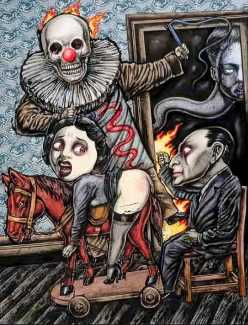
The darkness of night is the backdrop of Antoine Bernhart’s work – the night of jail cells, the night of thick forests, the night conducive to monsters that dawn dissolves. The artist chooses this dark setting for the scenes of rape and violence, a vast landscape of wretchedness where childlike figures in grinning masks torment victims who seem to reach a peak of ecstasy, like the Chinese torture victim described by Georges Bataille in Les larmes d’Eros (The Tears of Eros). This truly is a narrative of evil and the crossing of boundaries, where erotic excess is on first-name terms with death. Antoine Bernhart’s work is in the long tradition that links the Marquis de Sade with Hans Bellmer. The hallucinatory power of his characters, the fascinating cruelty of his sexual theatre, make Bernhart a radical exception in the field of contemporary art.
On Antoine Bernhart’s website he offers his own rationale for his work:
Do not kill, do not hurt, do not violate your neighbour – in other words, do no harm to anyone – are some of the prohibitions on which the social contract is founded. Education sets out to make them understood and accepted. Law enforcement and the judiciary strive to ensure people abide by them. Describing or depicting murders, assaults and sexual violence escapes prohibition, however, in the name of freedom of expression. While it is clearly necessary to avoid unsettling children or people who are nervous of excessive representations by exhibiting them in public, a depiction of murder does not kill, a description of rape does not rape. These representations can cause painful emotions and affront consciences. All adults are free to reject images that unsettle them, just as all adults are free to appreciate them as long as they are recognised as interpretations and not facts. A photograph of a scene of paedophilia is an act of complicity with a crime; a drawing or description of a similar scene can be a work of art. This is the paradox of representation.
Two recent collections of Antoine Bernhart’s work have recently been published by Dijon-based publisher Les Presses du Réel. Papiers hantés: Les yeux de la main (Haunted Papers: The Eyes of the Hand, 2022) is a compilation of work shown at the Museums of Modern Art in Geneva and Toulouse, while Juju Jinx (2022) is a collection of Bernhart’s trademark characters including a priapic Elvis, disturbing Wild Ones, sleazy folk bands, fiendish cowboys, shibari masters, an extra-lustful Bettie Page, and dead and undead rock’n’rollers including The Meteors, Tall Boys, and The Cramps.
These and much more can be found on Les Presses du Réel’s website here.