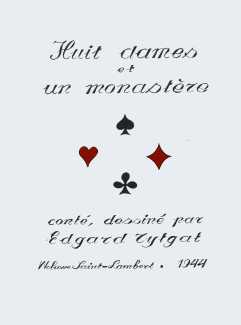
 Huit dames et un monastère (Eight Women and a Monastery) is Edgard Tytgat’s most intriguing late graphic work, bringing together many of the themes and ambiguities that run through his art. Produced during the final years of the German occupation of Belgium, the book consists of a sequence of original prints accompanied by a short, lightly sketched narrative.
The premise is deliberately slender and faintly absurd: eight women arrive at, inhabit, and subtly unsettle the enclosed world of a monastery. As so often with Tytgat, the story unfolds less through action than through atmosphere and implication. The monastery, usually a symbol of order, discipline and withdrawal from desire, becomes a stage for erotic tension, curiosity and social comedy.
Created in a period of censorship and constraint, Huit dames et un monastère can also be read as Tytgat’s personal commentary on confinement, rules and subversion.
So what actually happens in this narrative where the images tell us so much more than the slim text (given below) does? Eight women – bourgeois, fashionable, and clearly secular – arrive at a monastery, apparently as visitors or temporary residents rather than penitents. There is no sense that they are seeking religious conversion; their presence feels accidental, even frivolous. The monks receive them with a mixture of ritual politeness and quiet unease. From the outset, the balance of the cloistered world is disturbed. The women have entered a space explicitly organised around the repression of female presence and sexual desire. From that moment, the monastery becomes an institution under erotic strain.
The symbols central to the narrative are introduced – a birdcage created by one of the monks after a model belonging to one of the women, which then becomes a complex symbol of restraint, playfulness and exploration. And the playing cards, introducing chance, play, erotic unpredictability. The card game is suggested by one of the women, then taken up by a monk, who proceeds to allocate a card to each woman, the intention deliberately opaque.
Gradually the monastery’s atmosphere softens and frays. Discipline slackens; contemplation is interrupted by curiosity. The monks are distracted while the women seem increasingly at ease. Interactions between women and the inmates develop, the women shedding their garments while the monks remain stubbornly robed. The women do not appear to pursue the monks, nor do they seem romantically interested in them; their expressions are amused, distracted, politely sociable. They enjoy each other’s company, allowing their hosts to watch, assist, imagine, but not to participate.
The way Tytgat deliberately presents a loose narrative which can be read from many different angles is what makes Huit dames et un monastère so intriguing and powerful. Is it about a dangerous feminist presence in a controlled male environment? Is it about voyeurism, or repression, or the conventions of social interaction? The answer has to be that meaning is created not so much by a straightforward narrative as by the human tendency to use our own interpretations and imaginations to turn what we see into our own internal theatre.
Here is an English translation of the text, its very sparseness demonstrating that it is the images that really carry whatever story we choose to imagine:
Eight women, travelling together, arrived one afternoon at the gate of a monastery.
They rang the bell.
The porter opened and, seeing their respectable appearance,
informed the Reverend Father Superior.
The Father Superior came and greeted the visitors courteously.
The women explained that they wished to see the monastery.
Permission was granted.
The women entered the cloister.
They admired the galleries, the garden, and the silence of the place.
The monks continued their occupations.
Some read.
Some walked.
Some prayed.
The presence of the women caused a certain distraction.
The women sat on the benches of the cloister walk.
They spoke among themselves and looked about them with interest.
A monk, passing near them, lowered his eyes.
Another, who was reading, did not turn the page.
In the garden the women rested.
One removed her gloves.
Another adjusted her stocking.
A third leaned back in the sun.
The monastery remained very quiet.
Nevertheless, the monks were no longer entirely at ease.
The women were invited to rest.
They accepted with pleasure.
Chairs were brought into the garden.
The weather being fine, they remained there a long time.
The monks passed through the cloister as usual.
However, they walked more slowly than before.
One of the women had brought a small cage containing a bird.
It was placed near the bench.
The bird sang.
The women listened and smiled.
Several monks also listened.
One remained standing beside the cage for a considerable time.
The women proposed a game of cards.
A table was arranged.
They played.
The Reverend Father crossed the cloister.
He observed that the women were enjoying themselves.
He approved of their good spirits.
A monk attempted to continue his reading.
He read the same line several times.
Another occupied himself in the garden but forgot his work.
One of the women removed her hat.
Another loosened her shawl.
They complained of the warmth.
The windows of the cells remained open.
The monastery preserved its order.
But attention was no longer directed entirely toward prayer.
Towards evening the women prepared to depart.
They thanked the Reverend Father for his kindness.
The Reverend Father replied that the monastery had been honoured by their visit.
The bell was rung.
The porter opened the gate.
The women took leave of the monks.
The monks bowed.
The women passed into the road and were seen no more.
The gate was closed.
Silence returned to the cloister.
The monks resumed their occupations.
One took up his book.
He did not immediately begin to read.
Another went into the garden.
He remained there for some time without working.
The birdcage was no longer there.
The benches were empty.
Night came.
The monastery was again in perfect order.
Nevertheless, several monks slept badly.
Huit dames et un monastère was published privately in 1944 in a tiny edition, probably of no more than a dozen copies. Fortunately a high-quality reproduction was created by the Brussels published Laconti in 1974, and published to accompany a retrospective of Tytgat’s work at the Royal Museums of Fine Arts, Brussels. It was produced as loose sheets in a box folder, in a limited numbered edition of 510 copies.