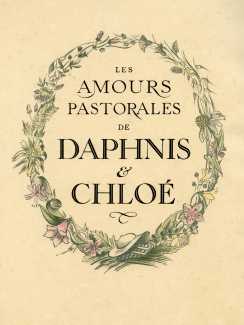
 Set on the island of Lesbos during the second century, Les amours pastorales de Daphnis et Chloé (The Pastoral Love of Daphnis and Chloe) is a remarkably modern tale, its main characters, the boy Daphnis and the girl Chloe learning the hard way about the rocky road from childhood innocence to adult relationship. Both children are left alone in the countryside at birth, along with tokens identifying who they are. A goatherd named Lamon discovers Daphnis, and a shepherd called Dryas finds Chloe; each decides to raise the child he finds as his own. Daphnis and Chloe grow up together, herding the flocks for their foster parents. They fall in love but, being naive, do not understand what is happening to them. Philetas, a wise old cowherd, explains to them what love is and tells them that the only cure is kissing. Shortly afterwards Lycaenion, a woman from the city, educates Daphnis in love-making, but Daphnis chooses not to test his newly-acquired skill on Chloe because Lycaenion tells Daphnis that Chloe will scream and lie bleeding. Meanwhile Chloe is courted by suitors, two of whom attempt with varying degrees of success to abduct her. After several more adventures Daphnis and Chloe are recognised by their birth parents, get married, and live happily ever after.
The story of the two innocent young lovers was an obvious subject for Bécat’s trademark engravings, and he was commissioned by Maurice Vasseur of the Paris art publishing house Le Vasseur to produce plates for this edition, which are beautifully reproduced with subtle additions of colour to help bring life to the narrative. This translation of the original text by the enigmatic Greek poet Longus is by Jacques Amyot and Paul-Louis Courier.
The Bécat-illustrated Daphnis et Chloé was published by Le Vasseur et Cie in a limited, numbered and boxed edition of 425 copies.