 François Villon (1431–63) is the best-known French poet of the late middle ages. A vagabond and petty criminal who spent time in prison and came close to the gallows, Villon wrote about these experiences in his poems.
Villon was a great poetic innovator; he understood perfectly the medieval courtly ideal, but often chose to write against the grain, reversing the values and celebrating low-lifes destined for the gallows, falling happily into parody or lewd jokes, constantly innovating in his diction and vocabulary; a few poems make extensive use of Parisian thieves’ slang. Villon’s verse is mostly about his own life, a record of poverty, trouble, and trial which was shared by his intended audience. His poems are sprinkled with mysteries and hidden jokes, peppered with the slang of the time and the underworld subculture in which Villon moved.
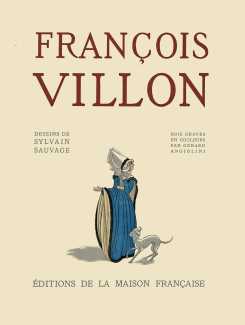
This edition of Villon’s poems was Sylvain Sauvage’s last book commission, and the way the title page describes the illustrations as ‘Dessins de Sylvain Sauvage; bois gravés en couleurs par Gérard Angiolini’ suggests that Sauvage’s contribution may have been confined to the original drawings, with Angiolini responsible for cutting the blocks.. The illustrations reflect Villon’s life in Parisian bars, brothels and jails, then rising above the everyday world in his muse and returning to contemplate the gallows. From the standpoint of the erotic, the illustrations imagine medieval Frenchwomen free with their bosomly favours, but the most important aspects of these engravings are concerned with Villon’s emphasis on matters of life and death. This edition contains Villon’s best-known works, Les Lais (The Lays) and Le Testament (The Testament), together with a selection of shorter poems and an introduction by the medievalist Albert Pauphilet.
If you would like to read François Villon’s poems in English translation, the best of many versions is David Georgi’s 2013 Poems of François Villon from Northwestern University Press, which includes Villon’s original French printed opposite the English. Notes in the back provide a wealth of information about Villon, the poems, and medieval Paris.
This edition of Villon was published by Éditions de la Maison Française, Paris, in a limited numbered edition of 800 copies.