Around the mid-1980s Marco Silombria shifted decisively from commercial work to fine art, developing what is best described as a homoerotic pop-classicist style. Silombria’s characteristic subject became the male nude, often athletic, youthful and idealised, treated with celebratory sensuality. Mythological figures such as Eros, Dionysus, centaurs and Saint Sebastian recur; classical antiquity provided both aesthetic legitimacy and a coded historical lineage for same-sex desire. In works like his ‘Dionysian’ compositions, dancing nude men evoke ritual ecstasy, physical pleasure and communal erotic energy, while their black-figure silhouettes deliberately echo Greek ceramics. Unlike much mid-century homoerotic art, Silombria’s is openly joyful. He presents the male body as playful, radiant and desired, fusing advertising brightness with political affirmation.
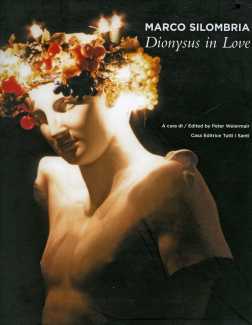 In 2002 his friend Peter Weiermair put together an illustrated book celebrating Silombria’s work entitled Dionysus in Love – hence the title of this portfolio. We show here Marco Silombria’s work in roughly chronological order, including drawings, paintings, mixed media works and ceramics. The book includes an extended introduction, in both Italian and English; the paragraphs relating to the Dionysian elements of Silombria’s work are reproduced here:
Dionysus is the god of ecstasy, of orgiastic, promiscuous sexuality. In the pre-AIDS age, he was the god of the hour. Love, on the other hand, stands for erotic, sexual, often unfulfilled desire, and stands in opposition to Dionysus. Silombria celebrates his admiration for his own gender against the background of a classical, Western tradition in which Greek and Roman culture, with its openly experienced pagan sexuality, occupies a very important place. He does not recognise the Judeo-Christian concept of guilt that overshadows all sexuality, regardless of its orientation, but instead makes use of a form of visual expression which Susan Sontag would refer to as ‘camp’ in celebrating beauty and desire. Only rarely, and then very discreetly, is the sexual act itself made the subject.
Silombria creates rather more metaphorical links between different levels of imagery and meaning, such as that between oral pleasure, ‘nature’ as Silombria often refers to it, and the realm of male sexuality. The viewer establishes associative connections between the different areas. The catalogue of strategies he employs ranges from travesties on masterpieces of late nineteenth-century erotic art, usually scandalous works by such artists as Courbet, Manet, Goya, and Ingres, to prototypes of glass condoms in appealing fish shapes or as sailor’s suits, clocks with hands formed by stately penises driven by the motor of desire, or neon arrows that illuminate Saint Sebastian and appear to highlight rather than pierce his masculine body. The book could just as well be entitled Dionysus Laughs, for we are constantly confronted with Silombria’s humour, which of course presupposes prior knowledge of the meaning of the visual elements he uses in his art. It is by no means a lascivious kind of visual humour but rather one that is always sensual and always suggests enjoyment of pleasure and its presentation.
Silombria hails from the French corner of ltaly and is familiar with that tradition. Apart from the Greek youths inscribed on vases and the slim, silhouette-like servants, flutists, and dancers, Silombria tends in his art to emphasise the ideal male image of a powerful, muscular prototype with a well-proportioned penis. The combination of vegetable nature with attributes of secondary sexual features is found throughout his oeuvre. Figures such as the faun or Pan allude to the corresponding mythological interpretations. Dionysus appears with an apron of foliage around his loins and a wreath of leaves pressed onto his forehead; in a detail his penis aggressively penetrates the wreath and is presented like a rare and luscious fruit.
Dionysus in Love was published in 2002 by Casa Editrice Tutti i Santi.