In her obituary of Árpád Elfer, his colleague Marie-Jaqueline Lancaster recalls ‘Perhaps my most typical memory of Árpád is when I took my then managing director at the British Printing Corporation to discuss a television project with him at the BBC. We were ushered into his office to find him ‘by chance’ putting the finishing touches to an illustration for the French magazine Lui. It was of a reclining nude in outline with a neat triangle of carefully arranged type forming her pubic area. It was both attractive and erotic, without being in the least pornographic.’
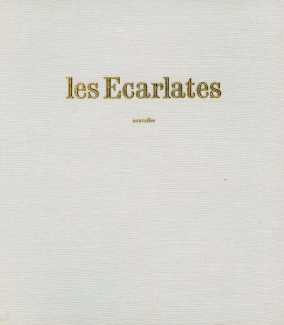 This is a fascinating memory which illuminates what is believed to be Elfer’s only foray into a full book illustration portfolio, this collection of stories, Les écarlates (The Scarlet Ones), for which he produced fifteen highly accomplished photorealistic monochrome drawings. The collection consists of eight short stories, erotic, charged and darkly atmospheric, evoking an ‘angel of desire’ seeking its way toward light through obscure paths of pleasure. The heroines of these ‘scarlet nights’ – Anne, Catherine, Hilda, Monique, Isabelle, Sylvia and Gisela – find themselves prisoners of an impossible quest, accepting absolute submission in the hope of some ultimate reward. The book has been compared to Barbey d’Aurevilly's famous collection Les diaboliques, situating it within a tradition of dark, decadent French erotic fiction.
If Elfer is the illustrator, who then is the author of Les écarlates?
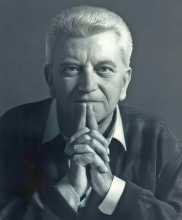
The preface to the book is written by the well-known journalist and author Louis Pauwels (1920–97), who wrote regularly for many monthly literary French magazines, including Esprit and Variété, throughout the late 1940s and 1950s. In 1954 he became literary director of Bibliothèque Mondiale (World Library), and in 1960 wrote his best known book, Le matin des magiciens (The Dawn of Magic), followed in 1970 by L’homme éternel (The Eternal Man). He founded the bi-monthly magazine Planète in October 1961, which appeared until May 1968. Pauwels wrote numerous articles for Le Journal du Dimanche from 1975 to 1976, and from 1977 directed the cultural services of Le Figaro, where he established Le Figaro Magazine, launched in October 1978.
Les écarlates thus appeared at the height of Pauwels’ book output, and the preface provides some intriguing clues as to its ‘anonymous’ author. Here are the most interesting extracts from Pauwels’ introduction:
It so happens that I knew Baron Georges Juan Muntaner Heycken – half-Spanish, half-Flemish – well. He was born, like me, under the sign of Leo, and in the same year, 1920. More than astrological kinship, there was a generational kinship between us. Twenty years old in 1940, we were all nailed to the crossroads of two worlds. All uprooted, cut off from our fathers. Youth lost. The past swallowed up and the future blocked. Starved, breathing the stench of fire and blood, searching for a god in no man’s land, ascetics by force, mystics by despair, religious without dogma, without earth or heaven, children of cellars, sons of occultation and ruins, reaping in middle age the fruits of a youth lived in uncertain catacombs. Refined, certainly, but poisonous.
And now Juan Muntaner has just died, quite suddenly. A report in La Flandre Libérale states that he fell, struck down, while crossing the famous hollow square of Siena. I imagine him, elegant, tall, and slender, lying in the centre of this basin of pinkish ochre. Three days earlier, a messenger had delivered to my office a manuscript, signed: G.M.H., accompanied by the following letter:
Dear Friend,
The doors open from the inside: one must efface oneself to pass through. For some time now I have been converted. Converted to an indifference, sometimes angry, sometimes sullen, towards myself. Converted to the shame of my night. When I get up early, which happens often now, I see the day dawn, so thin, so delicate, and so suddenly powerful, I suffer beyond words. And I get up. I wind my alarm clock. I put on my hair shirt. I can tell you nothing. My heart is beating me up. It’s the first time it’s done anything to me.
Georges.
P.S. Sex may be a key, but sexual obsession is a wall.
P.P.S. Publish this. I must be rejected. Not forgotten, rejected. As for the collection of stories, do as you please. One piece of advice – get drunk and write. Don’t reread it, and have no regrets. Cheers. I drink. I need a lot, because I am Flemish. I have bequeathed to museums and almshouses a very rich collection of Renaissance religious paintings. Each frame has a hinge and a secret lock, made by a Chinese cabinetmaker in London, who will not speak, for excellent reasons. Behind these Virgins, these Descents from the Cross, these Saint John the Baptists, and these Magdalenes, are forever affixed the most scandalous and marvellous erotic engravings of the Orient. That’s it. Let others sort it out! And let the restless and ardent soul of my poor friend find its way through space and time.
Given Pauwels’ identification with ‘Baron Georges Juan Muntaner Heycken’, it is very tempting to believe that he is offering the reader a massive clue that he himself is the true author of Les écarlates.
Les écarlates was published in Paris by the Cercle du Livre Précieux, in a limited numbered edition of 3,000 copies. The book was reprinted in 1980 by Librairie des Champs-Élysées, and again in 1985 by Le Pré aux Clercs. Two stories from Les écarlates were included in a 1955 English-language edition of The Image, a highly acclaimed French erotic novel by Catherine Robbe-Grillet under the pseudonym Jean de Berg.