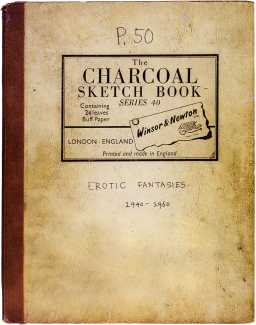
 When Keith Vaughan died in 1977, he left an enormous archive of sketchbooks and diaries, including an album into which he had pasted a collection of homoerotic drawings and sketches. Over the course of several years, Patrick Woodcock, one of Vaughan’s executors, and art historian Gerard Hastings explored the history of Erotic Fantasies, how it fitted with Vaughan’s extensive journals, and worked out how best to conserve and present the collection. The result is Awkward Artefacts: The ‘Erotic Fantasies’ of Keith Vaughan, a fascinating study of the artist’s complex relationship between life and art. The story of these images is a reminder of how painfully separate Vaughan kept his private and public lives.
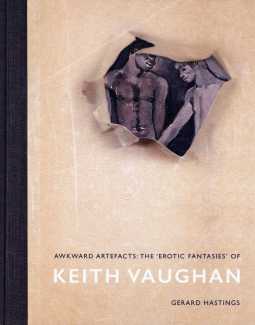 For anyone interested in the history of homosexuality and art in England in the mid-twentieth century, Awkward Artefacts makes for fascinating and essential reading. Copies of the book can be obtained from the Keith Vaughan Society by following this link.
The book opens with a foreword by the psychoanalyst Estela Welldon, where she writes:
Vaughan's Erotic Fantasies are presented here for the first time, and with close reference to his diary notes. Looking and reading both opens up our perception of his deep depression and his dread at facing a black hole of appalling emptiness. What, on the surface, appears to be of an extreme erotic nature is actually what I call a ‘survival mini-kit’. Sharing images of risqué sexual activities can easily evoke confusion. Sometimes, sadly, we respond to such intensity with anxious or judgmental laughter, in an attempt to disassociate ourselves from an experience that we find unsettling and stressful. Vaughan bravely wrote in his journal ‘Shame I still have & a feeling of nausea for much of my past living but I will not let it prevent my writing these things. Sex has been paramount in my life & my biography must necessarily appear obsessed with this subject because it has been, & still is, an obsession with me.’
Some practices are accepted later, once societal and cultural norms change and develop, and of course this was true of the concept of homosexuality, which was only decriminalised just over fifty years ago. The intense depression and the ‘nothingness’ that Vaughan was experiencing when he wrote the following words, makes less surprising his later suicide – ‘I get further outside things & more deeply lost. The burden of isolation & aloneness becomes intolerable. Now everything is finished – I am waiting for the exhibition to start & I feel only a great disinterest in every thing I have done & a deep distaste to start anything else.’
Vaughan’s erotic paintings represent an obvious manifestation of a dark but simultaneously vibrant and living side of his personality.