
The absent image: where has lesbian intimacy gone?
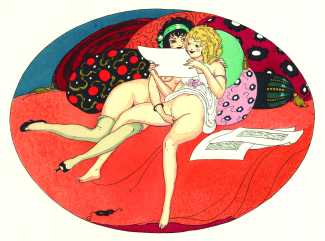
In 1925 the Danish artist Gerda Wegener, now living in Paris, created a series of twelve coloured pochoir plates titled Les délassements de l’Éros (The Amusements of Eros), created in collaboration with Louis Perceau, a French poet and connoisseur of erotica. The plates depict women in close, exciting relationships, clearly enjoying their shared intimacy. As Gerda Wegener wrote a few years later, ‘Women must unleash their womanly instincts and qualities, enjoy their feminine charms, and win the competition with men by virtue of their womanliness, never by trying to imitate them’.
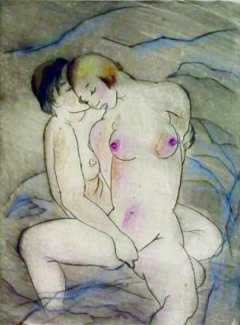
A year later, in 1926, the Viennese-born artist Mariette Lydis produced a body of work that remains, a century later, almost without parallel. Her Lesbiennes series – elegant, tender watercolours and drawings depicting women in intimate erotic relationships – combined technical accomplishment with genuine feeling. The women in her images are not performing for a male viewer. They are absorbed in each other, rendered with warmth and specificity that makes the intimacy feel lived rather than imagined. They are, in short, believable.
A hundred years on, with lesbian identity more publicly visible than at any point in history, one might expect the tradition that Wegener and Lydis established to have flourished. It has not. The serious, sustained, fine-art depiction of lesbian intimacy – work comparable in quality and emotional directness to what Keith Vaughan or Ernst Hildebrand achieved for gay male sexuality – remains remarkably rare. The question of why this should be is more complicated than it first appears.
The economic argument
The most obvious historical explanation is economic. The art market through most of the twentieth century was controlled by male dealers, male collectors, and male institutional gatekeepers. Women artists who wanted careers made pragmatic choices about subject matter. Explicit lesbian content was not merely unfashionable – it was professionally dangerous. Wegener and Lydis circumvented this by working in the private publishing economy of limited-edition illustrated books, a parallel world with different rules and a discreet, wealthy clientele. The constraint was real, and it shaped what was made and what survived.
But this explanation becomes less convincing as we move toward the present. The institutional art world of the twenty-first century actively celebrates queer identity. Gallery representation, critical attention, and museum retrospectives have all followed. The economic barriers that once operated so powerfully have substantially dissolved. And yet the work we might expect to follow – serious, intimate, technically accomplished depictions of lesbian desire – has not appeared in any quantity. Something else must be at work.
Contaminated territory
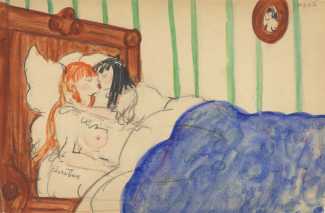
A second, deeper obstacle is the long history of lesbian imagery as male fantasy. From eighteenth-century French libertine prints onwards, images of women in intimate settings have been produced primarily by men, for men, as a subcategory of heterosexual pornography. It may have been dressed as ‘literary’ – every illustrator worth their salt was commissioned to illustrate Pierre Louÿs’ sapphic Songs of Bilitis in the 1920s and 30s – but it was still primarily destined for a male audience. This history has contaminated the territory in a specific way: to depict lesbian sexuality is to risk being consumed by the very voyeuristic apparatus one might wish to escape. For women artists with genuine personal investment in the subject, the awareness of how such work would be received – by whom, and in what spirit – has exercised a real inhibiting force.
The response of many feminist and queer artists from the 1970s onwards was not to reclaim the erotic image but to deconstruct it – to interrogate the gaze rather than paint real believable women touching each other. This was intellectually serious and politically motivated, but it left a gap. The tradition of direct, warm, technically accomplished erotic art was abandoned, not because it was exhausted but because it became theoretically suspect.
Identity as brand
Contemporary art culture celebrates queer identity enthusiastically, but more as concept, as politics, as position. What it rewards less readily is queer feeling, the private, specific, vulnerable depiction of actual desire. There is a strange prudishness at the heart of much queer art, which prefers transgression to tenderness and statement to intimacy. The result is that while lesbian identity is highly visible in contemporary art, lesbian desire rendered with directness and emotion is largely absent.
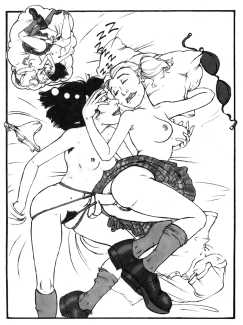
There are exceptions, but they are few and far between. Jennifer Finch’s 1997 The Adventures of a Lesbian College School Girl is a witty and believable story of lesbian desire, and uses the comic book tradition to explore the subject. Kersten Drechsel’s 1999 In Wärmeland (In Hot Country) the lovers act out a lesbian encounter which successfully manages to combine voyeurism with a sense of real-world desire. And in 2007 Colleen Coover again used the comic book format to explore real-world lesbian relationships in Small Favors, ‘a girly porno comic for adults’.
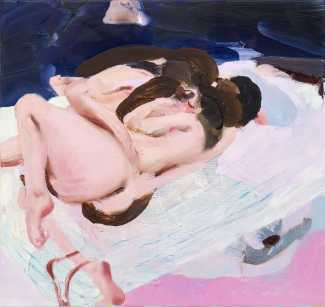
Figurative women artists have touched on the subject too. Ambera Wellmann’s visceral entangled bodies, Polly Nor’s witty temptations series, Anne van der Linden’s disturbing fantasies, Jacqueline Secor’s beautiful vulva studies, Lisa Yuskavage’s charged female pairings – these artists gesture toward the Wegener/Lydis tradition, but they remain exceptions.
Private portfolios
The history of erotic art is substantially a history of private work. Picasso’s explicitly sexual prints circulated very narrowly in his lifetime, Rodin’s watercolours of lesbian couples remained hidden for decades, Keith Vaughan’s most tender and explicit sketchbooks only became fully visible after his death, and they reveal an emotional register quite different from his exhibited paintings. It is entirely plausible, perhaps probable, that equivalent work exists in the studios and on the hard drives of living women artists, and that we simply will not know for twenty or thirty years.
The digital age complicates this in a new way. Vaughan could keep his sketchbooks private with reasonable confidence. Now the infrastructure for sharing exists constantly, but so does the knowledge that nothing, once shared, stays private. This may create a different kind of inhibition, not institutional pressure but the awareness of permanent exposure, of work intended for private circulation being taken out of context, misread or weaponised.
The censorship paradox
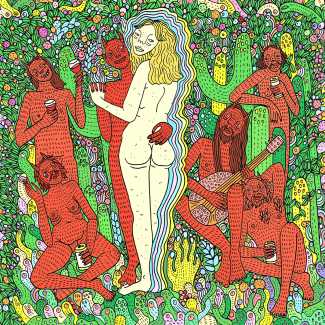
A final, cruder barrier has emerged in the social media era. A woman artist today with Wegener’s or Lydis’s gifts has unprecedented means of reaching an audience directly, without dealers or gatekeepers. But the platforms through which she would naturally build that audience, Instagram above all, apply content policies that make no distinction between exploitation and art, between pornography and the tender, serious erotic work we are describing. The female nipple alone is sufficient to trigger removal. The Wegener and Lydis prints would be censored and banned.
The effect is not only on distribution but on what gets created. Artists optimise for the platforms they inhabit. Work that cannot be shown where one’s audience lives faces a disincentive that operates long before any art is created. And this censorship falls unevenly: the male gaze tradition has always found alternative channels, institutional protections and sympathetic collectors. Serious erotic work by women, for women, occupies an awkward middle ground – too artistic for adult platforms, too sexually direct for mainstream ones.
Where the tradition survives
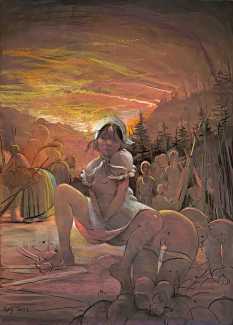
Yet the tradition has not entirely disappeared. It survives in the illustrated book world, in small print editions, on subscription platforms like Patreon where the audience is self-selecting and the relationship between artist and viewer is managed with some care. And of course you can see what imaginative and ground-breaking lesbian art there is in an uncensored online resource like honesterotica.
What all of these contexts share is a degree of protection from the mechanisms – institutional, critical, biased, misogynistic, embarrassed, algorithmic, censored, deleted – that have suppressed the tradition in mainstream art culture. Wegener and Lydis understood this instinctively, which is why they followed the route of the limited private edition and the discreet subscriber, the work reaching its audience directly without the intervention of gatekeepers who would misread or suppress it.
A century later that solution looks less like a historical curiosity and more like a model whose time has come. The audience for this work – women who want to see believable, beautiful, emotionally serious depictions of lesbian intimacy – is real, substantial, and largely unserved. The artists capable of serving it almost certainly exist. The gap between them and their audience remains, for now, one of the most interesting challenges in this corner of art history.