 Jean de La Fontaine (1621–95) was born in the Champagne region into a bourgeois family. There in 1647 he married an heiress, Marie Héricart, but they separated in 1658. From 1652 to 1671 he held office as an inspector of forests and waterways, an office inherited from his father. It was in Paris, however, that he made his most important contacts and spent his most productive years as a writer. An outstanding feature of his existence was his ability to attract the good will of patrons prepared to relieve him of the responsibility of providing for his livelihood. In 1657 he became one of the protégés of Nicolas Fouquet, the wealthy superintendent of finance. From 1664 to 1672 he served as gentleman-in-waiting to the dowager duchess of Orléans at the Palais du Luxembourg. For twenty years, from 1673, he was a member of the household of Madame de La Sablière, whose salon was a celebrated meeting place of scholars, philosophers, and writers. In 1683 he was elected to the French Academy after some opposition by the king to his unconventional and irreligious character.
La Fontaine is best known for his Fables (Fables) and Contes (Tales). The first of his Contes et nouvelles en vers (Tales and Novels in Verse) was published in 1664, the last posthumously. He borrowed them mostly from Italian sources, in particular Giovanni Boccaccio. The essence of nearly all his tales lies in their licentiousness, which is not presented with frank Rabelaisian verve but is thinly and flippantly disguised.
The most famous of La Fontaine’s narratives combine wit, erotic suggestion and elegant narrative economy. They include Les amours de Psyché et de Cupidon, an extended and refined adaptation of the classical myth, showing La Fontaine at his most literary. However, his reputation largely rests on shorter, more risqué narratives drawn from Italian and French sources. Notable among these is Le cocu battu et content (The Beaten and Contented Cuckold), a sharply comic tale of marital deception; Le tableau, famous for its playful obscenity and ironic twist; and La courtisane amoureuse, which explores the entanglements of love and commerce. Le diable de Papefiguière stands out for its anticlerical humour, while La servante justifiée offers a typically light-handed treatment of sexual intrigue and mistaken identity.
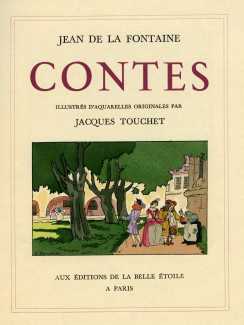
Of all Jacques Touchet’s illustration commissions, his La Fontaine illustrations stand out as masterpieces of miniature composition. His ability to portray the central theme and characters of a story in one image is remarkable, adding skilled stencilled colouring to deceptively simple line drawings.
The Touchet-illustrated Contes de Jean de La Fontaine was published by Éditions de la Belle Étoile in a limited numbered edition of 1,250 copies.