Few subjects appear more persistently in the work of Joaquín Sorolla y Bastida than unclothed children on the beaches of Mediterranean Spain. For Sorolla, these figures were vehicles for his central obsession, the effect of Mediterranean light on skin, water and wet sand. The children’s naked bodies allowed him to study the direct interaction of sun on flesh, and to render shadows and reflections with his characteristic rapid brushwork.
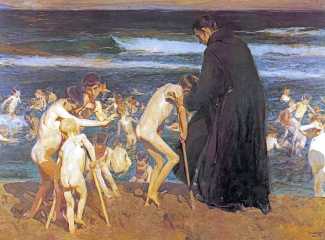
The most celebrated and complex of these works is ¡Triste Herencia! (Sad Inheritance!), painted in 1899. It depicts a group of disabled children bathing naked, assisted by a robed Brother of Saint John of God on Valencia’s Malvarrosa beach. The title implies that the children’s disabilities were attributable to their parents’ sexually transmitted diseases or to alcoholism. The emaciated, distorted bodies look painfully exposed, and here nakedness registers as poignant rather than as a sign of uninhibited joy, a marked departure from Sorolla's sunlit beach idylls. The painting won the Grand Prix at the Paris Exposition Universelle of 1900, confirming that Sorolla’s contemporaries received these images without any moral unease.
That reception makes complete sense in context. Childhood nudity at the beach was entirely unremarkable in late nineteenth-century Spain – the fact that children bathed naked was completely normal at a time before swimming costumes were common. Academic and impressionist painting at the time routinely depicted unclothed children in pastoral or coastal settings, treating them as natural subjects within a classical tradition. Modern viewers inevitably approach such images with different assumptions about privacy, childhood and representation than those that prevailed a century ago. Sorolla’s beach scenes illustrate how works of art can move between cultural frameworks over time – what he painted as natural glimpses of childhood and seaside life now also invites reflection on the changing boundaries between innocence, artistic representation, and contemporary concerns about the depiction of children.