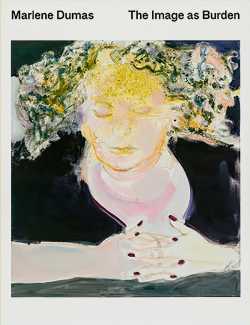
 The Image as Burden, the 2014 Marlene Dumas exhibition organised by the Stedelijk Museum in Amsterdam, travelling to the Tate Modern in London and the Fondation Beyeler in Basel, was accompanied by a substantial book with the same title. In addition to a chronological and highly illustrated history of the development of Dumas’ work, it includes an insightful discussion between Dumas and art historian Theodora Vischer, extracts from which you can read below.
Dumas rarely starts from a blank canvas – nearly every painting is based on photographs torn from magazines, stills from films, press pictures of war and grief and desire, polaroids of friends, medical illustrations, pornographic prints, and memories of paintings by Rembrandt, Holbein, Courbet and Caravaggio. She calls this the ‘saturated image,’ and it is the central principle of her practice – images are never neutral, never new, always already layered with meaning and use and history.
Here we show Dumas’ work in roughly chronological order. Her earliest work, made during and after her studies in Cape Town in the early 1970s, was primarily on paper – drawings, collages, and prints. Her first solo exhibition of paintings came in 1985, and by the late 1980s she had developed the formal approach that would define her mature work: isolated figures against flat, ambiguous backgrounds, leaving the viewer nowhere to stand except directly in front of a face or a body.
Through the 1990s she turned increasingly to erotic and sexual subject matter, working at the intersection of desire and power. Her Porno series assembled a compendium of spread-legged female figures drawn from across the Western tradition, from Courbet’s L’origine du monde through nineteenth-century erotic photography to contemporary pornographic magazines. The Magdalena series from the mid-1990s, shown at the Venice Biennale, presented tall, narrow canvases of naked women inspired by the figure of Mary Magdalene – simultaneously saint, penitent and sexual object.
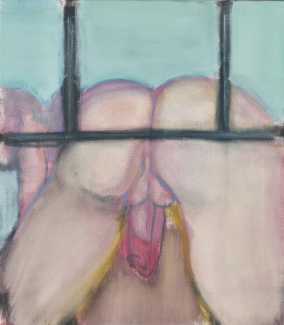
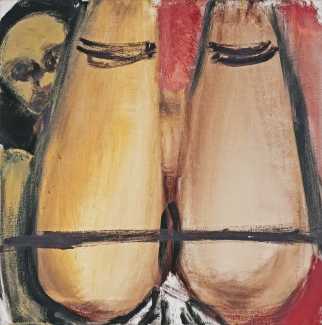
Dumas’ engagement with explicitly sexual subject matter is inseparable from her broader exploration of how images are made and received. Works such as All the Way and Both Sides (2001) present the genitals with an unflinching frontality that belongs to neither pornography nor clinical illustration – the paint is uncertain, layered with hesitation and reworking. In Both Sides, the visual ambiguity between face and groin – forms with closed lids that read simultaneously as eyes and labia – collapses the conventional distinction between the artistic and the sexual. The body does not present itself for consumption – it simply, stubbornly, is.
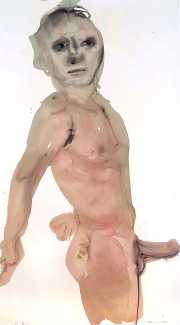
The explicitly sexual works also carry a persistent awareness of their artistic tradition. Primitive (1982, the fourth image in our gallery), one of Dumas’ early mixed-media pieces, places the body within a tradition of primitivism, tribal form, and western erotic projection. Her later X-Plicit extends this critical self-awareness into the representation of male sexuality – a slight, female-featured figure with an erect penis confronts the viewer with a directness that is at once matter-of-fact and profoundly disquieting. The title’s deliberate mis-spelling is typical of Dumas’ characteristic irony.
What unifies Marlene Dumas’ long and extensive body of work is an insistence that painting neither documents nor illustrates but transforms – there is something irreducible in the physical encounter between painter and image, something that neither photography nor language can replicate. Dumas has always worked against simplification, against the idea that great art must be morally clean, politically correct, or aesthetically comfortable. Paint, she insists, is a dirty business – and that is precisely where its power lies.
Extracts from the discussion between Dumas and Theodora Vischer, from The Image as Burden, Distributed Art Publishers, 2014.
You are sometimes quoted as having said that South Africa gave you content and Europe gave you form. Put like that it sounds a bit simple. Would you say exactly the same today?
I said that because my years at art school in Cape Town in the early seventies were very intense but also very enlightening. I learned so many things I knew nothing about. I filled notebooks with all kinds of definitions of art, by Carl Andre and all the others whose works I had not yet seen in real life, or definitions of what is beauty. You know, people always thought that South Africa and apartheid were the things that influenced me most, but what I kept on trying to make clear was that, besides coming from South Africa with its apartheid regime, I learned so many other things. I hadn’t produced any proper artworks yet, but I’d thought and learnt a lot about painting and art in general. What I’m trying to say is that I had already developed a sense for the problems in art back then in South Africa, but more on a theoretical level. It was only when I came to Europe, to Amsterdam, that I began – very slowly – to explore these ideas for my own art and to transform them into concrete works.
But that’s not the whole truth. The older one gets, the more you can turn almost everything around and look at it from a different angle. Take the big heads I made, especially the drawings, for example, the Models, the Rejects, the Jesus Serene series. Although the faces are individual and you can see that they are all different from one another, they all look a bit like masks. I’ve always loved African masks, in fact, the whole tradition in Africa, the fertility goddesses, the ancestors, all those figures that ward off evil. This same intriguing quality you find in South America where you have these sculptures of babies that look much more aggressive than their Western counterparts where all the babies are pretty. Some of my interests certainly originate from this perspective. However, it was not my intention to refer directly to African figures; in that sense I never wanted to be like Picasso and all those other guys. But I was certainly very fascinated by them.
Could you give an example of what you mean by that, how one could picture it?
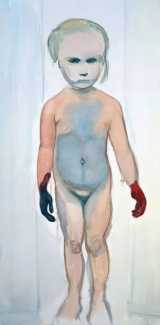
Take, for example, The Painter, a painting I made in 1994. What makes this painting so interesting is that it has to do with what I was saying about African sculptures. It’s a white girl, if you think racially, but as a figure it also has something of the feeling or expression of those statues and sculptures. Another thing about the painting is that the head is a bit greenish. It is also very important that the colours range between warm and cold, not too cold, not too hot.
It’s certainly not sweet.
True, if it was too sweet I think it wouldn’t be that interesting, but neither is it a monster.
You see a child with its hands and belly covered in colour, but it is actually much more. It’s a reflective painting which makes one think about what painting really means.
I have so many pictures of my daughter Helena, all kinds of pictures, and many of them are really lovely. I have also seen that it’s quite normal for children to use their hands as brushes and dip them in paint. But there was also so much symbolism in her actions; she even painted a cross over her belly button. When I started on this work, I knew there was a painting in this image. Originally I painted the cross, too, but then I wiped it off again, that’s why she’s got this blue tummy. So again, there is this element of reacting to what you see, building on your mistakes. The painting was basically done in one night. Never wait for paint to dry! I was so scared to make too many wrong moves because sometimes you do something, by chance or it just happens, and you realise that it works, but it’s almost impossible to repeat, it just doesn’t work a second time.
Almost twenty years after you painted The Painter, you produced another painting of a painter, The Artist and His Model.
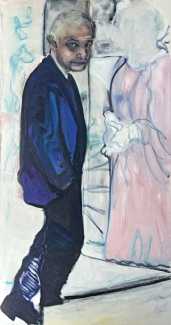
Yes, and there are important similarities between the two works. Both paintings include no instruments, like a brush or a camera, for the making of an artwork. Only the title refers to the act of painting. Just as The Painter was an important decision for my New York exhibition called Not From Here, so The Artist and His Model would not have come about without the context of the show Twice. I did not plan to use Luc as a model to make a portrait of an artist until I saw this photo of him with his painting of the Dutch queen in a magazine. This time it was important for me to have two figures in one frame. The exhibition Twice was starting to circle around things happening again, interactive nakedness and women with men. Now we have this male figure with the ghost-like presence of an older woman in the background. What can we make of it? Someone thought it was called The Artist and His Mother – why not?
Unlike The Painter, The Artist is dressed. I painted his suit with lavish quick marks and I liked the twist in his body that made him turn his head, facing the viewer as if we disturbed him. Then his face became a problem, I kept on changing it.
So maybe it was a problem initially, but it grew to become something very special. The painting’s focus is the face, the head. Here everything is drawn together and, at the same time it all flows into the picture from this midpoint. Our attention is relentlessly drawn to the face, only to be immediately thrown back or diverted again by its gaze. The figure as such has no real body, but the splendid blue suit lends it a strong presence that matches the head. The space around the figure is receded, yet without looking pale or flat. Instead, as you mentioned, it is more ghost-like in an overall tone of soft colours and hues. The model is not really a model posing for the artist; in the painting it has already become the image of a model. At the same time it’s just as near or distant as the space from which the Artist is looking out. The painting has strong pictorial power.