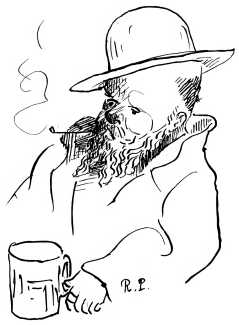
Raoul Ponchon (1848–1937) grew up in La Roche-sur-Yon (then called Napoléon-Vendée) in western France. He followed his father, a military officer, through various garrison towns before settling permanently in Paris, where he lived until his death at the Hôtel de Flandres in the rue Cujas near the Jardin de Luxembourg.
Ponchon was a thoroughgoing Bohemian, a fixture of Montmartre café life, and a friend of Paul Verlaine and Arthur Rimbaud. He was so important to Rimbaud that he was one of only seven known recipients of the first edition of Rimbaud’s 1873 self-published prose poem Une saison en enfer (A Season in Hell). Apollinaire called Ponchon ‘the last of our Bacchic poets, and one of our best, a little miracle of a lyric journalist who was perhaps the only French writer in whose talent appears no trace of foreign influence, and who has spent his life trying to do violence to himself in order to remain an insignificant poet,’ an ambition requiring, Apollinaire noted, both considerable talent and copious amounts of alcohol.
From 1887 to 1907 Ponchon published weekly poems in Le Courrier Français, then continued in Le Journal until 1913, commenting in verse on topical events including ministerial appointments, women's suffrage, and all the quotidian scandals of the Third Republic. His output ran to a remarkable 150,000 verses over thirty years. Despite this prodigious productivity, he was deeply reluctant to see his work collected in book form, considering himself unworthy of formal publication, and only one book appeared in his lifetime. He was nonetheless elected to the Académie Goncourt in 1924, widely understood as a way of providing him a pension, since by then he had stopped writing.
He died at the age of 88, having broken his femur getting out of bed one December morning, and was hospitalised at the Hôpital Saint-Joseph, where he died a few days later.
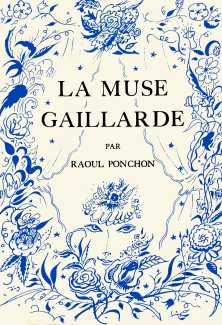 La muse gaillarde (The Lively Muse) was one of three posthumous collections drawn from Ponchon’s vast archive of verses, joining La muse au cabaret (The Muse at the Cabaret, 1920), La muse vagabonde (The Vagabond Muse, 1947), and La muse frondeuse (The Rebellious Muse, 1971). The title indicates exactly what to expect – poems celebrating wine, women, appetite, and the pleasures of the flesh.
For this collection Dignimont produced twelve full-page plates in colour, and 88 bandeaux – poem head vignettes – printed in blue-grey, of which we have included those for the poems about women and love. The two modes sit in pleasing counterpoint, the woodcut vignettes providing a jaunty, folk-art energy that captures the wit and lightness of the verse, while the colour plates offer something warmer and more painterly, the women rendered with Dignimont's characteristic mix of tenderness and frank appetite.
The Ponchon commission was completed at an interesting period in Dignimont’s career. He had married just weeks before the book went to press, and was beginning to turn his attention toward landscape painting and the countryside around Saint-Tropez and Poitou. La muse gaillarde is in many ways the culmination of his long engagement with the Parisian erotic illustrated book, the world of Gamiani and Nuits aux bouges, a world about to be overturned by the advent of war.
La muse gaillarde was published by Éditions Rieder, Paris, in a limited numbered edition of 2,100 copies.