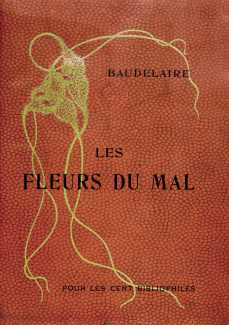
 The commission that secured Rassenfosse’s reputation came when he undertook a major contract with La Société des Cent Bibliophiles, a prestigious French bibliophile society founded in 1895, of which Eugène Rodrigues-Henriques was the president from 1896 until his death in 1928. This organisation was dedicated to the creation of luxurious editions, often illustrated by renowned contemporary artists. To illustrate Charles Baudelaire's renowned Les fleurs du mal (The Flowers of Evil), Rassenfosse created 170 colour etchings for an edition of 115 copies, and this edition is regarded as both the magnum opus of Rassenfosse’s career and one of the high points in the history of book illustration.
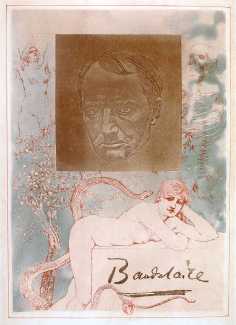 Rassenfosse printed the illustrations using the soft-ground etching and aquatint technique he had spent the previous decade perfecting, including the ‘Ropsenfosse’ process developed in collaboration with Félicien Rops, a method for transferring crayon-drawn marks onto the intaglio plate that gave the resulting lines their characteristic quality, looser and more spontaneous than conventional etching, closer in feel to drawing than to engraving. The colour is achieved through multiple plates printed in register, with aquatint washes creating the atmospheric backgrounds – warm ochre and sienna, cool grey-green, dusty rose, deep sepia – within which the etched figures are suspended. The headpiece illustrations, printed on the same page as the poem text, allow the ink of the letterpress to show faintly through the lighter areas of the plate, an effect that is not a technical deficiency but a deliberate integration of image and word.
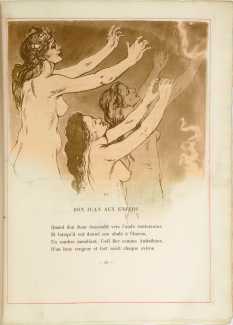
The range of treatments across the plates is striking. Rassenfosse moves without apparent strain between intimate psychological studies of individual women – pensive, absorbed, inward – and more complex symbolic compositions in which figures dissolve into landscape or are shadowed by death. Faces emerge from atmospheric washes of colour; skulls hover at the margins of portraits of the living. The macabre here is atmospheric rather than declarative; it does not announce itself but accumulates, working with suggestion and proximity rather than the theatrical allegory that characterised Rops. Elsewhere the bitter melancholy of spleen (an almost untranslatable French word suggesting despondency and existential despair) is interpreted with a slumped shoulder, a faraway look, the cold of a grey-green wash.
Other plates are openly lyrical – figures set against tropical skies, women with flowers in their hair, sensual reveries handled with a warmth and directness that Rops never attempted. Rassenfosse is alert to Baudelaire’s specific female types, the exotic muse, the indifferent beauty, the woman lost in reverie, each rendered with psychological insight; and he brings the same attentiveness to the sapphic register of ‘Lesbos’ and ‘Femmes damnées’, where his warmth removes the prurience without diluting the eroticism. A separate strand follows Baudelaire into the modern city – the tableaux parisiens – where the etched figures are crowds, beggars, the elderly, the marginal, observed with real sympathy. The result is an edition whose emotional range matches the poems, capable of tenderness and severity in equal measure.
In order to concentrate on Rassenfosse’s illustrations, the 170 etchings are shown here without the accompanying text; fortunately the Bibliothèque Nationale de France has digitised their copy, which is available to view online here, so you can see how the plates are integrated with the text, and how Rassenfosse interpreted each of Baudelaire’s poems.