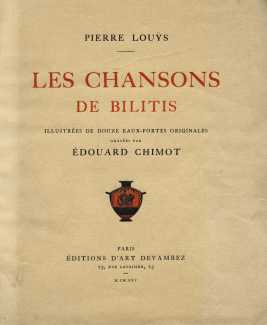
 Pierre Louÿs's Les chansons de Bilitis (The Songs of Bilitis, 1894), the prose-poem cycle masquerading as the translated work of a fictitious Hellenistic Greek poetess and divided into the pamphylian pastoral of Bilitis’s youth, the sapphic Élégies à Mytilène, and the Épigrammes dans l'île de Chypre of her courtesan years, was to become one of the most-illustrated French texts of the half-century after its appearance. The only serious illustrative engagement with the text before Chimot was the brilliant art deco Georges Barbier edition of 1922, which set the high-water mark for Bilitis as a fully realised livre d'artiste, and which you can see here. Chimot’s edition for Éditions d’Art Devambez, where he had become artistic director the previous year, was a very different interpretation – with the exception of the colour frontispiece, Chimot used monochrome aquatints to offer a darker and more psychological reading of the Louÿs text.
The strongest of Chimot’s plates are the darker, more fully-finished aquatints with burnished highlights, in which figures emerge from velvety backgrounds. This matches much of Louÿs’s text, which is nocturnal and intimate, set at festivals, in private chambers, and at the threshold of the tomb. Chimot’s nocturnes catch that mood even where they do not specifically illustrate any particular poem. A handful of these plates have genuine textual references – a funerary scene drawing on the Cypriot epitaphs at the close of the third book, a single figure whose bracelet and earring nod to her courtesan phase, an embrace anchored by a Greek vase.
The lighter drypoints and single-figure plates are less engaging, reading as studio studies onto which a vague hellenism has been projected. If they were not associated with the Louÿs text, many of these plates could illustrate any luxury erotica produced in interwar Paris. The standard Chimot woman, kohl-eyed, slender, modern, was already well established by 1925, and does the same work for Bilitis that she subsequently does for almost any commission Chimot undertakes.
The colour frontispiece is the single most ambitious plate in the portfolio, and the only one with an obvious narrative. Two women, one fair, with closed eyes, leaning against the dark-haired figure beside her, stand on a high ground above a Mediterranean horizon of cypresses and a distant temple, while at their feet a goat-legged satyr crouches, working at the trailing dark drape on which they stand. The composition reads as an emblem of Bilitis’s life as Louÿs constructs it – the pastoral, Pan-haunted pamphylian world being left below as the women ascend into the sapphic union of Mytilene. It is rare for Chimot to attempt this kind of iconographic work, and there is little to match it elsewhere in his output.
The Chimot-illustrated Les chansons de Bilitis was published by Éditions d’Art Devambez in a limited numbered edition of 536 copies.