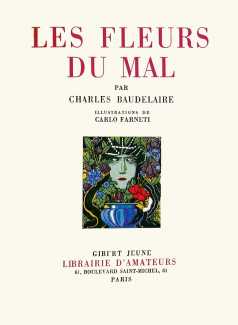
 The Farneti-illustrated edition of Charles Baudelaire’s Les fleurs du mal (The Flowers of Evil) occupies a position in the tradition of Baudelaire illustration that is quite unlike any other. Where most illustrated editions of the poems, such as the Lobel-Riche edition of a decade earlier, which you can see here, had approached the text through the French bibliophile tradition, Farneti brought to it the visual language of northern European expressionism. The affinities are with James Ensor and Edvard Munch rather than with Félicien Rops or Alméry Lobel-Riche – a flat, graphic colour palette, figures distorted towards caricature or hallucination, and a persistent collapse of the boundary between the erotic and the macabre.
Farneti’s visions appropriately mirror Baudelaire’s text – the skull-faced bride attended by owls, the naked women observed by a death’s-head cupid, the vampire-goddess enthroned against bat-wing rocks, the cherub astride a bleeding skull in a planetary void. These images do not choose between desire and death, but render them in the same tonal and compositional whole. Farneti understood, as few illustrators of the poems have, that the frisson Baudelaire sought was inseparable from the recognition of mortality, and that the erotic charge of the poems depends precisely on that inseparability.
The Parisian poems are handled with equal assurance. The plate for Les aveugles (The Blind Ones) depicts a city street with expressionist angularity, with elongated, blank-faced figures tilted towards an obliterating sun. Les hiboux (The Owls) translates the birds’ unblinking regard into a corridor of red-eyed surveillance that is both comic and unsettling. These are not decorative illustrations but interpretive acts, each plate arriving at a visual equivalent for the poem’s feeling rather than merely depicting its content.
The colour plates are pochoir, applied through hand-cut stencils, a technique whose chalky matte surface differs markedly from the inked warmth of etching. The flatness is deliberate – Farneti’s colour is applied in broad unmodulated areas that give the plates something of the quality of devotional images, an effect exploited most deliberately in the plate depicting a crowned and sword-pierced virgin, which reads simultaneously as Catholic icon and Baudelairean emblem of suffering beauty.
The Farneti-illustrated Les fleurs du mal was published by Gibert Jeune, Paris, in a limited numbered edition of 3000 copies.