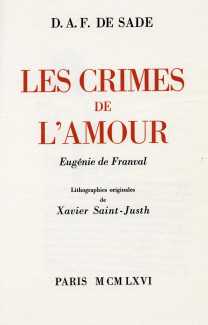
 The Marquis de Sade composed Les crimes de l’amour (The Crimes of Love) during his long incarceration in the Bastille between 1787 and 1788, though the collection was not published until 1800, after his release. It belongs to the strand of his work he was prepared to acknowledge under his own name: a sequence of nouvelles tragiques framed as moral tales in the manner of late eighteenth-century sentimental fiction, with the narrator repeatedly intervening to guide judgement and vice ostensibly punished. The moral framework, however, is a notably thin veneer. Eugénie de Franval, the most disturbing of the eleven tales, pushes its material to an extreme that strains, and arguably subverts, the moralising apparatus Sade pretends to invoke.
Franval, an aristocrat of cold intellect, sets about deliberately shaping his daughter Eugénie from infancy as the eventual object of his desire, isolating her from her mother, schooling her in his own libertine philosophy, and engineering her seduction with method rather than impulse. The tale closes with a characteristic moralising assertion, that crimes prepared in cold blood are the most monstrous because they unite passion with calculation. Yet the real narrative fascination lies in Franval’s pedagogical experiment – enlightenment reason turned into systematic corruption.
Saint-Justh’s drawings read this tension acutely, working in warm ochres, terracottas and corals set against cool grey-blues and dense blacks. The contrast performs much of the interpretive work – bodies are rendered in warm colours while judgement and authority remain cold, and transgression itself becomes the dark wash spreading across both.
 His treatment of Eugénie is an especially intelligent reading of Sade’s text. In two plates she appears multiplied, once as a triple portrait against a cool blue-grey ground, and once as three near-identical naked bodies graduated from cool ochre to hot terracotta. This is not merely decorative repetition. Sade’s Eugénie is a constructed subject, repeatedly remade by her father’s will, and Saint-Justh emphasises this by showing her again and again, youthful, vulnerable, and repeatedly invaded by sinister black adult figures.
The illustration sequence as a whole traces a remarkable stylistic arc, from the abstract opening plate, where flesh tones and black ink resolve gradually into the suggestion of an embrace, through the more decorously rendered images of Eugénie, and finally into the expressionist horror of the screaming old man embedded in the forest and the inverted female body beneath the standing male figure of the closing plate. There are traces of Egon Schiele in the auburn-haired ecstasy plate, and of Hans Bellmer’s psychological unease in the doubled compositions, though Saint-Justh remains cleaner and more overtly illustrative than either.
Saint-Justh’s achievement is to avoid both pornographic literalism and bibliophile prettiness, succeeding instead in illustrating the psychological tension at the heart of Sade’s profoundly transgressive text.
Les crimes de l’amour was published by Les Éditions d’Albusse in a limited, signed and boxed edition of 990 copies.