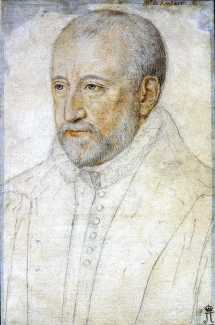
 Pierre de Ronsard (1524–85) stands at the centre of French renaissance poetry, and for generations was regarded as the greatest poet France had produced before the nineteenth century. Born into a minor noble family, he was originally intended for a courtly or diplomatic career. After serving as a page and travelling widely in his youth, a serious illness around 1540 left him partially deaf and turned him away from public life towards scholarship and literature. During the long convalescence that followed, he immersed himself in Greek and Latin poetry under the guidance of the scholar Jean Dorat, and became one of the leading figures of the group later known as La Pléiade. Together, these poets sought to transform French into a literary language capable of rivalling the achievements of classical antiquity and contemporary Italian poetry. Their ambition was not merely to imitate the ancients, but to absorb classical forms, mythology and rhetorical richness into a new vernacular literature.
Ronsard’s importance lies not only in the scale of his ambition but in the vitality of his poetry. He helped restore the alexandrine, the twelve-syllable line that would dominate French verse for centuries, to a place of central importance as a supple and expressive poetic form, capable alike of grandeur, tenderness and intimacy. His work ranges widely, from political discourses and hymns to nature poetry and elegies, but it is above all his love poetry that has secured his enduring reputation. Unlike some renaissance poets whose work now feels remote or overly decorative, Ronsard still conveys an immediacy of feeling, an intense responsiveness to beauty, desire, time and mortality. His poetry continually balances learned classical artifice with moments of startling directness and emotional sincerity, qualities that later writers from the Romantics onwards would rediscover and admire.
The various collections gathered under the title Les amours form the heart of Ronsard’s lyric achievement. Written across several decades and repeatedly revised during his lifetime, they are less a single unified sequence than an evolving exploration of love poetry itself. The earliest sonnets, addressed to Cassandre Salviati after Ronsard encountered her at a court ball at Blois in April 1545, are deeply indebted to the Italian Petrarchan tradition. These poems delight in elaborate imagery, mythological allusion and rhetorical brilliance, presenting love as both exaltation and torment. Yet even within their highly stylised framework, Ronsard brings an unusual sensual vividness to the beloved’s physical presence and to the emotional turbulence of desire. Beauty, nature, erotic longing and philosophical reflection are woven together so closely that they become inseparable themes within the poems.
The later poems addressed to Marie Dupin in the mid-1550s, and eventually the Sonnets pour Hélène of 1578, reveal a poet whose style has become freer, more flexible and more recognisably modern. The elevated classical diction of the early sonnets gives way to a more conversational voice, richer in colloquial expression and emotional nuance. Ronsard increasingly favours the alexandrine over the shorter decasyllabic line, helping shape the future rhythm of French poetry. Throughout these collections, however, love remains both a lived experience and a literary construction. Ronsard was constantly reworking, rearranging and republishing his poems across successive editions, transferring verses from one beloved to another as the occasion required, on the principle that poets were not bound by the factual obligations of historians. What matters in Les amours is therefore not autobiography in any strict sense, but the transformation of desire into art: the attempt to preserve fleeting beauty against time, ageing and death through the permanence of poetry.
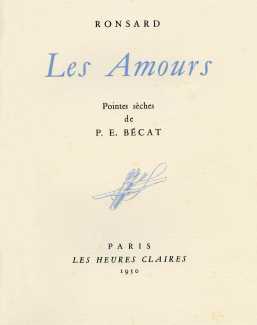 Bécat’s drypoints for this edition of Ronsard’s love poems (not to be confused with his plates for the Ovid collection with the same title published five years later) show him at the height of his technical skills, but rather lacking in originality. The frontispiece sets the scene, with the three beloveds – Cassandre, Marie and Hélène – crowning the poet’s bust. The recurring rose motif in many of the plates quietly carries the seize-the-day undercurrent that runs through Ronsard’s verses – the conviction, most famously voiced in his ode to Cassandre, that beauty, like the rose that blooms and fades in a single day, must be enjoyed before time takes it away. With the period detail – ruffs, pearls and Valois-court jewellery – Bécat depicts believable, real women, though in a timeless, sensual, lightly mythologised world. His interpretation is a respectful, somewhat conservative reading which feels appropriate for Ronsard’s verse, even if it rather underplays Ronsard’s franker erotic strain in the Sonnets pour Hélène.
The Bécat-illustrated Les amours was published by Les Heures Claires, Paris, in a limited, numbered and boxed edition of 310 copies.