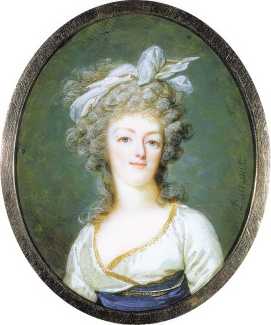
 In eighteenth-century Paris Marguerite Gourdan (1730–83), a merchant’s daughter from Béziers, ran the most exclusive brothel in pre-revolutionary France. She had already been to Paris in the company of a young officer who had abandoned her there, but on returning home in 1748 was married off to a captain called François-Didier Gourdan. The arrangement suited neither of them, and with his cheerful consent she returned to Paris. In 1759 she opened her first house in the rue Sainte-Anne, and a move four years later to the rue Comtesse-d’Artois gave her the lifelong sobriquet La Petite Comtesse, less for any aristocratic bearing than for the street name itself. Her real success came in 1774 when, fresh out of hospital after treatment for venereal disease, she went into partnership with Justine Pâris on the corner of the rue Saint-Sauveur and the rue des Deux-Portes. Behind a discreet antique shop a private staircase led to a richly appointed first floor, and within months Pâris was dead and Gourdan running alone what would become the most celebrated house of its kind in France.
Madame Gourdan drafted twenty articles of conduct for her girls, ran a network of women in private apartments, and circulated a famous set of instructions ‘pour une jeune personne qui veut faire fortune avec les charmes qu’elle a reçus de la nature’ (for a young woman who wants to make a fortune with the charms she has received from nature). The austerer climate of Louis XVI’s reign hurt the trade – she became bankrupt in May 1778, never quite recovered, and died in her own bedroom five years later.
The book that made her a literary as well as historical figure has, however, almost nothing to do with her. It first appeared in the year of her death as Le porte-feuille de Madame Gourdan, dite la Comtesse (The Portfolio of Madame Gourdan, Known as The Countess). It is most likely the work of the scandal-monger, blackmailer, and eventual master-spy Charles Théveneau de Morande, who turned out a steady stream of erotic-political pamphlets aimed at the French court.
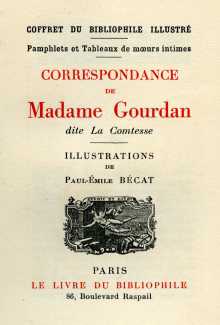 But that wasn’t the end of the story. In 1883 the bibliophile Octave Uzanne and the Brussels publisher Henry Kistemaeckers brought out a new edition, adding a study of eighteenth-century Parisian brothels, a description of Gourdan’s establishment, and a splendid mock funeral oration for Justine Pâris. In the early twentieth century the text passed from Uzanne to the Bibliothèque des Curieux, where Jean Hervez, the pen-name of the indefatigable Raoul Vèze, re-edited it in 1910 and again in 1924.
This Bécat-illustrated edition, issued by Le Livre du Bibliophile in pocket-size format, is a good example of the artist’s rapidly-executed pencil drawings with ochre crayon highlights, rather than his better-known etchings and drypoints. The freer style suits both the subject and the format well.
The Bécat-illustrated Correspondance de Madame Gourdan was published by Le Livre du Bibliophile, 86 Boulevard Raspail, Paris, in their pocket-sized ‘Coffret’ series.