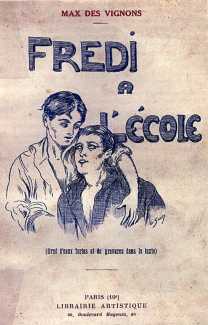
 The Fredi trilogy occupies a curious and revealing place within the history of French erotic publishing between the wars. Published by the Parisian house Librairie Artistique et Édition Parisienne réunies, the three novels – Fredi à l’école (Fredi at School), Fredi s'amuse (Fredi is Having Fun) and Fredi en ménage (Fredi Sets Up House) – present themselves not simply as libertine fiction but as a sustained narrative of homosexual formation. The books are framed in the pseudo-scientific language of ‘sexual inversion’ common to the period, contrasting Juvenal’s ideal of ‘a sound mind in a sound body’ with the notion of ‘a woman in a man’s body’. Yet beneath this medicalised rhetoric lies what is, structurally at least, a conventional bildungsroman – childhood, school, adolescence, emotional discovery and the search for domestic stability. What made the trilogy remarkable in the context of inexpensive popular fiction of the 1930s was not just its eroticism, but its refusal to punish or pathologise its protagonist in narrative terms. The concluding vision of a stable household shared by three men, tacitly accepted by Fredi’s mother, was exceptional for the period.
The author, writing under the pseudonym Max des Vignons, emerges as a highly adaptable specialist in clandestine erotic literature. Like many French erotic writers of the early twentieth century, he appears to have followed shifts in fashionable transgression with calculated flexibility. His bibliography includes flagellation narratives, lesbian fiction, libertine adventures, gender ambiguity and finally male homosexuality. Though guesses have been made, his true identity has never been established.
The Fredi novels belong to the last phase of this progression, alongside earlier works such as Arlette, petite garçonne and the Betty trilogy. Contemporary publicity presented the books as a ‘sincere and conscientious study of sexual inversion’, emphasising psychological observation as much as erotic content. The language is revealing – inversion is treated simultaneously as pathology, confession and identity. This mixture of voyeurism, medical curiosity and apparent sympathy was characteristic of much interwar homosexual literature aimed at a clandestine readership.
The trilogy also belongs to a distinct publishing milieu shaped by Paul Brenet’s interconnected erotic imprints. By the early 1920s these publishers had already developed a recognisable catalogue devoted to homosexuality, lesbianism and gender nonconformity, often advertised in quasi-documentary terms. Titles such as Féminisé and Amour inverti were marketed as truthful case histories exposing the psychology of the effeminate man. Within this context, Fredi appears less as an isolated curiosity than as part of a commercial enterprise that blended pornography, sexology and modern urban anxieties about gender and desire. The books were affordably priced and illustrated throughout by ‘Gaston Smit’, though as you will see from the accompanying portfolio the variation in drawing style and quality suggests the work of at least two Gaston Smits.
The trilogy’s titles deliberately echo the enormously successful Claudine novels associated with Colette and Henry Gauthier-Villars – Claudine à l’école (Claudine at School), Claudine à Paris (Claudine in Paris) and Claudine en ménage (Claudine Married). The parallel was almost certainly intentional. Like the Claudine books, the Fredi novels explore same-sex attachments and unconventional domestic arrangements while presenting them through the accessible format of serial popular fiction.
 The Fredi trilogy (in French of course) is available as an illustrated three-book boxed set, published by Question de Genre/GayKitschCamp, and with an introduction by Patrick Cardon. It can be bought from the GayKitschCamp website, which you will find here.