 Following Pierre Louÿs’ death in 1925, the management of his literary estate became entangled in an unusually complex legal and financial arrangement shaped by French inheritance law, family circumstance, and the clandestine nature of much of his unpublished work. Louÿs had formally married his lover Aline Steenackers only shortly before his death, an act which legitimised the three children already born of their long liaison – Gilles (1920), Suzanne (1923) and Claudine (1924). As his widow, Aline inherited the rights accorded to a surviving spouse, including a share of the royalties and the droit moral, the authority to control how his writings could be published, edited or adapted. The remainder of the estate belonged to the three children, all of whom were still minors. Under French law they were the ultimate heirs to Louÿs' copyrights and literary property, but they could neither administer contracts nor freely access their inheritance; their shares were legally protected and effectively frozen until they turned twenty-one.
The situation changed significantly in 1927, when Aline married Georges Serrière, Louÿs' former private secretary (and also Aline's lover while Louÿs was still alive). Serrière became not merely a stepfather but the legal co-guardian of the children, placing him at the centre of the estate's administration. His intimate knowledge of Louÿs' chaotic finances, outstanding debts and hidden manuscript archives made him indispensable. Although he did not legally own the children's shares, he exercised practical control over the estate's operations, overseeing royalty income from established publishers while managing the household, which now included both the three Louÿs children and three younger Serrière children. The children's inheritance remained protected by law, but estate revenues could still be used to sustain the family and address the financial instability Louÿs had left behind.
This legal rigidity helps explain the family's close involvement with discreet publishers of erotic curiosa, particularly Marcel Lubineau. Much of Louÿs' explicit unpublished material had been deliberately omitted from the official estate inventory to avoid scandal or police intervention, creating a shadow archive outside the normal mechanisms of inheritance and accounting. Serrière quietly exploited this by arranging private editions of previously unseen texts. Sold through confidential subscription networks rather than mainstream bookshops, these editions generated income that could be used to settle debts and support the family without touching the legally protected funds belonging to the children.
The Parisian publisher Marcel Lubineau, born in 1904 in the rural Sarthe commune of Écorpain, emerged in literary circles during the late 1920s as a cultivated independent publisher specialising in luxury limited editions. In 1928 he married Marthe Peltier, with whom he had two children. The family maintained a private provincial life that stood in deliberate contrast to Lubineau's reputation in the publishing world, a separation between domestic respectability and clandestine publishing that formed a central part of his working method throughout his career.
From the outset, Lubineau operated less as a conventional bookseller than as the head of an elite subscription project serving wealthy bibliophiles. Rather than issuing mass-market books, he assembled projects financed in advance by collectors, allowing him to produce expensive illustrated editions. During the 1930s he became closely associated with the publication of refined erotica and literary curiosa, in particular previously suppressed writings by Pierre Louÿs and Paul Verlaine, presenting material that might otherwise have been prosecuted as pornography in the form of bibliophile editions protected by exclusivity, typography and artistic prestige.
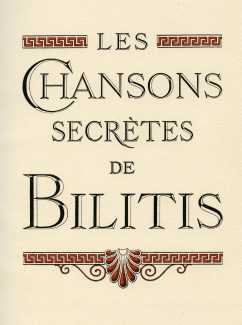
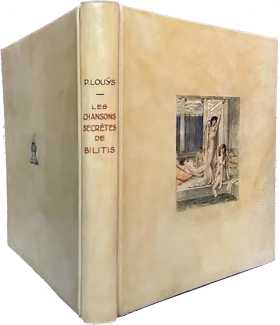 It was through these credentials that Lubineau won the confidence of Aline Steenackers and Georges Serrière, who granted him access to Louÿs' hidden manuscripts. He had already issued an anonymous text-only edition of Les chansons secrètes de Bilitis in 1933. The 1938 edition was a more ambitious undertaking, a fully illustrated livre d'artiste with twenty-four original colour etchings by Paul-Émile Bécat, plus a full-colour frontispiece. The texts were drawn from manuscripts and variants preserved among Louÿs' surviving papers and connected to the fictional ‘untranslated songs’ invoked in the 1894 Les chansons de Bilitis itself. The Bécat etchings are his most explicitly erotic late work, made possible by Lubineau’s exclusive publishing strategy.
For this Bécat-illustrated edition, Lubineau asked Serrière to write an introduction, partly to extol Louÿs as an important writer, but mostly to guarantee that both the original Les chansons de Bilitis, and the additional material included in the Chansons secrètes, was undeniably original Louÿs. We include a translation of Serrière’s introduction below.
When war came to France in 1939, publishing explicit erotica under Nazi and Vichy censorship was no longer viable, and during the early 1940s Lubineau pivoted toward luxurious editions of politically unobjectionable French classics. After the war, as obscenity laws gradually softened and the market for illustrated livres d'art expanded, he abandoned much of the old clandestine strategy and established himself as a publisher of mainstream French literature, producing illustrated editions of works by Stendhal, André Gide, Françoise Sagan and Federico García Lorca, collaborating with artists such as Henry Lemarié and Emilio Grau Sala. In 1963 Lubineau published a prestigious edition of Le fil de l'épée (The Edge of the Sword) by French president Charles de Gaulle, illustrated with engravings by Albert Decaris. For a publisher whose early fame had rested on erotic manuscripts circulated privately among collectors, the publication of a de luxe edition by the sitting president marked his passage from the margins of literary culture into the French literary establishment.
Returning to Louÿs’ explicit ‘Bilitis’ material found in his archive after his death, several related texts not included in the 1938 edition have since been unearthed, and are included in Jean-Paul Goujon’s collection Pierre Louÿs: Œuvre érotique. These are Le pornéïon (The Porneion) and La poupée (The Doll), which appeared in an extremely rare collection entitled Proses inédites: pièces libres; and Clitoris en rêve (Clitoris in a Dream), from an unpublished manuscript entitled Scènes de vie érotique (Scenes of Erotic Life). Here is Clitoris en rêve, demonstrating Louÿs’ remarkable erotic imagination and understanding of female desire.
Clitoris en rêve
J’ai rêvé (grâce à toi, déesse) que Mnasidika m’avait croqué le mamelon gauche et que la blessure était vagin jusqu’au coeur. De ses bords perpétuellement ruisselait une jouissance de sang.
Elle, qui dans mon rêve avait un clitoris monstrueux, se mettait alors à genoux et à cheval sur ma poitrine; ses genoux m’entraient sous les aisselles; mes seins tremblaient entre ses cuisses.
Elle se porta en avant. … oh! je sentais l’odeur de son ventre! Elle appliqua sa vulve à ma blessure et fit entrer tout son clitoris dans le trou. Et je crus sentir au coeur la pointe d’une épée ardente qui se branlait dans ma chair mouillée.
Ah! tant sa vulve était écarlate, le sang n’y paraissait pas. Mnasidika poussait des hurlements de joie ...
Clitoris in a Dream
I dreamed (thanks to you, goddess) that Mnasidika had bitten my left nipple, and that the wound was a vagina opening to my heart. From its edges a pleasure of blood streamed ceaselessly.
She, who in my dream possessed a monstrous clitoris, then knelt astride my breast; her knees pressed under my armpits; my breasts trembled between her thighs.
She leaned forward … oh! I could feel the scent of her belly! She pressed her vulva against my wound and thrust the whole of her clitoris into the opening. And I thought I felt, in my heart, the point of a burning sword moving within my wet flesh.
Ah! so crimson was her vulva that the blood could no longer be seen upon it. Mnasidika uttered cries of joy …
Georges Serrière’s introduction to the 1938 Les chansons secrètes de Bilitis
No work defines the personality of Pierre Louÿs more precisely than the Songs of Bilitis. Even more than the admirable preface to Aphrodite; even more than The Adventures of King Pausole, The Songs of Bilitis reveal the master’s neo-paganism and his longing for the marvellous civilisation of Greece. For Louÿs thought as a Greek — not the Greek of the barbaric and Homeric age, but the Greek of what has wrongly been called decadence, and which was in truth the flowering of that uniquely radiant era. The great writer did not dream of an Athenian republic, but of a Corinthian or Alexandrian one. It is well known that, like Renan, he despised profoundly that mistress of dark errors: Sparta.
When the Songs of Bilitis first appeared, they created such an impression of authenticity that everyone was deceived by them. Only Louÿs’s intimates, forewarned by his confidences, knew that it was all literary pastiche and mystification.
Even today, although scholars and men of letters know the truth, the general public still largely believes that the Songs are merely a translation and that Bilitis herself truly existed. We are fortunate today to publish an unpublished letter by the master, in which he provides details concerning the materials that enabled him to compose his masterpiece.
Here is the text of that letter, whose recipient remains unknown:
147 Boulevard Malesherbes, 14 May 1898
Sir,
I have the right to deceive the public, but I should be distressed to mislead a scholar. The Songs of Bilitis are entirely apocryphal, save for seven or eight pieces imitated from various authors. Song no. 6 is an elaboration whose theme you will find again in volume III of the Poetae Lyrici Graeci collected by Bergk. No. 81 is almost a summary of the sixth mime of Herondas. No. 139 is a mosaic composed from Philodemus, Meleager, Sappho, and Antipater. The second section of no. 114 is a quatrain from Alexis, in his comedy The Return, of which only fragments survive; in the same piece one finds a line from Theocritus, two images from Bhartrihari – who was never Greek – and ten lines by Pierre Louÿs, who is no more Greek than he; but you can see how all of this harmonises. And besides, believe me, the difficulty of these little pieces lies entirely in composition. Nothing is easier than inventing Greek; and if I borrowed here and there a few authentic lines, it was from scruple, not laziness.
I should add that I sought to give the book a character less Hellenic than Asiatic, in accordance with my personal preferences and the biography of Bilitis.
This poetess did in fact exist, though under the name Damophyla (cf. song 157). You will find information about her in Philostratus (Life of Apollonius, I.30).
You also ask me what the ‘untranslated’ songs are. They are pieces necessary to the composition of the volume and which will be added to it as soon as we have obtained from the French legislator the moral liberty for which I campaign. We shall not have to wait long, whatever Monsieur de Vogüé may think.
Please accept, sir, the assurance of my highest consideration.
Pierre Louÿs
I fully accept the discretion you offer me.
It is these ‘untranslated’ songs that we publish today. It will become apparent that some are merely freer variants of pieces published in the Mercure de France edition and its subsequent reprints. More accurately, one should say that we probably possess here the original text, which the demands of public decency forced the master to soften considerably. Others, by contrast, had remained unpublished. And perhaps there are still more unknown to us.
Since much has been said about false ‘unpublished’ works attributed to Pierre Louÿs, and while it is true that certain posthumous poems circulated clandestinely are not by him, it is necessary to affirm here the perfect authenticity of the songs we publish today. All of the master’s close friends and immediate circle knew them.
Because Pierre Louÿs was under no constraint when writing them, one will perceive that his genius unfolds here more freely than in the published pieces.
Now that we finally enjoy, in practice, the ‘moral liberty’ that Louÿs demanded so insistently, it is at last possible for us to bring to light the most significant of his masterpieces, those in which the genius of this great writer and consummate poet is expressed with the greatest perfection. In doing so, we believe we serve the memory of the master.
G.-C. Serrière
(his full name was Charles Edmond Georges Serrière, sometimes spelt Serrières, 1903–75)
The Bécat-illustrated Les chansons secrètes de Bilitis was published by Marcel Lubineau, Paris, in a limited, numbered and boxed edition of 450 copies.