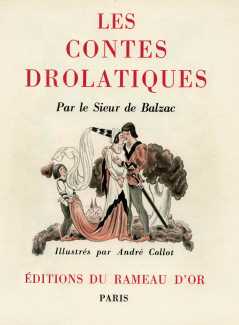
 Honoré de Balzac (1799–1850), who on the title page styles himself simply as the Sieur de Balzac, was a highly influential nineteenth-century French writer and one of the founders of the realist novel, celebrated for the vast sequence of fiction he gathered under the title La comédie humaine (The Human Comedy). Born at Tours, in the Touraine in which these tales are set, he belonged to the generation that shaped the modern French novel, which makes these tales, with their deliberately antique manner, a particularly striking achievement.
Les contes drolatiques, or Humorous Tales, represents an aspect of Balzac’s writing for which he is much less well known than for his novels. These short stories belong instead to the tradition of the conte gaulois, short, often bawdy or satirical prose narratives drawing on renaissance and late-medieval French storytelling. Many of the titles deliberately evoke an archaic or pseudo-medieval atmosphere through old-fashioned spelling and references to figures such as Louis XI or François I, looking back to the earthy humour of François Rabelais, and often revolving around erotic intrigue, clerical humour, deception and ironic reversals of fortune, themes inherited from renaissance novella literature.
Yet the collection is not merely farce. The stories are highly literary exercises, utilising deliberately archaic diction, elaborate titles and mock-chronicle tone to create a playful distance between narrator and material. Balzac was writing at a moment when the romantics were rediscovering France’s medieval and renaissance past, and these tales can be read as sophisticated literary jeux d’esprit masquerading as popular old narratives. The tension between cultivated style and earthy content is part of their distinctive flavour, the work of a nineteenth-century master channelling the exuberance of the French renaissance, poised between learned pastiche and libertine amusement.
Collot brings a manner wholly of the nineteen-thirties to Les contes drolatiques, a colourful palette and economical composition nearer to the deco fashion plate than to the romantic vignette. His faces often tip into caricature, the beaked noses and goggling eyes of cuckolds, friars and fat burghers set down with affectionate relish. Yet he can also be sensuous and frankly amorous when imagining a moonlit tryst in a punt, the lovers half-reclined beneath overhanging trees while a maidservant watches from the bank.
His crowded comic set-pieces demonstrate how much Collot evidently enjoyed this commission – a scandal boiling out of a church porch, the outraged matron with her hands on her hips, the swooning girl, the craning gossips. Then there are the bedchamber scenes – a husband bursting into the bedroom, furniture upended, a chamber-pot and scattered playing cards across the floor.
The plates are colour etchings, the line warmed and softened by washes of colour that read almost as watercolour, giving the interiors a candle-lit depth and the night scenes a pooled blue.
Collot reads Balzac’s tales attentively and with evident affection for their world, faithful to its late-medieval and renaissance Touraine in costume, headdress and architecture, and he is careful to pitch his style to each – knockabout for the tavern and the street, a real tenderness for the trysts, a sly relish for the bedchamber farces of surprised husbands and complaisant wives. The eroticism is warm, rounded, good-humoured, but never clinical.
The thirty tales in the collection are:
La belle Impéria (The Beautiful Impéria)
Le péché véniel (The Venial Sin)
La mye du roy (The King’s Darling)
L’héritier du diable (The Devil’s Heir)
Les ioyeulsetez du roy Loys le unziesme (The Jests of King Louis the Eleventh)
La connestable (The Constable’s Wife)
La pucelle de Thilhouze (The Maiden of Thilhouze)
Le frère d’armes (The Brother-in-Arms)
Le curé d’Azay-le-Rideau (The Priest of Azay-le-Rideau)
L’apostrophe (The Apostrophe)
Les trois clercs de Sainct-Nicholas (The Three Clerks of Saint Nicholas)
Le ieusne de Françoys premier (The Fast of Francis the First)
Les bons proupos des religieuses de Poissy (The Good Sayings of the Nuns of Poissy)
Comment feut basty le chasteau d’Azay (How the Château of Azay was Built)
La faulse courtizane (The False Courtesan)
Le dangier d’estre trop cocquebin (The Danger of Being Too Innocent)
La chiere nuictée d’amour (The Dear Night of Love)
Le prosne du ioyeulx curé de Meudon (The Sermon of the Merry Priest of Meudon)
Le succube (The Succubus)
Désespérance d’amour (Despair in Love)
Persévérance d’amour (Perseverance in Love)
D’ung iusticiard qui ne se remembroyt les chouses
(Of a Magistrate Who Could Not Remember Things)
Sur le moyne Amador, qui feut ung glorieux abbé de Turpenay
(On the Monk Amador, Who was Once a Vainglorious Abbot of Turpenay)
Berthe la repentie (Berthe the Penitent)
Comment la belle fille de Portillon quinaulda son iuge
(How the Beautiful Daughter of Portillon Outwitted Her Judge)
Cy est démonstré que la fortune est tousiours femelle
(In Which it is Shown that Fortune is Always Female)
D’ung paouvre qui avoyt nom Le Vieulx-par-chemins
(Of a Pauper named The Old Man by the Roadside)
Dires incongrus de trois pèlerins (Incongruous Sayings of Three Pilgrims)
Naifveté (Naivety)
La belle Impéria mariée (The Beautiful Impéria Married)
The Collot-illustrated Les contes drolatiques par le Sieur de Balzac was published in three volumes by Éditions du Rameau d’Or, Paris, in a limited numbered edition of 468 copies.
If you would like to read the Balzac tales in English, the 1874 translation by George R. Sims, with engravings by Gustave Doré, can be found at Project Gutenberg here. It is, however, quite hard going as it uses a dense, stylised and archaic pastiche of early English. For a more readable modern translation, look out for the 1958 Alec Brown translation, available in (sadly out of print) paperback, or in a 1961 Folio Society edition with illustrations by Mervyn Peake.