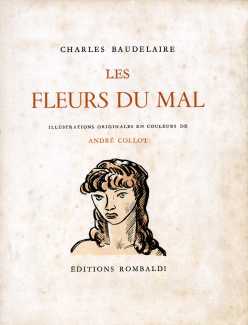
 When he was invited by the Paris publisher Rombaldi to illustrate Baudelaire’s masterpiece, Collot’s response was to emphasise the erotic elements of the poems, reading Les fleurs du mal almost entirely as a book about the female body. Four of his five plates are studies of young women, their large eyes and faintly stunned expressions lending them an air of melancholy rather than abandon. Only the fifth, a crowned skeleton riding a pale horse over a field of corpses, turns to the death and damnation that run through the collection, and it is much the strongest of the set. Baudelaire’s other themes appear to hold no interest for him.
The commission belongs to the public side of Collot’s career, alongside his Verlaine and his Boccaccio, rather than to the erotica for which he is mostly remembered. It shows him in an unfamiliar guise – in the woodcuts of Historiettes galantes he cut his own printing blocks, and in the late Symphonies amoureuses he worked his own copperplates, but here he is simply a draughtsman, supplying finished colour drawings for someone else to reproduce. The result is correspondingly softer and more sentimental, with the cold palette of blue-greys and sage greens catching the chill of the poems, offset by a little warmth in the skin and hair tones.
The plates were not printed from anything Collot himself engraved. They are photogravures, reproductions made by photographing his original colour drawings onto metal plates, which were then etched and printed under pressure much as an ordinary etching is, the dampened paper forced into the inked plate so that it comes away with a slightly sunken border or platemark around each image. Printed separately from the text in a handful of colours and then tipped individually into the book, they allowed Rombaldi to issue the volume in a substantial run, far more than any hand-pulled etching could ever have yielded.
The edition sits squarely in Rombaldi’s well-known line of affordable illustrated classics, each volume with five colour plates by a contemporary artist. It is a handsome piece of commercial book production rather than a hand-made edition for collectors, but it preserves a side of Collot, the painterly and melancholy draughtsman, that his better-known prints tend to hide.
The Collot-illustrated Les fleurs du mal was published by Rombaldi in a limited numbered edition of 5,000 copies.