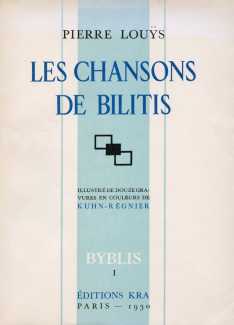
 Pierre Louÿs’ Les chansons de Bilitis (The Songs of Bilitis), a collection of erotic lesbian poetry, was first published in Paris in 1894. Bilitis is one of the most successful literary frauds of all time, and most of Louÿs’ early readers honestly believed that they were reading genuine translations of rediscovered ancient poetry found on the walls of a tomb in Cyprus, written by a woman called Bilitis who was a courtesan and contemporary of Sappho. In the 143 poems Bilitis shares her most intimate thoughts, from childhood innocence in Pamphylia to the loneliness and chagrin of her later years. To lend authenticity to the forgery, Louÿs listed some poems as ‘untranslated’; he even craftily fabricated an entire section of his book called ‘The Life of Bilitis’, crediting a fictional German archaeologist as the discoverer of Bilitis’ tomb. Though Louÿs displayed great knowledge of ancient Greek culture, ranging from children’s games to the application of scents, the literary fraud was eventually exposed. This did little to taint its literary value, and Louÿs’ open and sympathetic celebration of lesbian sexuality earned him both popularity and historic significance.
Although for the most part Les chansons de Bilitis is original work, many of the poems were reworked epigrams from the Palatine Anthology, and Louÿs even borrowed some verses from Sappho herself. The poems are a blend of mellow sensuality and polished style in the manner of the Parnassian school, but underneath run subtle French undertones that Louÿs could never escape.
Louÿs’ book has three movements – the Pamphylian pastorals of Book I, the Mytilenean sapphic elegies of Book II, and the Cypriot epigrams of Book III, where Bilitis ends as an urban courtesan in Amathous. Almost every other illustrator of Bilitis concentrates on Book II, because the Mytilene affair with Mnasidika is what gave the book its lesbian interest. Interestingly, Kuhn-Régnier all but skips it – the plate depicting the bedchamber with the two women is the closest he comes, and even there the second figure reads as much like a servant tending the reclining woman as like a lover. The clear centre of gravity in the cycle is the courtesan world of Book III – the litter procession, the inspection of the two novices, the dressing-room with the patterned underwear, the doll-and-mirror solitude, the flower-seller pestering the men in togas in the colonnade.
Though set in classical antiquity, it is hard to miss how 1929 the whole portfolio looks. The bobbed hair, the kohled eyes, the high-waisted briefs, the modernist red interiors with their hard architraves and Bakst-derived friezes – this is Bilitis as it would have been imagined by the readership of La Vie Parisienne and Fantasio, which is precisely the readership Kuhn-Régnier had been supplying for the previous twenty years. He brings his magazine vocabulary straight into the limited-edition book.
The technique used in the Bilitis plates is two-colour intaglio etching; they have a registration drift and tonal grain not seen in Kuhn-Régnier’s later pochoir work.
The Kuhn-Régnier Les chansons de Bilitis was published by Éditions Kra in a limited numbered edition of 3,300 copies.