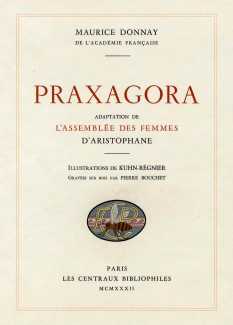
 Praxagora is a brilliant French theatrical adaptation of Aristophanes’ classical Greek comedy, The Assemblywomen (Ἐκκλησιάζουσαι or Ecclesiazusae). Originally written in 391 BCE, the narrative follows a clever Athenian woman named Praxagora who convinces her fellow citizens to disguise themselves as men, infiltrate the all-male assembly, and vote to hand total political control over to women. Once in power they institute a radical system of utopian, egalitarian wealth redistribution.
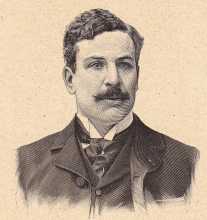
To modernise this ancient satire for the twentieth-century stage, the specialised publisher Les Centraux Bibliophiles turned to the dramatist Maurice Donnay (1859–1945). Renowned for his sharp wit and his earlier, highly acclaimed adaptation of Lysistrata in 1892, Donnay successfully preserved Aristophanes’ bawdy, subversive political humour while infusing the text with a fluid, contemporary French lyricism. Donnay was possibly Paris’s best-known playwright during the 1890s and early twentieth century, achieving acclaim with plays such as Les amants (The Lovers, 1895), La douloureuse (The Painful Experience, 1897) and Le torrent (The Deluge, 1899). His plays featured famous actors such as Cécile Sorel, Réjane and Lucien Guitry, and were appreciated for their progressive ideas regarding relations between the sexes and for their convincingly rendered spoken language.
Praxagora was first performed on 21 November 1930 at the Théâtre Edouard VII in Paris, and was published in an unillustrated version in 1931. This 1932 deluxe illustrated edition transforms Donnay’s text into a pinnacle of the livre d’art, defined by its exquisite production and presentation. The book features vibrant pochoir coloured illustrations by Kuhn-Régnier, by then well-known for his elegant, art deco-infused interpretations of classical antiquity. Kuhn-Régnier’s stylish designs were meticulously brought to life by master engraver Pierre Bouchet, who cut and applied the pochoir stencils used for the colour printing.
The publisher, Les Centraux Bibliophiles, occupied a unique niche in the twentieth-century French publishing landscape. Founded in 1926 by a passionate group of book-collecting engineers from the elite École Centrale, including notable early members like aviation pioneer Pierre-Georges Latécoère and automotive industrialist Robert Peugeot, the society focused on commissioning ultra-exclusive, deeply artistic luxury editions for its tightly capped membership. Over several decades they curated a fascinating catalogue that typically paired timeless literary works, philosophies, or original contemporary poetry with prominent art deco, surrealist or modernist visual artists.
True to the traditions of elite French bibliophile societies, the book was printed as a subscription-only volume in a limited run of just 130 numbered copies. The entire edition was produced on Japon double nacré, a pearlescent Japanese paper prized for its shimmering texture and ability to hold deep ink tones. It was issued in loose, unbound sheets protected by a paper cover, card wrapper and slipcase. This allowed members of the society either to preserve the book in its pristine, original state or commission a bespoke, luxury leather binding from a master bookbinder of their choice.