 In many ways Charles-Marie-Georges Huysmans led an uneventful life, working as a civil servant at the Ministry of the Interior for thirty-two years. Yet during the last two-thirds of his government career he was also a prolific novelist. Starting out as a Zola-inspired naturalist, he became associated with the decadent movement with his publication in 1884 of the novel À rebours (Against the Grain). Huysmans found himself spurned by the naturalists, embraced by the symbolists, and associated with the career of the notorious Oscar Wilde. His work expressed his deep pessimism, which had led him to the philosophy of Arthur Schopenhauer. In later years his semi-autobiographical novels reflected his study of both satanism and Catholicism, leading to Huysman’s religious conversion and becoming an oblate in the Catholic church.
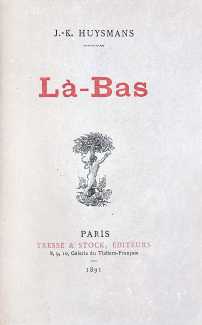
Là-Bas (Down There), published in 1891, is Huysmans’s best-known work after À rebours. Là-Bas deals with the subject of satanism in contemporary France, and the novel stirred controversy on its first appearance. It features the character Durtal, a thinly disguised portrait of the author himself, who would go on to be the protagonist of Huysmans’s subsequent novels En route (On the Path), La cathédrale (The Cathedral), and L’oblat (The Oblate).
The plot of Là-Bas concerns the novelist Durtal, who is disgusted by the emptiness and vulgarity of the modern world. He seeks relief by turning to the study of the medieval period – the first chapter includes the first critical appreciation of Matthias Grünewald’s Isenheim altarpiece – and begins to research the life of the notorious fifteenth-century child-murderer and torturer Gilles de Rais. Through his contacts in Paris, notably Dr Johannès (modelled on the Catholic priest and medievalist Joseph-Antoine Boullan), Durtal finds out that satanism is not simply a thing of the past but is alive in fin de siècle France. He embarks on an investigation of the occult underworld with the help of his lover Madame Chantelouve. The novel culminates with a description of a black mass.
Là-Bas was first published in serial form by the newspaper L’Écho de Paris, with the first instalment appearing in February 1891. It came out in book form in April of the same year. Many of L’Écho de Paris’ more conservative readers were shocked by the subject matter and urged the editor to halt the serialisation, but he ignored them. Sale of the book was prohibited from French railway stations.
Huysmans’s work is remarkable for its idiosyncratic use of the French language, large vocabulary, descriptions, satirical wit and far-ranging erudition. His ability to mesmerise his readers with a torrent of sound and image is itself akin to the magic arts he describes. He manages to combine grimly realistic detail with deep esoteric knowledge, and searches relentlessly for the divine in the depths of evil and in the furthest reaches of human experience.
Là-Bas would not be published in a de luxe fully-illustrated edition until 1926, when the Paris publisher Georges Briffaut commissioned Fernand Hertenberger to produce engravings and woodcuts for a limited edition. However, around 1912 a now-unknown (and presumably wealthy) bibliophile collector commissioned Martin van Maële to create fifteen coloured plates to accompany their copy of the 1891 edition. The collaboration between Van Maële’s artistic style and Huysmans’ prose represents a defining peak of late nineteenth-century French decadence and occult art. Van Maële’s illustrations capture the dark, transgressive atmosphere of the novel, the illustrations focusing heavily on the novel’s most grotesque and occult themes, including depictions of the medieval serial killer Gilles de Rais and his alchemist magus François Prelati, a scene where Prelati collapses after allegedly being beaten by a demon. In many scenes nature itself appears distorted, featuring trees morphed into obscene phallic and priapic shapes, with dark, eroticised imagery mirroring the book’s themes of spiritual degradation, succubi, and the psychological descent into the black mass.
To put the timing into context, by the time van Maële painted these scenes Huysmans had died in 1907, having completed his own real-life transformation from a decadent investigator of satanism into a devout Roman Catholic. The unique copy of the van Maële-illustrated book subsequently passed through several collectors’ hands, and now resides in the New York Varshavsky Collection.