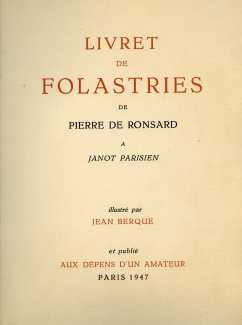
 Pierre de Ronsard (1524–85) is widely regarded as the greatest French poet of the renaissance and the leading figure of La Pléiade, the group of humanist writers who sought to enrich the French language by drawing on the models of classical Greece and Rome. Celebrated for his love poetry, odes and sonnets, Ronsard became court poet to the Valois kings and helped establish French as a literary language capable of rivalling Latin and Italian. His reputation has long rested on elegant, highly wrought works such as Les amours, in which love is idealised in the Petrarchan tradition, and on his later political and philosophical verse. And among his youthful writings lies a strikingly different collection – the Livret de folastries (Little Book of Follies), published in 1553 when Ronsard was still in his twenties.
The title itself announces a world of playful licence, for folastrie suggests frolics, amorous escapades and mischievous foolery rather than mere folly. Far removed from the lofty sentiments of courtly love, these poems delight in the comic, physical and often unruly realities of desire. Drawing inspiration from Latin poets such as Catullus, Martial and Ovid, as well as the earthy traditions of French farce and popular song, Ronsard abandons idealised heroines in favour of flirtatious lovers, prostitutes, drunken revels, jealous quarrels and unabashed sensuality.
As Ronsard’s career progressed and he assumed the role of royal poet during the turbulent years of the French wars of religion, the youthful exuberance of the Livret de folastries became increasingly at odds with the dignified public image he wished to project. He therefore excluded the collection from later authorised editions of his works, and for centuries it remained one of his least familiar works. Modern scholarship has restored its significance, recognising it not as an embarrassing curiosity but as an essential counterpoint to the more elevated poetry for which Ronsard is best known.
Jean Berque’s illustrations for this edition of the Livret de folastries were printed ‘à la poupée’, with the different colours inked directly onto the plate by hand rather than added afterward by stencil. This accounts for the soft, layered bleeding of tones, with a result closer to watercolour wash than to flat colour printing.
Berque’s line is loose and painterly, laid under washes of deep green, cobalt, and blood-red. His faces are simplified and almond-eyed, in the style of much interwar illustration, but the bodies carry real anatomical weight. The sequence reads as a deliberate pastoral arc rather than illustration chosen at random – discovery and voyeurism in woodland settings frame the portfolio, with scenes of same-sex intimacy on a draped bed, solitary naked reclining figures in garden and boudoir settings, embracing couples outdoors, bathing scenes, and a harvest figure with fruit baskets. The range of setting and storylines – rustic seduction, bathing, abundance — sits very comfortably with the pastoral themes of Ronsard’s Folastries.
The Berque-illustrated Livret de folastries was published ‘Aux dépens d’un amateur’ (at the expense of an amateur) in a limited and numbered edition of 350 copies.