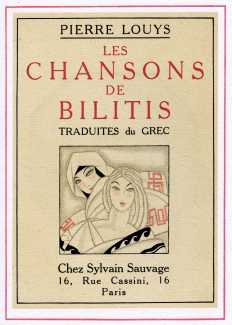
 Pierre Louÿs’s Les chansons de Bilitis (The Songs of Bilitis) is a collection of erotic lesbian poetry first published in Paris in 1894, and one of the most successful literary frauds of all time; most of Louÿs’s early readers honestly believed that they were reading genuine translations of rediscovered ancient poetry found on the walls of a tomb in Cyprus, written by a woman called Bilitis who was a courtesan and contemporary of Sappho.
In the 143 poems Bilitis shares her most intimate thoughts, from childhood innocence in Pamphylia to the loneliness and chagrin of her later years. To lend authenticity to the forgery, Louÿs listed some poems as ‘untranslated’; he even craftily fabricated an entire section of his book called ‘The Life of Bilitis’, crediting a fictional German archaeologist as the discoverer of Bilitis’ tomb. Though Louÿs displayed great knowledge of ancient Greek culture, ranging from children’s games to the application of scents, the literary fraud was eventually exposed. This did little to taint its literary value, and Louÿs’s open and sympathetic celebration of lesbian sexuality earned him both popularity and historic significance. Although for the most part Les chansons de Bilitis is original work, many of the poems were reworked epigrams from the Palatine Anthology, and Louÿs even borrowed some verses from Sappho herself. The poems are a blend of mellow sensuality and polished style in the manner of the Parnassian school, but underneath run subtle French undertones that Louÿs could never escape.
Sauvage was the second of the many artists to produce illustrations for Bilitis, following the sumptuous George Barbier edition of five years earlier, which Sauvage no doubt knew and admired; you can see the Barbier illustrations here. Like Barbier’s, Sauvage’s plates are pure art deco, the movement which took its name from the Exposition Internationale des Arts Décoratifs et Industriels Modernes (International Exhibition of Modern Decorative and Industrial Arts) held in Paris in 1925, and with which Sauvage immediately identified.
Sauvage’s illustrations for this edition occupy a distinctive position in the spectrum of 1920s French livre d'artiste production, poised between the lingering sinuousness of art nouveau and the flatter, more self-conscious geometry of art deco. His technique combines fine intaglio line work, delicate hatching modelling flesh with almost vaporous lightness, with bold, heavily-inked contrast for hair and decorative foliage, creating a tension between the ethereal and the graphic that suits Louÿs's text well. Colour is applied sparingly, the warm buff of the background functions as the dominant tone, punctuated by soft teal greens, rose accents on lips and nipples, and occasional vivid notes – the blue flowers in a headdress, a red ornament, a green hair-ribbon – that read as deliberate jewel-like interventions rather than naturalistic colouring.
The facial type is unmistakably of its decade, elongated and masklike, with exaggerated eye make-up and a knowing half-lidded expression that recurs whether the figure is solitary or paired. What gives the series particular coherence is Sauvage’s restraint in composition. which keeps the erotic content unhurried and lyrical, brilliantly matched with the pastoral-elegiac register of Louÿs’s prose poems.
Les chansons de Bilitis was published Chez Sylvain Sauvage in a limited numbered edition of 287 copies.