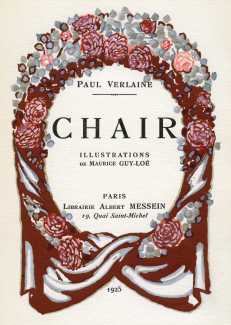
 Chair (Flesh), first published in 1896, is one of the most striking and controversial collections of the French symbolist poet Paul Verlaine (1844–96). Issued shortly after his death, the book gathers a group of poems written largely in the later years of his life and centred on the theme of sensual desire. As the title suggests, Chair explores the tension between the body and the spirit, a conflict that runs throughout Verlaine’s work but is here treated with unusual frankness.
The poems in Chair focus primarily on erotic attraction, and Verlaine’s language alternates between lyric tenderness and an almost confessional directness, presenting desire as both intoxicating and morally troubling. The poet had long struggled with the conflict between his catholic faith and his sexual impulses, and this tension gives the poems a distinctive emotional charge. Pleasure, guilt, longing, and self-reproach coexist uneasily, producing an atmosphere at once intimate and troubled.
Stylistically, the poems retain many features characteristic of Verlaine’s mature verse. The lines are musical and fluid, frequently using short metres and delicate rhythms that emphasise mood over narrative. Images of skin, warmth, and physical closeness recur throughout the collection, reinforcing the sense of sensual immediacy suggested by the title.
Reception of Chair was inevitably mixed. Some readers regarded it as an embarrassing or excessive revelation of private impulses, while others saw in it a final expression of Verlaine’s characteristic honesty and vulnerability. Today the collection is often read as part of the complex late phase of Verlaine’s career, when illness, poverty and spiritual anxiety intensified his poetry.
This selection of poems from the collection concentrates on Verlaine’s poems about young women, though Verlaine’s desires were equally directed towards young men. Maurice Guy-Loë’s delicate prints of naked young women in an imaginative array of poses are stylish, using a limited palette to produce a linked set of vignettes of beautiful young bodies, just as Verlaine had imagined when he wrote Chair.
One of the best-known poems from Chair is ‘Chanson pour elle’ (A Poem for Her), which plays humorously with clichés about women of different hair colours while celebrating physical beauty in a frankly sensual tone, very characteristic of the late Verlaine.
Chanson pour elle
Ils me disent que tu es blonde
Et que toute blonde est perfide,
Même ils ajoutent «comme l’onde».
Je me ris de leur discours vide!
Tes yeux sont les plus beaux du monde
Et de ton sein je suis avide.
Ils me disent que tu es brune,
Qu’une brune a des yeux de braise
Et qu’un cœur qui cherche fortune
S’y brûle … Ô la bonne foutaise!
Ronde et fraîche comme la lune,
Vive ta gorge aux bouts de fraise!
Ils me disent de toi, châtaine:
«Elle est fade», et rousse trop rose.
J’encague cette turlutaine,
Et de toi j’aime toute chose,
De la chevelure, fontaine
D’ébène ou d’or (et dis, ô pose
Les sur mon cœur), aux pieds de reine.
A Poem for Her
They tell me that you are blonde,
And that every blonde is treacherous;
They even add ‘like the tide’.
I laugh at their empty talk!
Your eyes are the loveliest in the world,
And your breast is what I desire.
They tell me that you are brunette,
That brunettes have eyes of flame,
And that any heart seeking fortune
Burns there … What nonsense!
Round and fresh as the moon;
Long live your strawberry-tipped breasts!
They say that you are chestnut-haired:
‘She is dull’, or ‘too vivid a redhead’.
I scorn such silly chatter.
In you I love every single thing,
From your hair, a fountain
Of ebony or gold (ah, lay it, please,
Upon my heart), down to your queenly feet.
The Guy-Loë illustrated Chair was published by Librairie Albert Messin of Paris, in a limited numbered edition of 550 copies.