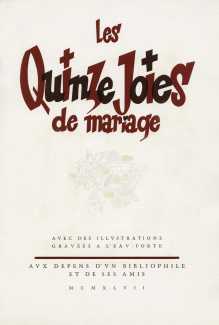
 Les quinze joies de mariage (The Fifteen Joys of Marriage) is one of the great monuments of late medieval French prose satire. Written anonymously around the mid-fifteenth century, it presents marriage not so much as a blessing but more of a trap, the fifteen ‘joys’ being the forms of suffering visited upon a hapless husband by a scheming wife. It is sharp, comic and misogynistic in the manner of the period, depicting domestic intrigues, infidelities, and the husband’s perpetual bewilderment. The anonymous author’s identity has never been established, though various attributions, including to Antoine de la Sale, have been proposed over the centuries.
The fifteen ‘joys’ are structured as a sustained ironic inversion – each is framed as a blessing of married life but unfolds as a comic trap from which the husband cannot escape. The text’s genius lies in its repetitive, cumulative structure — by the time the reader reaches the fifteenth joy the husband’s fate feels both inevitable and absurd.
Several of the early joys centre on a wife who demands expensive clothes, jewellery, and social display beyond the husband’s means. He exhausts himself working to satisfy her, falls into debt, and ages prematurely, while she barely notices. A cluster of joys deals with the wife taking a lover, often with the connivance of her female friends and servants, who cover for her and manipulate the husband’s perceptions. He is kept docile through flattery, sulking, and strategic tenderness. The text is remarkably specific about the social architecture of female solidarity that makes this possible.
The joys touching on pregnancy and childbirth are particularly pointed: the husband is run ragged attending to his wife’s demands, financially ruined by the costs, and yet remains excluded from any real intimacy with the child or the domestic world that forms around it. The later joys grow darker. By the final entries the husband is old, broken, and entirely domesticated, sitting by the fire, good for nothing, still imagining that one day things will improve. The closing image of a fish swimming endlessly in a pond, unable to escape, is one of the most famous metaphors in medieval French literature. The husband, the author suggests, is exactly this fish – he has glimpsed the open water, but it is already too late.
What makes the text so durable is the author’s even-handedness. The wives are scheming and manipulative, but the husbands are vain, credulous, and wilfully blind. The real target of the satire is not women but the institution of marriage itself, and the human capacity for self-deception that makes marriage’s ‘joys’ so easy to sell and so hard to enjoy.
The Traynier etchings for this luxurious postwar edition of Les quinze joies are some of his best book illustrations, detailed and appropriately lecherous. In addition to the frontispiece and twelve coloured plates, he added a range of delicate two-colour woodcuts for the chapter openers and other small ornaments. The volume is a tour de force of high-quality erotic bibliophilia.
Les quinze joies de mariage was published ‘Aux dépens d’un bibliophile et de ses amis’ (At the expense of a bibliophile and his friends), a classic formula of the French semi-clandestine publishing world, a polite fiction indicating private, self-financed production outside commercial and regulatory channels. It was printed in a limited, numbered and boxed edition of 150 copies.