 The most famous of the Roman poet Juvenal’s attacks on women is Satire VI, often called the Satire on Women. Written in the late first or early second century CE and included in Juvenal’s second book of satires, it is the longest poem in his surviving work and one of the most notorious texts of classical Latin literature. It takes the form of a long address to a friend, Postumus, whom the poet tries to dissuade from marrying. What begins as friendly advice rapidly expands into an extravagant catalogue of female vices, delivered with the aggressive rhetorical energy that characterises Juvenal’s satire as a whole.
The poem belongs to the long Roman tradition of misogynistic moralising that can already be seen in earlier authors such as Horace and Ovid, though Juvenal pushes the theme to an unprecedented extreme. Marriage, he argues, inevitably leads to humiliation and misery for the husband. Women are portrayed as simultaneously extravagant, sexually voracious, domineering, jealous, and intellectually pretentious. Juvenal constructs a parade of examples – aristocratic adulteresses, women who poison their husbands, devotees of exotic religions, learned ladies who pedantically correct grammar at dinner, and women who pursue lovers among actors, gladiators or slaves. Each anecdote builds the impression that Roman society has been corrupted by luxury and moral decay.
A famous section of the poem concerns the story of Messalina, the notoriously promiscuous wife of the emperor Claudius. Juvenal recounts how she allegedly slipped out of the imperial palace at night to work in a brothel under an assumed name, competing with prostitutes in sexual endurance. Whether historically true or not, the episode illustrates Juvenal’s method – sensation based on rumour and gossip.
Juvenal’s Satire on Women had a long and controversial afterlife. In the renaissance and early modern period it was frequently cited as a classical authority for misogynistic views, while modern readers often find it disturbing or offensive. Yet its vivid storytelling, sharp characterisation and rhetorical brilliance have ensured its place as one of the most memorable works of Roman satire.
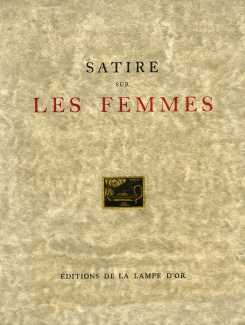
Maurice de Becque’s stylish illustrations for this sumptuous edition of Satire sur les femmes are among the best he ever produced, including six full-page plates, a headpiece for each of the twelve sections, tailpieces for most of them, and a selection of illuminated capital letters for the beginning of the sections. Many of them are embellished with gold, adding to the outstanding quality of this finely produced limited edition.
The de Becque illustrated Juvenal was published by Éditions de la Lampe d’Or in a limited, numbered and boxed edition of 300 copies.