Joaquín Sorolla is often celebrated for his sun-drenched beach scenes, yet his paintings of naked women reveal a more intimate dimension of his art. Unlike the academic nudes of the late nineteenth century, which often relied on mythological pretexts, Sorolla’s approach is strikingly naturalistic. His women are not idealised goddesses but observed figures, rendered with a sensitivity to light, atmosphere, and the tactile qualities of skin.
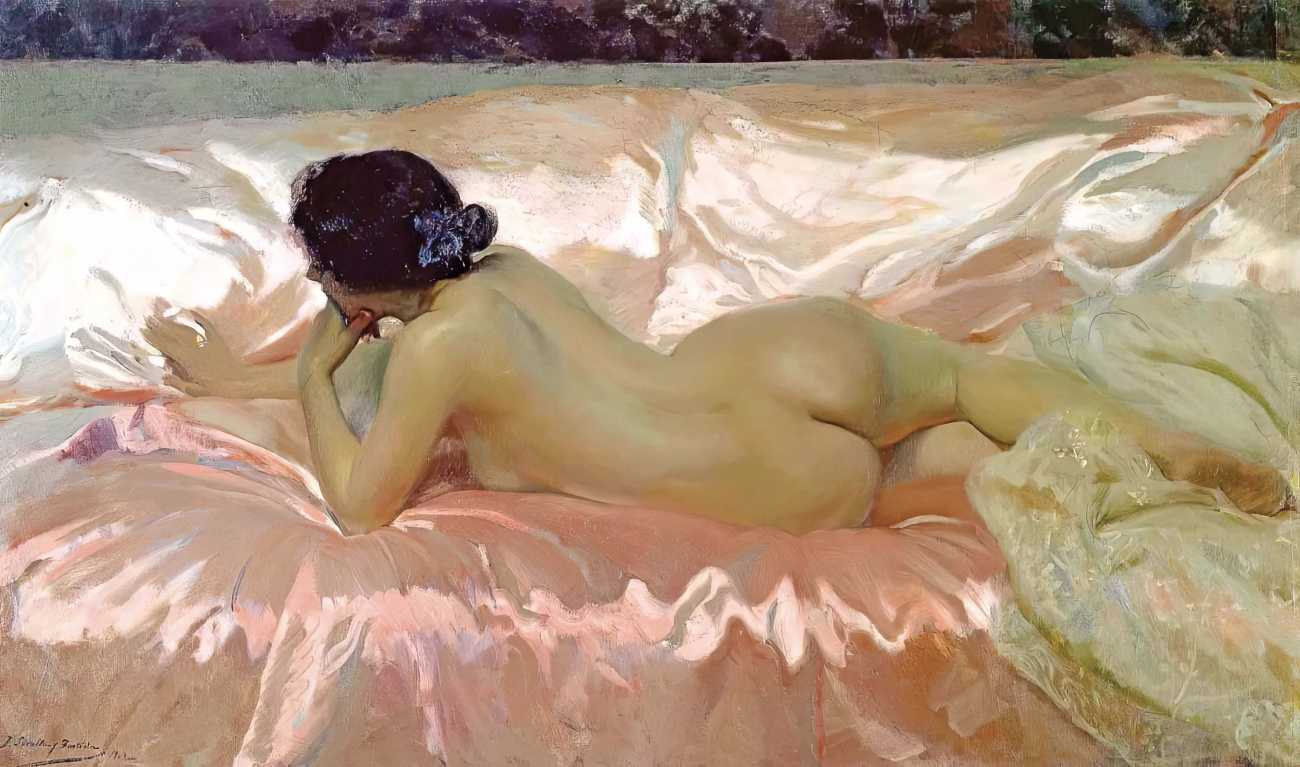
Works such as Desnudo de Mujer, painted in 1902, show his characteristic handling of luminous flesh tones, where the body becomes a surface upon which Mediterranean light plays. Rather than sharply defined contours he preferred fluid brushwork and soft transitions, allowing the figure to dissolve into its surroundings. This aligns him with impressionism, though his technique remains solidly grounded in Spanish realism.
There is a notable absence of overt eroticism. Sorolla’s nudes tend toward quiet introspection: women drying themselves, reclining, or turning away from the viewer. The emphasis is less on display than on fleeting, private moments. Sorolla’s naked women extend his broader artistic project, capturing life through light. Whether on a crowded Valencian beach or in a secluded interior, the body becomes a vehicle for exploring radiance, movement and immediacy rather than an object of theatrical or symbolic display.