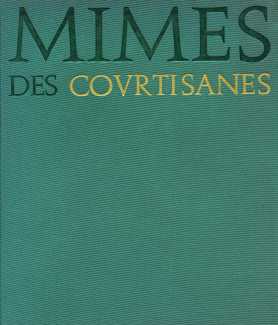
 This edition of Lucian’s Mimes des courtisanes (Dialogues of the Courtesans), published by the Club Français du Livre, is a multi-layered combination of cultures. The text originates in the text of Lucian of Samosata, a second-century writer whose brief, incisive exchanges expose the emotional and economic realities of erotic life in the ancient world. In the hands of the French writer Pierre Louÿs the dialogues were transformed into a refined and deliberately sensuous French prose, less a strict translation than a literary recreation shaped by fin-de-siècle tastes for classical texts and erotic subtlety.
The illustrations by Pablo Picasso used in this stylish book club edition play a useful role in the mixture. The sixteen plates are not original etchings created for the book, but carefully chosen reproductions of drawings selected from different phases of Picasso’s engagement with classical and erotic themes. Their style – economical, fluid, playfully explicit – recalls both the neoclassical linearity of his 1920s work and the freer erotic line of later decades. Rather than narrating specific episodes, they establish a visual atmosphere in which antiquity is reimagined through modern gesture, and erotic encounter rendered with candour and wit.
For Lucian's original audience these dialogues would have raised few eyebrows. Sex work in the ancient Greek world occupied a recognised, if stratified, place in civic and commercial life, neither hidden nor especially transgressive. His vignettes move across that social landscape with easy familiarity – rivalries over clients, the economics of gift-giving, the management of difficult men and degrading encounters. The pleasures and indignities are rendered with equal frankness. The hetaerae occupied the upper stratum of this world — educated, relatively independent, possessing freedoms that respectable citizen women were largely denied. Lucian's cast is more mixed and his sympathies more democratic than the term hetaerae alone suggests. It was two millennia of accumulated moral censure rather than anything in the texts themselves that rendered this corner of the classical corpus untranslated until Louÿs – too insignificant to suppress entirely, too candid to acknowledge fully.
Louÿs’ prose, with its cultivated sensuality and literary polish, softens and aestheticises Lucian’s sharp observations, while Picasso’s drawings introduce an element of immediacy and irony through their stripped-down forms. The result is a book that operates across three historical influences at once – classical, fin-de-siècle, and modern – each providing a mirror for the others, contributing to a nuanced re-presentation of erotic life as both performance and artifice.