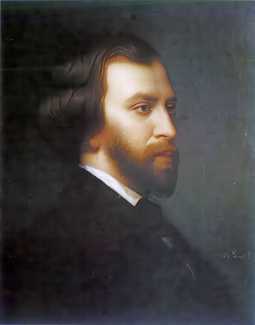
 The French dramatist, poet and novelist Alfred Louis Charles de Musset-Pathay (1810–1857) was one of the most prolific and widely-read authors of his time, comparable in many ways with Byron, Shelley, and even Charles Dickens. He was a central figure of the French romantic movement, his writing combining emotional intensity with elegant classical restraint. Born in Paris into a cultivated but relatively poor family, he achieved early success with his Contes d’Espagne et d’Italie (Stories of Spain and Italy, 1830) and became associated with leading literary circles of the July Monarchy.
His turbulent relationship with the novelist George Sand profoundly influenced his work, most notably La confession d’un enfant du siècle (Confession of a Child of the Century, 1836), a semi-autobiographical exploration of disillusionment and romantic suffering. Although many of his plays, including Lorenzaccio (1834), were not staged in his lifetime, they are now regarded as masterpieces of French drama. Elected to the Académie Française in 1852, Musset remains a key voice of nineteenth-century French literature, admired for his lyrical style and insight into the psychology of love and despair.
Musset matched the emotional register of the nineteenth century perfectly. His central preoccupations – passionate love, romantic betrayal, the anguish of the sensitive soul in a coarse world, the consolations and torments of alcohol and excess – were precisely what the bourgeois reading public wanted to feel vicariously. His verse has an immediacy and confessional warmth that felt like lived experience rather than literary performance.
The much-publicised affair Musset had with fellow author George Sand affair provided endless cultural fuel. Throughout the second half of the century the Sand–Musset liaison remained a subject of enormous public fascination, with memoirs, counter-memoirs and dramatisations. La confession d’un enfant du siècle was read as a roman à clef, which gave it a readership well beyond purely literary interest. Scandal and celebrity operated then much as they do now, and Musset was a celebrity author whose personal mythology kept his work in print.
Once Musset entered the school curriculum – and by the Third Republic he was firmly fixed in it – the demand for cheap, accessible collected editions meant that his work became part of every child’s education.
But Alfred de Musset is barely read today. The confessional romantic lyric as a mode has lost its prestige, and what felt like depth and sincerity to a nineteenth-century reader now feels like self-pity dressed up as poetry. Musset has none of Baudelaire’s structural irony, none of Rimbaud’s formal violence, none of Verlaine’s musicality.
There is also a gender dimension – much of Musset's appeal rested on a particular construction of wounded masculine sensibility, the enfant du siècle exhausted by history and betrayed by love. That figure commanded enormous sympathy for decades, but is no longer a model that most young men can identify with.
 Inevitably, and again rather like Dickens in English, every major publisher wanted to produce a Musset complete works, and between 1866 and 1948 more than twenty Œuvres complètes were produced, consisting of between ten and thirteen volumes. These collections were illustrated from the start, during the nineteenth century by monochrome steel-engraved plates. This Librairie de France ten-volume edition illustrated by Charles Martin was the first to introduce colour, with forty colour plates and a hundred in monochrome.
The Martin plates are quite a mixed bunch, both in terms of style and of sophistication. It is possible, maybe likely, that the publication deadline meant using some already-existing artwork, together with some plates having sense of being rushed to completion. Whatever the reason, this portfolio does not represent Charles Martin’s best work, though some of the illustrations stand out as witty and well-composed, and all are perfectly competent.