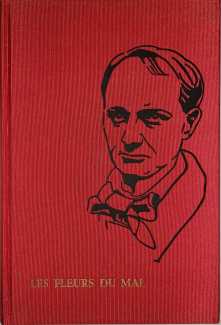
 Produced just a year before he died, Paul-Émile Bécat’s illustrations for Baudelaire’s Les fleurs du mal employ a sensibility well-tempered by his long engagement with French erotic literature. His watercolour and crayon originals, reproduced in pochoir in the book, suit the dark verses unusually well. Where a harder line might have resolved the poems’ ambiguities into illustration, Bécat's technique preserves atmosphere over incident – forms dissolve into fog, and figures seem to materialise from rather than inhabit their backgrounds. The result is less a portfolio of illustrations than a set of moods held in suspension.
The edition contains just five colour plates, a deliberately spare allocation that forces each image to carry considerable symbolic weight across the collection as a whole. Bécat responds by organising them around a single sustained theme – the proximity of desire and death. Skeletons and skulls recur across four of the five plates, never as memento mori but as presences already intimate with the erotic scene, watching, waiting, dancing.
Bécat's illustrations constitute a meditation on its core proposition, that beauty is most itself when overshadowed. His women are consistently vivid, sensuous, unhurried; his skeletal figures consistently patient. The tension between the two is the emotional theme of Les fleurs du mal, and a tension Bécat sustains across the five images with a studied consistency. For a text that had by the mid-twentieth century acquired the double patina of canonical respectability and persistent notoriety, Bécat's illustrations restore something of Baudelaire’s original and unresolved provocation.
For an edition of 1,600 copies produced as recently as 1959, it is remarkable that only a handful of copies of the Gibert Jeune edition have survived – as far as we are aware only one copy has come to auction since 2000, the copy in the Bibliothèque Nationale is the sole institutional copy, and we are fortunate enough to have found a copy lurking in a New York second-hand bookshop. Why should this be?
Legal seizure is a possible candidate. 1959 sits in a complicated moment for French publishing. The Loi du 16 juillet 1949 on publications dangereuses had been actively deployed through the 1950s, and while Baudelaire himself had been rehabilitated by the courts in 1949, with the 1857 conviction posthumously quashed, an explicitly erotic illustrated edition was a different matter. Gibert Jeune occupied the more adventurous end of the Paris curiosa trade, and a seizure of stock before distribution would neatly explain the near-total absence of copies. They may have simply decided to hold distribution pending a clearer reading of the legal climate, and never returned to it.
Then there is the fact that Bécat died on 1 January 1960, less than a year after this edition was published. If copies were being held for signature, or if distribution to subscribers was still in progress at the time of his death, the disruption to that process could easily account for stock remaining undispersed.
But publisher-side destruction is the strongest candidate. Gibert Jeune had a reputation for high quality illustrated books, and this volume does little justice to that reputation. The page size is small, the paper poor quality, the typography second-rate; the only features redeeming the edition are the five colour plates and the embossed front cover. It is more than likely that the bulk of the 1,600 copies were destroyed shortly after arrival from the binders, which explains its almost complete absence from libraries and the book trade.
The Bécat-illustrated Les fleurs du mal was published by Gibert Jeune, Paris, in a limited numbered edition of 1,600 copies.